
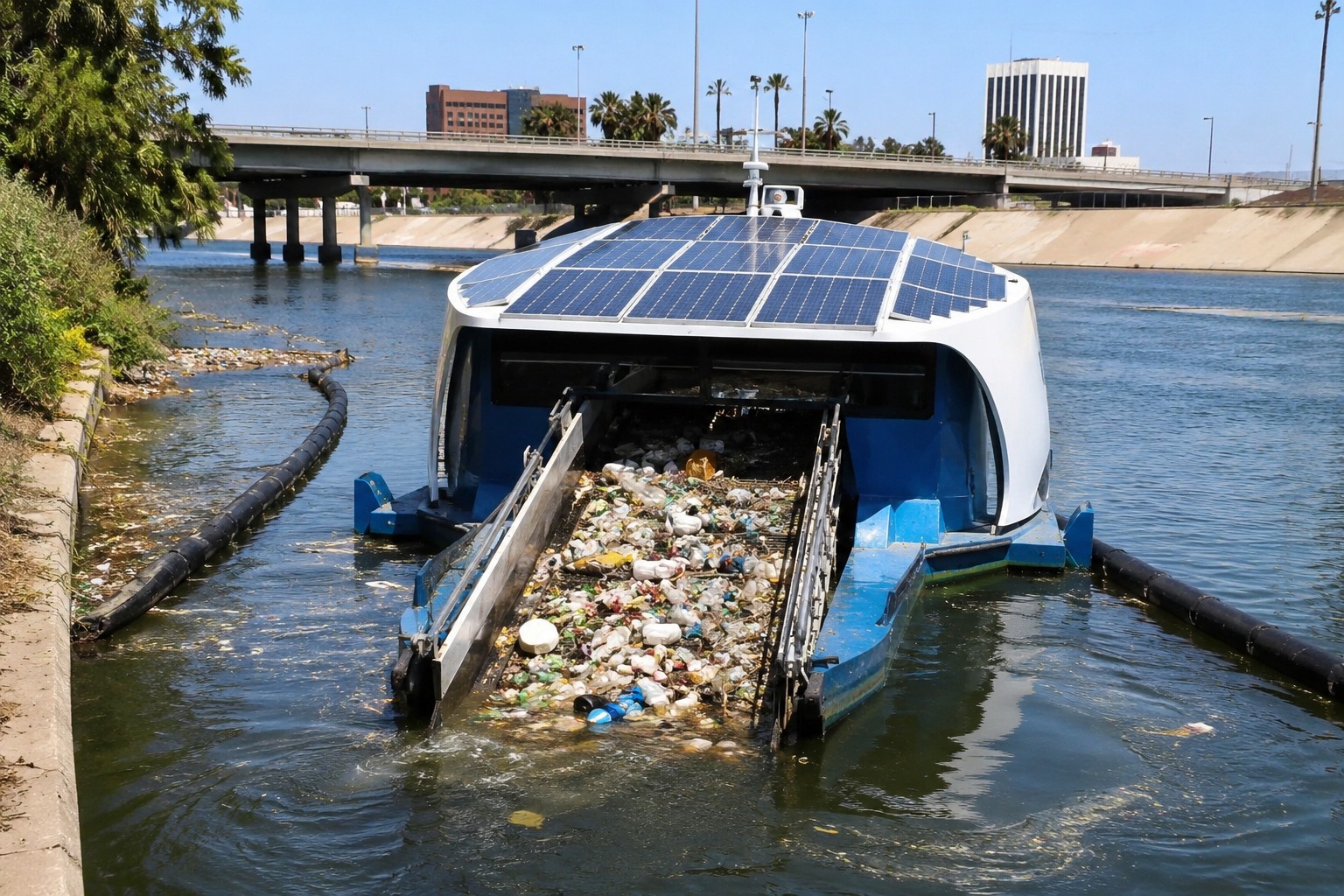
A solar-powered vessel designed to intercept floating rubbish before it reaches the ocean is demonstrating how innovative technology can help combat one of the world’s fastest-growing environmental challenges. Operating on a river in Los Angeles, the Interceptor has already prevented more than 143,000 pounds of waste from flowing into the Pacific Ocean, offering a glimpse of how automation and renewable energy could reshape global efforts to reduce marine plastic pollution.
An innovative approach to cleaning rivers
Rather than attempting to remove plastic from the vast expanse of the open ocean, the Interceptor focuses on stopping waste while it is still travelling through rivers and waterways. Floating barriers guide bottles, packaging, branches and other debris towards the vessel, where a fully automated conveyor system lifts the rubbish onboard.
Powered primarily by solar energy, the system sorts and stores the collected waste inside large onboard containers. Once the containers are full, they are transported for recycling or disposal before the vessel resumes operations.

By targeting pollution upstream, engineers say the system captures waste at one of the most efficient points in the plastic pollution cycle.
Thousands of tonnes of waste avoided
The Interceptor operating on one of Los Angeles’ major rivers has already collected more than 143,000 pounds of rubbish that would otherwise have entered the Pacific Ocean.
Plastic bottles, food packaging, polystyrene, discarded household items and organic debris make up much of the material removed from the water. During periods of heavy rainfall, when rivers carry significantly larger volumes of waste, the vessel can operate continuously to prevent surges of pollution from reaching coastal ecosystems.
Environmental experts estimate that rivers account for a substantial proportion of the plastic entering the world’s oceans each year, making interception technology an increasingly important part of global conservation strategies.
Technology meets sustainability
One of the vessel’s defining features is its reliance on renewable energy. Solar panels provide much of the electricity required to operate its conveyor systems, sensors and monitoring equipment, reducing both emissions and operating costs.
The Interceptor functions largely autonomously, allowing continuous collection with minimal human intervention. Remote monitoring systems enable operators to track performance, schedule waste collection and optimise operations based on weather conditions and river flow.
The combination of automation, artificial intelligence and renewable energy is attracting growing interest from municipalities seeking cost-effective ways to improve environmental protection while limiting operational expenses.
A model for cities worldwide
Plastic pollution remains one of the greatest environmental challenges facing the world’s oceans. Millions of tonnes of waste enter marine ecosystems annually, threatening wildlife, fisheries and coastal economies.
Projects such as the Interceptor demonstrate that practical engineering solutions can significantly reduce pollution before it reaches open water. Similar systems are already being deployed in rivers across Asia, Latin America and other regions where waste management infrastructure is under increasing pressure.
While no single technology can solve the global plastics crisis, environmental organisations argue that interception systems form an important part of a broader strategy alongside improved recycling, reduced single-use plastics and stronger waste management policies.
As governments and cities search for scalable environmental solutions, the success of the solar-powered Interceptor illustrates how innovation can transform the fight against marine pollution. By preventing rubbish from reaching the ocean in the first place, the vessel offers a practical and increasingly proven approach to protecting marine ecosystems for future generations.
Newshub Editorial in North America – 15 June 2026

If you have an account with ChatGPT you get deeper explanations,
background and context related to what you are reading.
Open an account:
Open an account
Recent Comments