
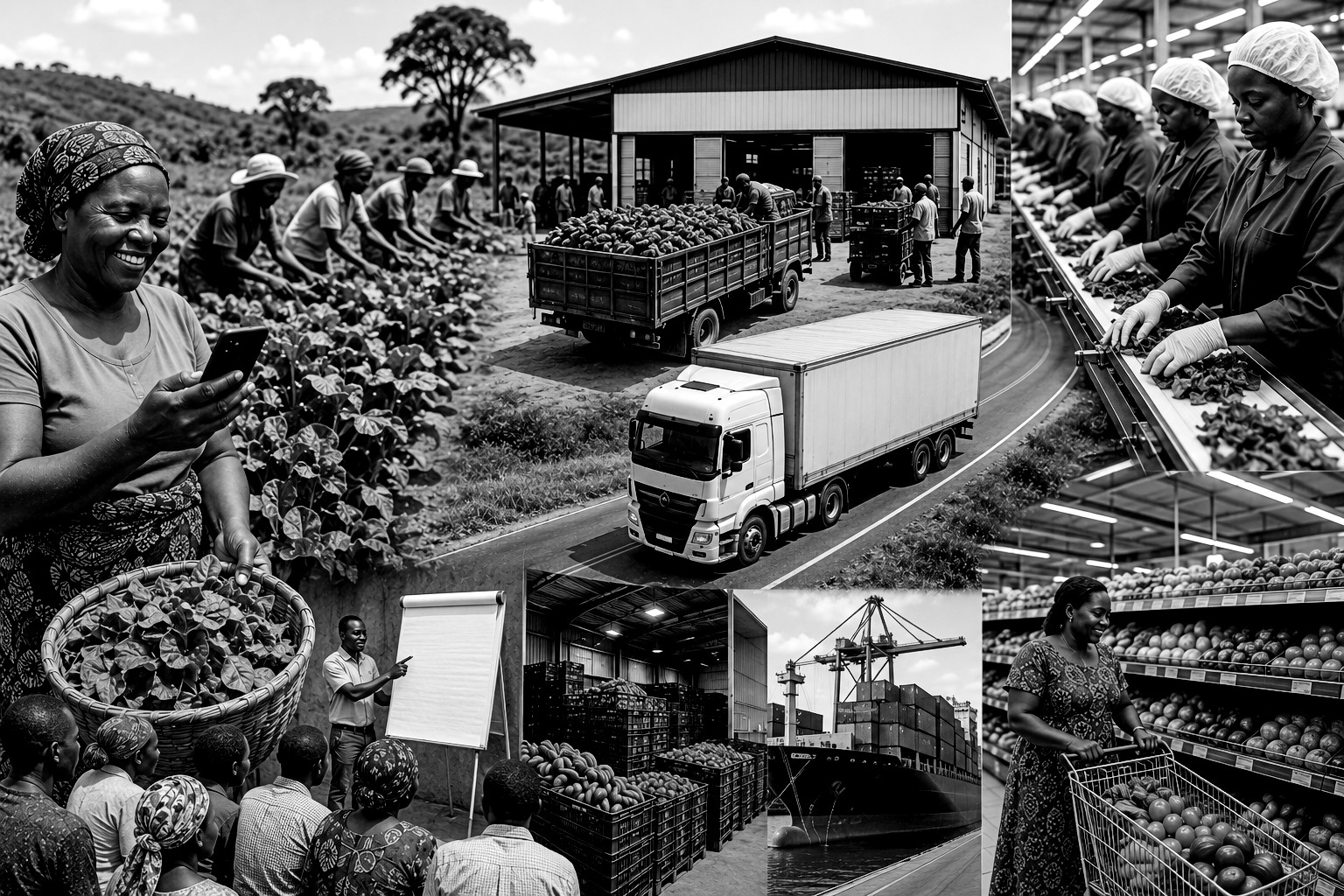
Africa’s agricultural challenge is not only about production. In many countries, farmers grow food, but weak logistics, fragmented buying systems, poor storage and limited processing capacity prevent that food from reaching markets efficiently. China’s experience shows that the missing link is often organisation.
The problem between farm and market
Across Africa, millions of smallholder farmers operate individually, often selling through informal middlemen with limited bargaining power. Even when harvests are strong, value is lost through poor roads, weak cold-chain infrastructure, lack of warehousing and limited access to reliable buyers. The result is lower farmer income, higher consumer prices and unnecessary food losses.
China’s organisational lesson
China did not transform rural agriculture only by increasing output. It built structures that connected farmers to cooperatives, processors, exporters, logistics networks and finance. Local governments, producer organisations and agribusinesses helped coordinate production standards, aggregation and market access. This made small farms part of larger commercial systems.

Why coordination matters
A farmer with one hectare cannot easily negotiate with a supermarket chain, exporter or food processor. But thousands of farmers organised through a cooperative, digital platform or structured buying network can supply consistent volumes, meet quality standards and access better prices. Coordination turns scattered production into bankable supply.
Africa’s opportunity
Africa has the land, labour force and demographic growth to become a major agricultural and food-processing region. But that potential depends on moving beyond raw production. Countries need rural collection hubs, storage systems, mobile payment infrastructure, farmer identity systems, transport links and local processing zones close to production areas.
Technology as an enabler
Digital tools can accelerate this shift. Mobile payments, farmer registries, satellite data, crop insurance and logistics platforms can help connect producers with buyers and finance. But technology alone is not enough. The key lesson from China is that digital systems must sit inside real-world structures: cooperatives, buying centres, processors and distribution networks.
From subsistence to supply chains
Fixing Africa’s farm-to-market failure means treating agriculture as infrastructure, not charity. Farmers need predictable demand, fair pricing, working capital and access to processing. Governments and private investors need to build systems that make smallholder farming commercially organised without excluding rural communities.
A development priority
China’s model cannot be copied directly, but its core lesson is clear: small farmers need large systems around them. If Africa can build those systems, agriculture can become a driver of food security, exports, rural employment and industrial growth.
Newshub Editorial in Africa – 20 May 2026

If you have an account with ChatGPT you get deeper explanations,
background and context related to what you are reading.
Open an account:
Open an account
Recent Comments