
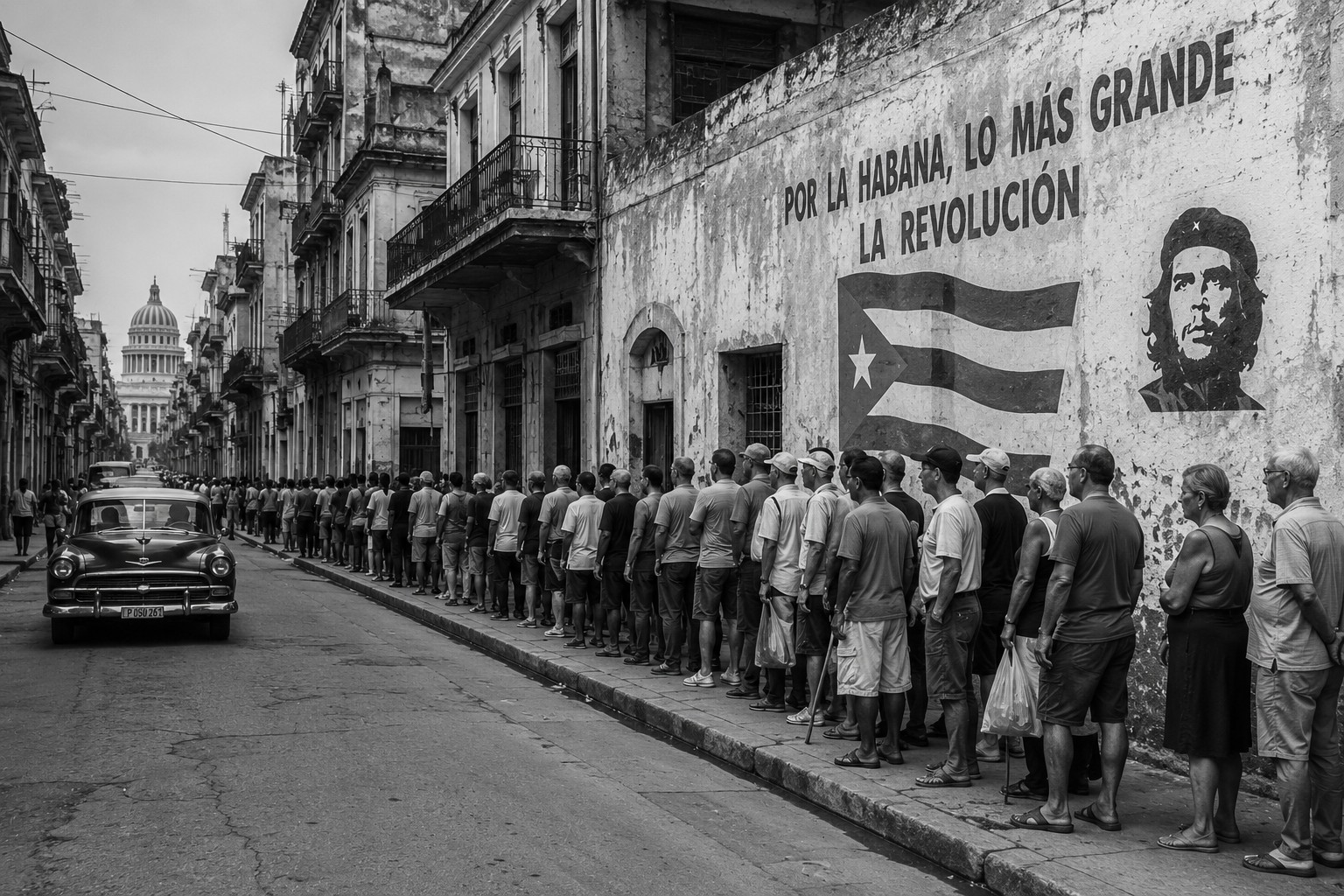
The United States has restated its willingness to provide up to $100 million in direct humanitarian and economic assistance to the Cuban people, but only if the Cuban government permits independent and transparent distribution mechanisms. The proposal reflects continuing tensions between Washington and Havana while also highlighting growing concern over Cuba’s worsening economic and humanitarian conditions.
Aid linked to direct access and transparency
US officials stated that the assistance package would focus on supporting Cuban citizens directly through food, medicine, healthcare supplies, internet access and humanitarian infrastructure.
However, Washington stressed that the aid would require guarantees ensuring that funds and supplies reach the population without interference or diversion by the Cuban state apparatus.

The proposal forms part of a broader US strategy aimed at supporting civil society and independent economic activity on the island while maintaining pressure on the Cuban government over political freedoms and human rights concerns.
American officials have argued that ordinary Cubans continue suffering from severe shortages, deteriorating infrastructure and declining purchasing power amid the country’s prolonged economic crisis.
Cuba faces deep economic challenges
Cuba has experienced increasing economic pressure during recent years due to a combination of US sanctions, reduced tourism revenue, energy shortages, declining foreign currency reserves and structural weaknesses within the state-controlled economy.
The country has faced recurring blackouts, shortages of medicine and food, fuel supply disruptions and rising emigration as many Cubans seek opportunities abroad.
Analysts note that Cuba’s economic model remains heavily dependent on state planning and limited foreign currency inflows, making it vulnerable to external shocks and declining productivity.
The government has introduced partial market reforms and expanded some private-sector activity, although major areas of the economy remain tightly controlled.
Political tensions continue shaping relations
Relations between United States and Cuba remain highly sensitive more than six decades after the Cuban Revolution.
Washington continues criticising Havana over political repression, restrictions on free expression and the treatment of opposition groups. Cuban authorities, meanwhile, accuse the United States of using sanctions and economic pressure to destabilise the country.
The latest aid proposal therefore carries both humanitarian and geopolitical significance.
US officials framed the offer as a demonstration that Washington is prepared to support the Cuban population directly if operational access and transparency can be guaranteed.
Havana has historically been cautious regarding foreign aid programmes linked to independent oversight or external distribution channels.
Migration and regional stability remain concerns
The worsening economic situation in Cuba has also contributed to increased migration pressures across the region. Large numbers of Cubans have travelled toward the United States and other Latin American countries during recent years, adding strain to regional migration systems.
American policymakers increasingly view economic stability in Cuba as interconnected with broader Caribbean security, migration management and regional economic conditions.
Observers note that humanitarian assistance could potentially ease some immediate pressures, although deeper structural reforms would still be required for long-term economic recovery.
Uncertainty remains over whether Cuba will accept
It remains unclear whether the Cuban government will accept the conditions attached to the proposed assistance package.
Analysts believe Havana may resist arrangements perceived as undermining state control or increasing foreign influence within domestic institutions.
Nevertheless, the renewed offer highlights how economic hardship in Cuba continues drawing international attention as both governments navigate one of the Western Hemisphere’s longest-running geopolitical disputes.
For now, the proposal remains conditional — dependent not on the availability of funding, but on whether Cuban authorities permit aid to flow directly to the Cuban people.
Newshub Editorial in North America – May 16, 2026

If you have an account with ChatGPT you get deeper explanations,
background and context related to what you are reading.
Open an account:
Open an account
Recent Comments