
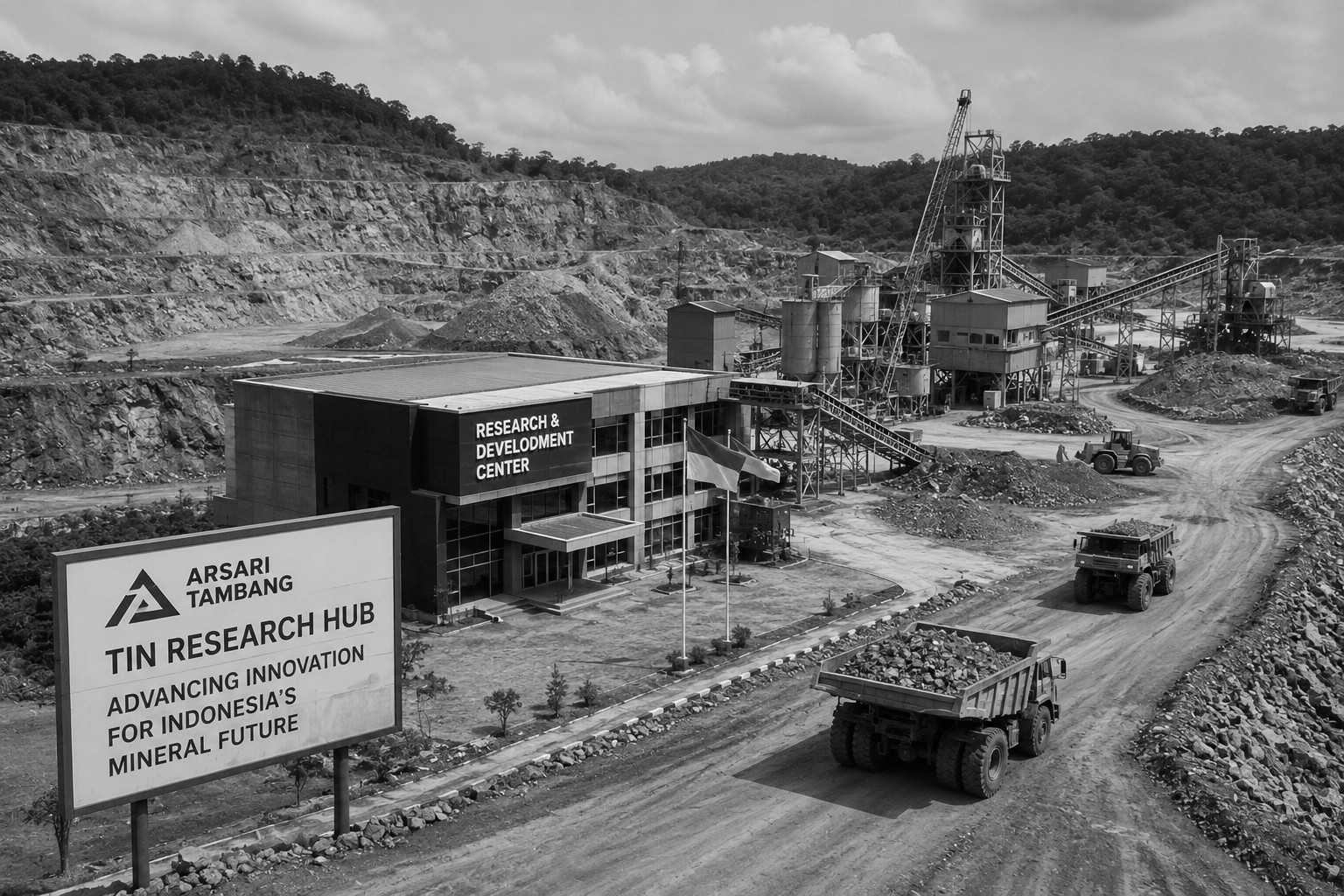
Indonesian mining group Arsari Tambang is accelerating its expansion into rare earth minerals through the launch of Indonesia’s first dedicated tin research and downstream development hub, signalling the country’s growing ambition to move beyond raw commodity exports and become a strategic supplier in the global critical minerals market. The initiative reflects wider efforts across Southeast Asia to strengthen domestic processing industries linked to batteries, electronics and advanced manufacturing.
Indonesia seeks greater control over mineral value chains
The new research hub is expected to focus on extracting higher-value materials from tin-related mineral deposits, including rare earth elements and strategic by-products used in semiconductors, electric vehicles and defence technologies.
Indonesia has long been one of the world’s largest producers of tin, but policymakers increasingly want the country to capture more value domestically rather than relying primarily on raw material exports.

Government officials have repeatedly stated that Indonesia’s long-term industrial strategy centres on building integrated downstream industries connected to batteries, renewable energy systems and advanced electronics manufacturing.
The research initiative is viewed as part of that broader industrial transformation agenda.
Rare earths becoming a geopolitical priority
Rare earth minerals have become strategically important as global demand surges for electric vehicles, AI infrastructure, wind turbines, defence systems and semiconductor manufacturing.
Countries worldwide are attempting to reduce dependence on dominant global suppliers, particularly amid growing geopolitical tensions and supply-chain fragmentation.
Indonesia sees an opportunity to position itself as a major alternative supplier within Asia, leveraging its vast natural resource base and rapidly expanding industrial capacity.
Analysts note that Southeast Asia could become increasingly important in the diversification of global critical mineral supply chains during the coming decade.
Tin industry positioned for technological expansion
Indonesia’s tin sector has traditionally focused on exports tied to soldering materials and industrial metals. However, advances in extraction and refining technologies are creating new opportunities to recover strategic minerals associated with tin deposits.
The new hub reportedly aims to support geological research, refining technologies, processing innovation and partnerships with universities and industrial groups.
Industry observers believe that combining tin expertise with rare earth extraction capabilities could strengthen Indonesia’s role within the global electronics and energy transition economy.
The initiative may also encourage additional foreign investment into Indonesia’s mining technology and processing sectors.
Environmental and sustainability questions remain central
Despite optimism surrounding critical minerals, environmental concerns remain significant. Mining operations linked to rare earth extraction often involve complex chemical processing and large-scale environmental impacts if poorly regulated.
Indonesian authorities have increasingly faced pressure to balance industrial expansion with sustainability standards, environmental protection and local community interests.
Investors are also paying closer attention to governance and traceability within global critical mineral supply chains, particularly as Western markets tighten sustainability requirements.
How Indonesia manages environmental oversight could therefore become a decisive factor in attracting long-term international investment.
Indonesia positioning itself for the next industrial cycle
The launch of the research hub highlights Indonesia’s broader ambition to become a central player in the global transition toward electrification, AI infrastructure and advanced manufacturing.
By combining natural resources with domestic processing and research capabilities, the country hopes to avoid the historical pattern where developing economies export raw materials while higher-value industrial production occurs elsewhere.
For Arsari Tambang, the project represents not only an expansion into strategic minerals, but also a bet that rare earths and downstream processing will define the next phase of global industrial competition.
Newshub Editorial in Asia – May 16, 2026

If you have an account with ChatGPT you get deeper explanations,
background and context related to what you are reading.
Open an account:
Open an account
Recent Comments