
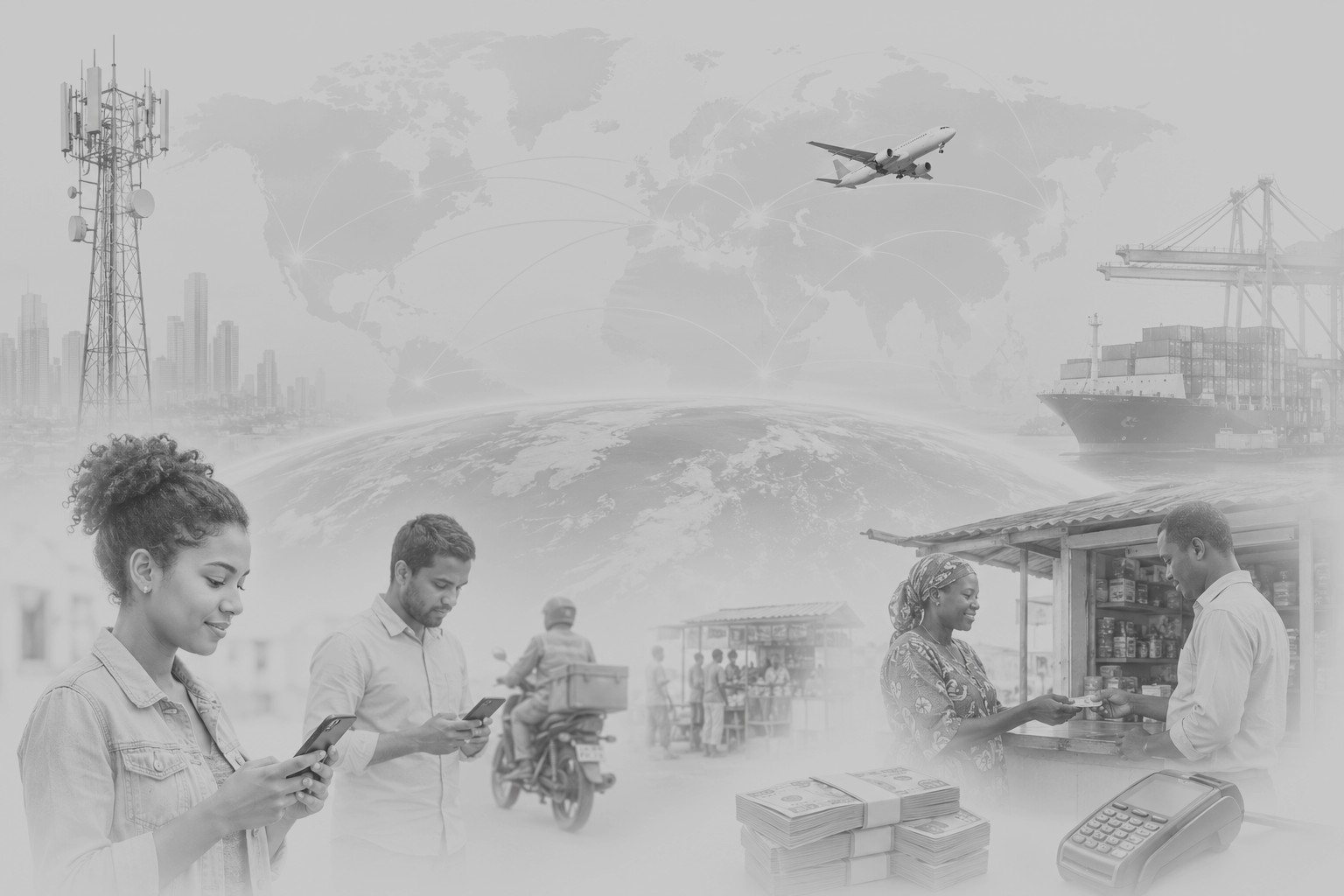
How hidden money networks power emerging markets
Every day across Africa, Asia and Latin America, trillions in local currencies move through a financial system that most of the world barely notices. It does not rely primarily on skyscraper banks, stock exchanges or corporate headquarters. Instead, it functions through kiosks, motorcycles, roadside agents, mobile phones, market traders and physical cash. Beneath the polished image of modern fintech lies one of the most important and least understood infrastructure systems in the global economy: the cash networks powering emerging markets.
For more than a decade, the international financial industry promoted the idea that the future would become entirely digital. Mobile banking, contactless payments, cryptocurrencies and online finance were supposed to eliminate physical money and traditional cash systems.
That never fully happened.

Instead, a hybrid financial model emerged across much of the developing world — one where smartphones and digital wallets actually increased the importance of physical cash infrastructure rather than replacing it.
In many emerging economies, millions of people now move constantly between digital and physical money. Salaries may arrive digitally, but groceries are bought in cash. Small businesses may accept mobile payments while paying suppliers physically. International remittances may arrive through apps but get withdrawn from roadside agents within minutes.
The result is a vast invisible financial ecosystem built around cash mobility.
The rise of the human ATM
One of the most important developments in modern emerging-market finance has been the rise of agent banking systems.
In many regions, local shopkeepers and small businesses effectively function as human ATMs.
These agents often operate from:
- convenience stores
- kiosks
- pharmacies
- fuel stations
- market stalls
- shipping containers
Using smartphones and mobile-payment systems, they provide:
- cash withdrawals
- cash deposits
- remittances
- wallet funding
- bill payments
- account services
This model became globally recognised through Kenya’s M-Pesa ecosystem, but similar structures now exist across large parts of Africa and Asia.
The system solved one of the biggest problems in emerging-market finance: physical access.
Traditional banking expansion is expensive. Branches require buildings, staff, security and infrastructure. In many low-income or rural regions, large banks struggled to operate profitably.
Agent networks changed the economics completely.
Instead of building thousands of branches, financial platforms could decentralise banking functions through local businesses.
This transformed financial inclusion.
Why cash still dominates
Despite rapid fintech growth, cash remains central to daily life across much of the world for several reasons.
First, trust.
In countries with histories of inflation, corruption or banking instability, many people still trust physical money more than digital balances.
Second, informality.
Large informal economies naturally depend heavily on cash transactions.
Third, resilience.
Cash continues functioning during:
- internet outages
- cyberattacks
- power failures
- political instability
Fourth, accessibility.
Not everyone possesses:
- stable internet
- smartphones
- formal identification
- banking literacy
Cash remains universal.
Ironically, the expansion of mobile finance often increased cash circulation because digital systems made it easier to move and access physical money.
The logistics business behind fintech
Every digital wallet ultimately depends on physical liquidity somewhere in the system.
Cash must still be:
- transported
- counted
- secured
- distributed
- balanced between regions
This has created a hidden infrastructure industry surrounding:
- cash logistics
- armored transport
- liquidity forecasting
- merchant servicing
- regional distribution hubs
In many emerging markets, these operations are extremely complex due to:
- poor roads
- security risks
- fragmented transport systems
- fuel costs
- unstable electricity networks
The companies mastering these challenges increasingly resemble infrastructure operators rather than traditional fintech firms.
Some analysts now believe that the future giants of emerging-market finance may not primarily be banks at all.
They may instead be:
- telecom companies
- logistics operators
- smartphone ecosystems
- agent networks
- payment infrastructure providers
The boundaries between finance, mobility and communications are rapidly disappearing.
Africa becomes the world’s financial laboratory
Africa has become one of the world’s most important testing grounds for hybrid finance because traditional banking infrastructure historically remained limited across many regions.
Without extensive legacy systems, mobile-first finance expanded rapidly.
Countries including:
- Kenya
- Ghana
- Nigeria
- Tanzania
- Uganda
now operate some of the world’s most advanced mobile-money ecosystems.
This matters globally because the next billion financial users are likely to emerge not from Europe or North America, but from emerging economies across Africa and Asia.
The institutions controlling these financial access networks may become some of the most strategically valuable infrastructure companies of the coming decades.
The future financial system may therefore look very different from what many Western policymakers once imagined.
The world is not becoming cashless.
It is becoming hybrid.
And the hidden infrastructure moving physical money may quietly become one of the most important industries on Earth.
Newshub Editorial in Africa – May 12, 2026

If you have an account with ChatGPT you get deeper explanations,
background and context related to what you are reading.
Open an account:
Open an accountEvery day across Africa, Asia and Latin America, trillions in local currencies move through a financial system that most of the world barely notices. It does not rely primarily on skyscraper banks, stock exchanges or corporate headquarters. Instead, it functions through kiosks, motorcycles, roadside agents, mobile phones, market traders and physical cash. Beneath the polished image of modern fintech lies one of the most important and least understood infrastructure systems in the global economy: the cash networks powering emerging markets.
Recent Comments