
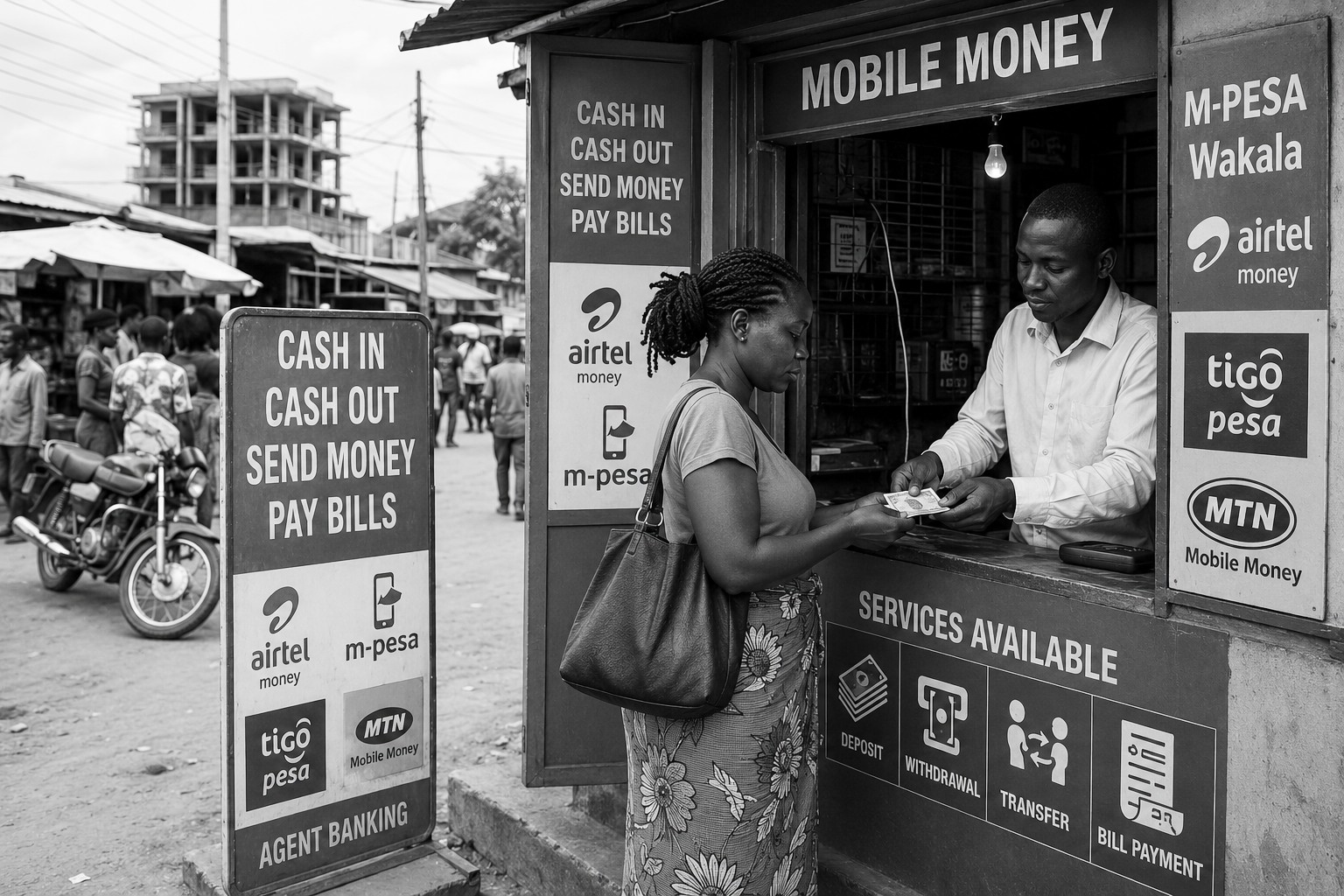
Why cash infrastructure may become the most valuable business in emerging markets
For years, the global financial industry has promoted the idea that the future is entirely digital. Investors, technology companies and governments have celebrated the rise of online banking, contactless payments, cryptocurrencies and app-based financial ecosystems. Yet across large parts of Africa, Asia and Latin America, the reality on the ground remains very different. Cash still dominates daily economic life — and the infrastructure surrounding physical money may quietly be becoming one of the most strategically valuable industries in the world.
In many developed economies, the disappearance of cash has become almost ideological. Policymakers often describe physical currency as outdated, inefficient or linked to informality. But in emerging markets, cash is not a relic of the past. It is infrastructure.
Hundreds of millions of people continue relying on cash for salaries, transport, groceries, fuel, healthcare and savings. Entire economic ecosystems still operate primarily through physical transactions, even where smartphones and digital wallets are spreading rapidly.


This contradiction has created one of the most misunderstood opportunities in global finance: the emergence of a new cash economy built around logistics, human networks, mobile technology and hybrid financial systems.
The companies and institutions that control cash distribution, conversion and movement across emerging markets may ultimately become some of the most important financial infrastructure operators of the coming decades.
The myth of the cashless world
The assumption that digital payments automatically eliminate cash has repeatedly proven inaccurate outside advanced Western economies.
Even in countries experiencing rapid fintech growth, digital systems often increase cash circulation rather than replacing it entirely. Mobile money platforms, banking apps and digital wallets still require cash entry and cash exit points.
A worker may receive money digitally, but withdraw it physically from an agent kiosk. A merchant may accept mobile payments while paying suppliers in cash. A customer may store value in a digital wallet but rely on cash for transportation and food purchases.
This hybrid system now defines much of the emerging-market financial environment.
The reality is simple: digital finance cannot expand without physical liquidity infrastructure.
Cash therefore remains deeply embedded within the operational structure of emerging economies.
In Africa alone, informal economies account for substantial portions of GDP in many countries. Small traders, transport operators, street vendors and local merchants frequently operate almost entirely in cash due to limited banking penetration, regulatory barriers or practical necessity.
In parts of Asia and Latin America, similar patterns continue despite rising smartphone adoption and expanding internet access.
The financial world increasingly resembles a layered system where digital technology sits on top of physical cash rather than replacing it.
Cash as infrastructure
In developed markets, financial infrastructure usually refers to banks, exchanges, payment rails and data centres.
In emerging markets, infrastructure often means something much more physical:
- cash transport
- local agents
- kiosks
- motorcycles
- small merchants
- branch liquidity
- roadside payment points
- fuel-powered mobility
The ability to move physical money efficiently across difficult environments is itself a financial technology.
This becomes especially important in countries where large populations remain outside traditional banking systems.
The unbanked do not lack economic activity. They lack financial access.
A farmer in rural Tanzania may own livestock, operate a business and participate actively in commerce while still lacking a formal bank account. A market trader in Senegal may process dozens of transactions daily entirely outside the conventional banking sector.
Cash remains their primary operational medium.
The institutions capable of bridging physical cash systems with digital financial services therefore occupy an increasingly strategic position.
This is where agent networks become critically important.
The rise of the human ATM
One of the defining developments in emerging-market finance has been the growth of agent banking systems.
In many regions, local agents effectively function as human ATMs.
These agents may operate from:
- kiosks
- convenience shops
- fuel stations
- pharmacies
- roadside stalls
- mobile units
They provide services such as:
- cash withdrawals
- cash deposits
- remittances
- bill payments
- wallet funding
- currency exchange
- account verification
This model became globally recognised through Kenya’s M-Pesa system, but versions now exist across large parts of Africa and Asia.
The key insight is that agent networks solve a physical problem rather than purely a digital one.
Traditional banks often struggle to expand into remote or low-income areas due to branch costs and infrastructure limitations. Agent systems dramatically reduce expansion costs while extending financial access into underserved regions.
In effect, they decentralise banking infrastructure.
The result is a new type of financial geography where liquidity is distributed through human networks rather than fixed banking branches.
This model has become especially powerful because it aligns with the realities of emerging-market economics:
- fragmented transportation
- uneven internet connectivity
- high informality
- mobile-first populations
- cash-dependent commerce
The “human ATM” may therefore become one of the defining financial archetypes of the 21st century emerging-market economy.
Smartphones changed everything
The expansion of cheap Android smartphones transformed the economics of financial inclusion.
Before widespread smartphone adoption, extending banking services into rural or low-income populations was expensive and operationally difficult.
Now, millions of people can access digital financial systems through devices costing less than US$50.
But smartphones alone are not enough.
The crucial development was the combination of:
- mobile connectivity
- digital wallets
- local cash agents
- biometric verification
- simplified interfaces
This ecosystem allowed hybrid finance to emerge at massive scale.
A customer can now:
- receive wages digitally
- convert cash locally
- transfer money internationally
- pay merchants electronically
- store funds in a mobile wallet
- withdraw cash nearby
All without ever entering a traditional bank branch.
This is not merely financial innovation. It is infrastructure compression.
Entire banking functions are being condensed into smartphone-agent ecosystems.
The implications are enormous.
Why cash still matters
There are several reasons cash remains dominant across large parts of the world.
First, trust.
Many people trust physical money more than digital systems, particularly in countries with histories of inflation, banking instability or political uncertainty.
Cash is tangible.
Second, informality.
Large informal economies naturally rely on cash because transactions occur outside formal reporting systems.
Third, resilience.
Digital systems can fail due to:
- power outages
- internet disruptions
- cyberattacks
- political instability
- technical breakdowns
Cash continues functioning during crises.
This became especially visible during periods of conflict, natural disasters and banking disruptions.
Fourth, accessibility.
Not everyone possesses:
- identification documents
- stable internet access
- smartphones
- banking literacy
Cash remains universally usable.
Ironically, the future of finance may therefore depend less on eliminating cash than on integrating it more efficiently into digital systems.
The geopolitics of cash
Cash infrastructure also carries geopolitical implications.
Control over payment systems increasingly influences:
- sanctions
- trade
- monetary sovereignty
- economic influence
Western financial systems remain heavily tied to traditional banking rails dominated by major institutions and reserve currencies.
Emerging markets are increasingly exploring alternatives.
This includes:
- mobile money systems
- local payment networks
- digital currencies
- hybrid cash-digital ecosystems
The countries and companies capable of building independent financial distribution infrastructure may gain substantial strategic influence.
China understood this early through its expansion of digital payment ecosystems and smartphone manufacturing.
Africa is now becoming a critical battleground in this infrastructure competition.
Who controls:
- the wallet?
- the agent network?
- the liquidity flow?
- the smartphone layer?
- the transaction rails?
These questions increasingly matter geopolitically.
The logistics business nobody talks about
Behind every digital wallet sits a physical logistics system.
Cash must still be:
- transported
- counted
- secured
- distributed
- converted
This creates enormous demand for:
- cash management
- armored transport
- liquidity forecasting
- merchant servicing
- regional distribution hubs
In many emerging markets, poor logistics remain one of the biggest constraints on financial expansion.
A digital transfer is meaningless if physical liquidity cannot be accessed locally.
This reality is creating a hidden industry around cash mobility.
Some of the most important financial infrastructure companies of the future may not resemble traditional banks at all.
They may instead resemble:
- logistics firms
- telecom operators
- distribution networks
- mobility companies
The boundaries between fintech, logistics and telecommunications are increasingly dissolving.
The next phase: hybrid finance
The future emerging-market financial system is unlikely to become purely digital or purely cash-based.
Instead, it will probably evolve into a hybrid ecosystem where:
- cash
- wallets
- stablecoins
- local agents
- smartphones
- biometric systems
- telecom networks
all interact simultaneously.
This hybrid model may actually prove more resilient and scalable than the fully centralised banking systems dominant in developed economies.
It also aligns better with demographic and economic realities across many emerging regions.
The populations driving global growth during the coming decades are overwhelmingly mobile-first, young and increasingly urbanised — but not necessarily fully banked.
Financial infrastructure must therefore adapt to practical realities rather than ideological visions of a cashless society.
Why investors are paying attention
Investors are increasingly recognising the scale of this opportunity.
The next billion financial users are unlikely to emerge from New York, London or Frankfurt.
They are more likely to come from:
- Lagos
- Nairobi
- Jakarta
- Dhaka
- Kinshasa
- Karachi
The companies capable of serving these markets efficiently may control enormous future transaction volumes.
Importantly, many of these users will enter the financial system through hybrid cash-digital models rather than traditional banking pathways.
That changes everything.
The winning platforms may not be those with the most sophisticated Wall Street products.
They may instead be those capable of solving very practical problems:
- cash access
- agent liquidity
- smartphone compatibility
- low-bandwidth transactions
- local trust
- mobility
The future of finance may therefore be less about eliminating cash and more about mastering it.
The cash empire is already forming
The emerging-market financial revolution is often portrayed as a story about apps and digital wallets.
In reality, it is increasingly becoming a story about infrastructure.
Cash remains the bloodstream of enormous parts of the global economy.
The institutions that understand how to bridge physical liquidity with digital access may ultimately become the dominant financial platforms of the next generation.
The world is not becoming cashless.
It is becoming hybrid.
And in that hybrid world, the companies controlling cash movement, local liquidity and financial access may quietly build one of the most powerful infrastructure industries of the 21st century.
The new cash empire may already be here.
Newshub Editorial in Africa – May 12, 2026

If you have an account with ChatGPT you get deeper explanations,
background and context related to what you are reading.
Open an account:
Open an accountFor years, the global financial industry has promoted the idea that the future is entirely digital. Investors, technology companies and governments have celebrated the rise of online banking, contactless payments, cryptocurrencies and app-based financial ecosystems. Yet across large parts of Africa, Asia and Latin America, the reality on the ground remains very different. Cash still dominates daily economic life — and the infrastructure surrounding physical money may quietly be becoming one of the most strategically valuable industries in the world.
Recent Comments