
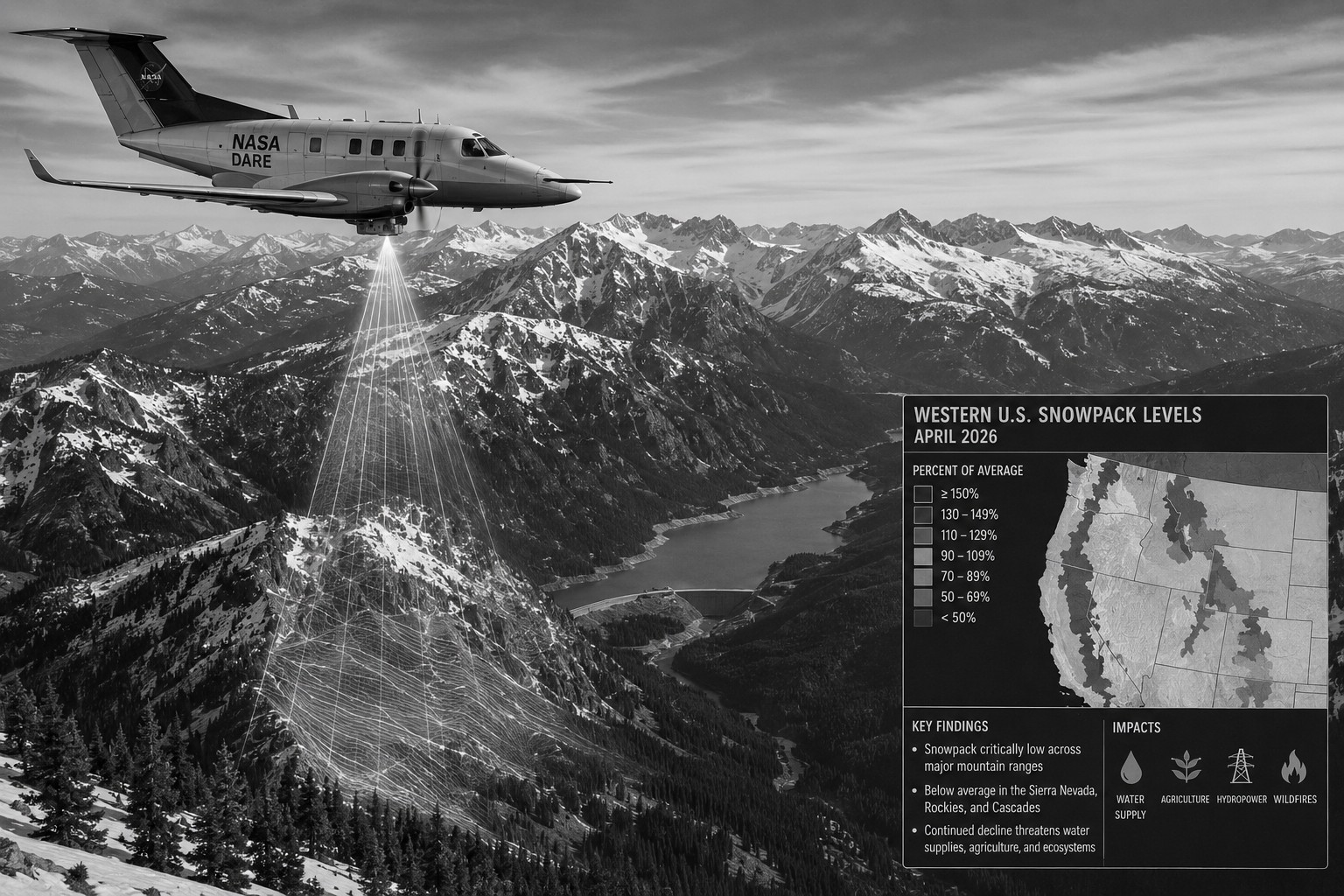
New high-technology monitoring missions using airborne lasers and satellite-based measurement systems are revealing alarming declines in mountain snowpack across the western United States, raising growing concerns among climate scientists, water authorities and environmental experts about the long-term future of regional water supplies. The findings indicate that snow accumulation levels in several critical mountain regions remain far below historical averages, intensifying fears over drought conditions and climate-related water stress.
The missions, which rely on advanced lidar technology and remote sensing systems, are capable of measuring snow depth, density and water content with unprecedented precision. Scientists say the data now provides a far more detailed picture of how climate change is affecting snowpack systems that millions of Americans depend on for freshwater resources.
Much of the western United States relies heavily on snowmelt from mountain ranges including the Sierra Nevada, Rocky Mountains and Cascades. Snowpack functions as a natural water reservoir, gradually releasing water throughout spring and summer into rivers, reservoirs and agricultural systems.

However, recent measurements suggest that warming temperatures and shifting weather patterns are increasingly disrupting this critical natural cycle.
Technology transforms climate monitoring
The latest monitoring efforts involve a combination of aircraft-mounted laser systems, satellite observation platforms and advanced climate modelling tools capable of mapping snowpack conditions across vast and often inaccessible terrain.
Researchers say lidar-based systems can detect subtle changes in snow accumulation with far greater accuracy than traditional ground-based surveys. The technology enables scientists to analyse both seasonal fluctuations and long-term climate trends affecting water storage across western mountain systems.
Experts warn that declining snowpack threatens not only water availability but also agriculture, hydroelectric power generation, urban consumption and wildfire management.
Several regions have already experienced reduced river flows and increased pressure on reservoirs following years of irregular snowfall and warmer winters.
Climate pressures intensify across the west
The western United States has faced repeated drought conditions over the past decade, with climate scientists increasingly linking prolonged dryness to broader global warming trends. Rising temperatures can cause snow to melt earlier in the season while also reducing the proportion of winter precipitation falling as snow rather than rain.
Earlier snowmelt disrupts water management systems designed around traditional seasonal cycles. Reservoirs and irrigation networks often struggle to compensate when runoff patterns shift significantly.
Environmental experts warn that continued snowpack decline could create long-term structural challenges for states including California, Colorado, Nevada, Arizona and Utah, all of which depend heavily on mountain water systems.
At the same time, declining snow levels can contribute to worsening wildfire conditions by drying vegetation earlier in the year and extending fire seasons.
Water security becomes growing policy issue
The findings are expected to intensify debates surrounding climate adaptation, infrastructure planning and long-term water management strategies throughout the American west.
State governments and federal agencies are increasingly investing in monitoring technology, reservoir management systems and conservation programmes aimed at improving resilience against future water shortages.
Scientists emphasise that precise data collection is becoming essential for forecasting drought conditions and managing increasingly strained water resources in a warming climate environment.
While annual snowfall variability remains natural, researchers warn that the broader trend now points towards a gradual long-term reduction in snowpack stability across many western mountain regions.
The advanced laser missions therefore represent more than a scientific breakthrough; they also provide increasingly urgent evidence of how climate change is reshaping one of North America’s most important freshwater systems.
Newshub Editorial in North America – May 12, 2026

If you have an account with ChatGPT you get deeper explanations,
background and context related to what you are reading.
Open an account:
Open an account
Recent Comments