
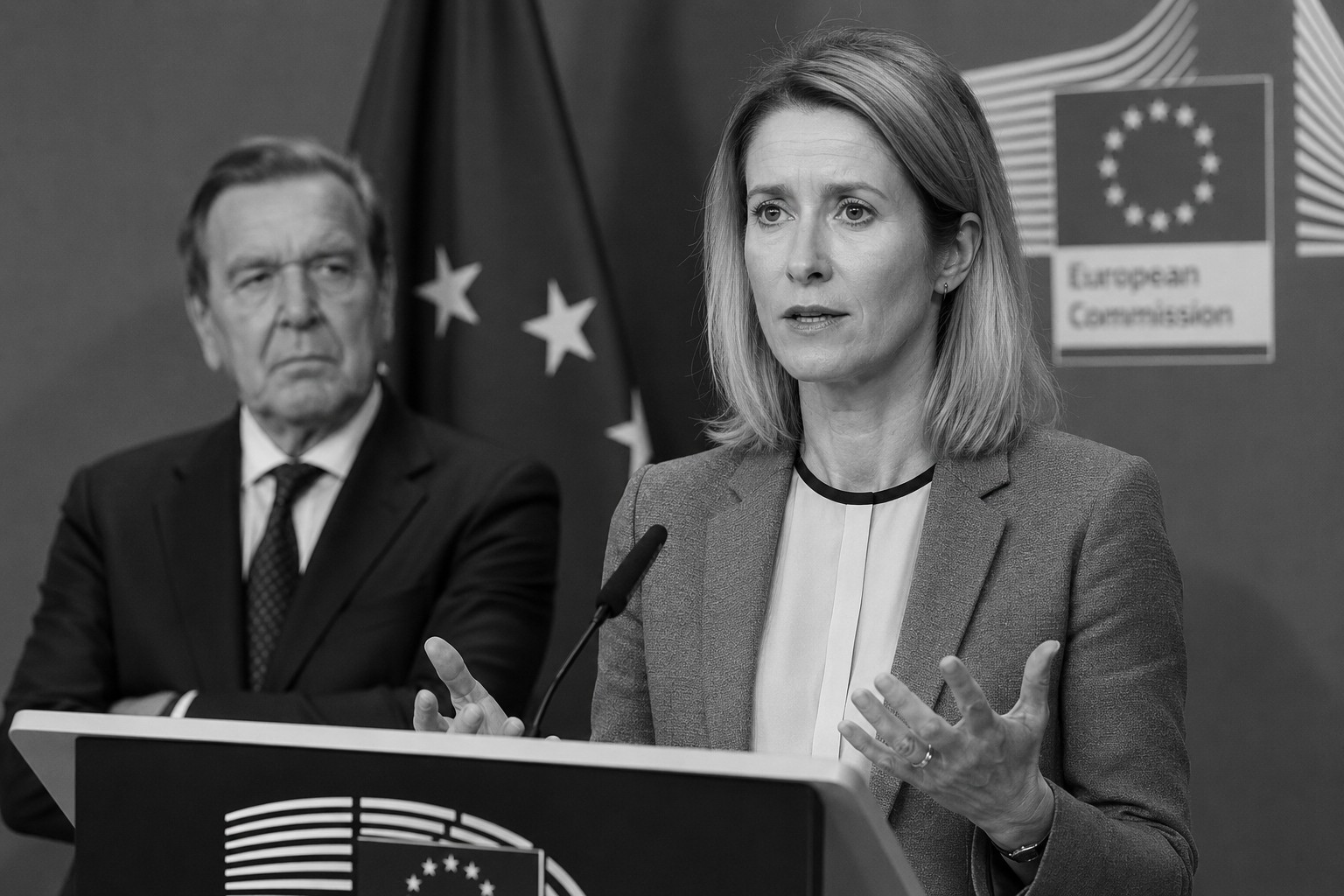
European Union foreign policy chief Kaja Kallas has sharply rejected suggestions that former German Chancellor Gerhard Schröder could serve as a mediator in future Ukraine peace negotiations, arguing that allowing Russia to effectively influence the choice of negotiators would undermine European interests and diplomatic credibility.
Kallas, who previously served as Estonia’s prime minister before assuming the EU’s top diplomatic position, stated that Schröder’s longstanding ties to Russian state-owned companies made him fundamentally unsuitable for any neutral mediation role involving the war in Ukraine.
“If we give the right to Russia to appoint a negotiator on our behalf, that would not be very wise,” Kallas said in comments reflecting growing European frustration with proposals viewed as favourable to Moscow’s strategic interests.


She further argued that Schröder’s history of working closely with Russian energy companies created an unavoidable conflict of interest. “Gerhard Schröder has been the high-level lobbyist for Russian state-owned companies, so it’s clear why Putin wants him to be the person so that actually he would be sitting on both sides of the table,” she said.
Schröder’s Russian ties remain controversial
Schröder has remained one of Europe’s most controversial former political leaders since Russia’s invasion of Ukraine in 2022 due to his extensive business relationships with Russian state-linked energy firms including Gazprom and Rosneft.
His personal relationship with Vladimir Putin has repeatedly generated criticism across Europe, particularly among Eastern European governments that view Russian political influence as a major regional security threat.
Germany itself has increasingly distanced from Schröder in recent years, with political pressure intensifying after the start of the war. Critics argue that his continued association with Russian corporate and political networks damaged European unity during one of the continent’s most serious security crises since the Cold War.
Kallas’ comments reinforce a broader European position that future negotiations involving Ukraine must be conducted by actors viewed as politically independent and trusted by both Kyiv and European allies.
Warnings over Russian influence operations
Beyond the question of mediation, Kallas also warned that European governments must remain alert to wider Russian influence activities across the continent.
“Clearly, our adversaries are not sleeping; so clearly, they want to increase the influence in Europe,” she stated, reflecting growing EU concern over disinformation campaigns, political interference and strategic lobbying operations linked to Moscow.
Since the invasion of Ukraine, European security agencies have repeatedly warned about hybrid threats involving cyber operations, propaganda networks, political financing and attempts to influence public opinion within EU member states.
Eastern European governments in particular have maintained a more hawkish stance regarding Russian influence risks, shaped partly by historical experience and geographic proximity to Russia.
Ukraine diplomacy remains uncertain
Discussions surrounding potential mediation figures continue as diplomatic prospects for ending the Ukraine conflict remain highly uncertain. Ukraine continues insisting that any negotiations must respect its sovereignty and territorial integrity, while Russia maintains demands that Western governments and Kyiv reject.
European leaders remain publicly committed to supporting Ukraine militarily and financially while simultaneously keeping diplomatic channels open where possible.
However, Kallas’ remarks signal that Brussels intends to resist any negotiation frameworks perceived as granting Moscow disproportionate influence over the diplomatic process itself.
Analysts note that trust, credibility and political neutrality have become increasingly central issues in discussions surrounding future peace negotiations, particularly given the deep mistrust that now defines relations between Russia and much of Europe.
As the war continues reshaping European security policy, debates surrounding influence, mediation and geopolitical loyalty are likely to remain highly sensitive across the continent.
Newshub Editorial in Europe – May 12, 2026

If you have an account with ChatGPT you get deeper explanations,
background and context related to what you are reading.
Open an account:
Open an accountEuropean Union foreign policy chief Kaja Kallas has sharply rejected suggestions that former German Chancellor Gerhard Schröder could serve as a mediator in future Ukraine peace negotiations, arguing that allowing Russia to effectively influence the choice of negotiators would undermine European interests and diplomatic credibility.
Recent Comments