
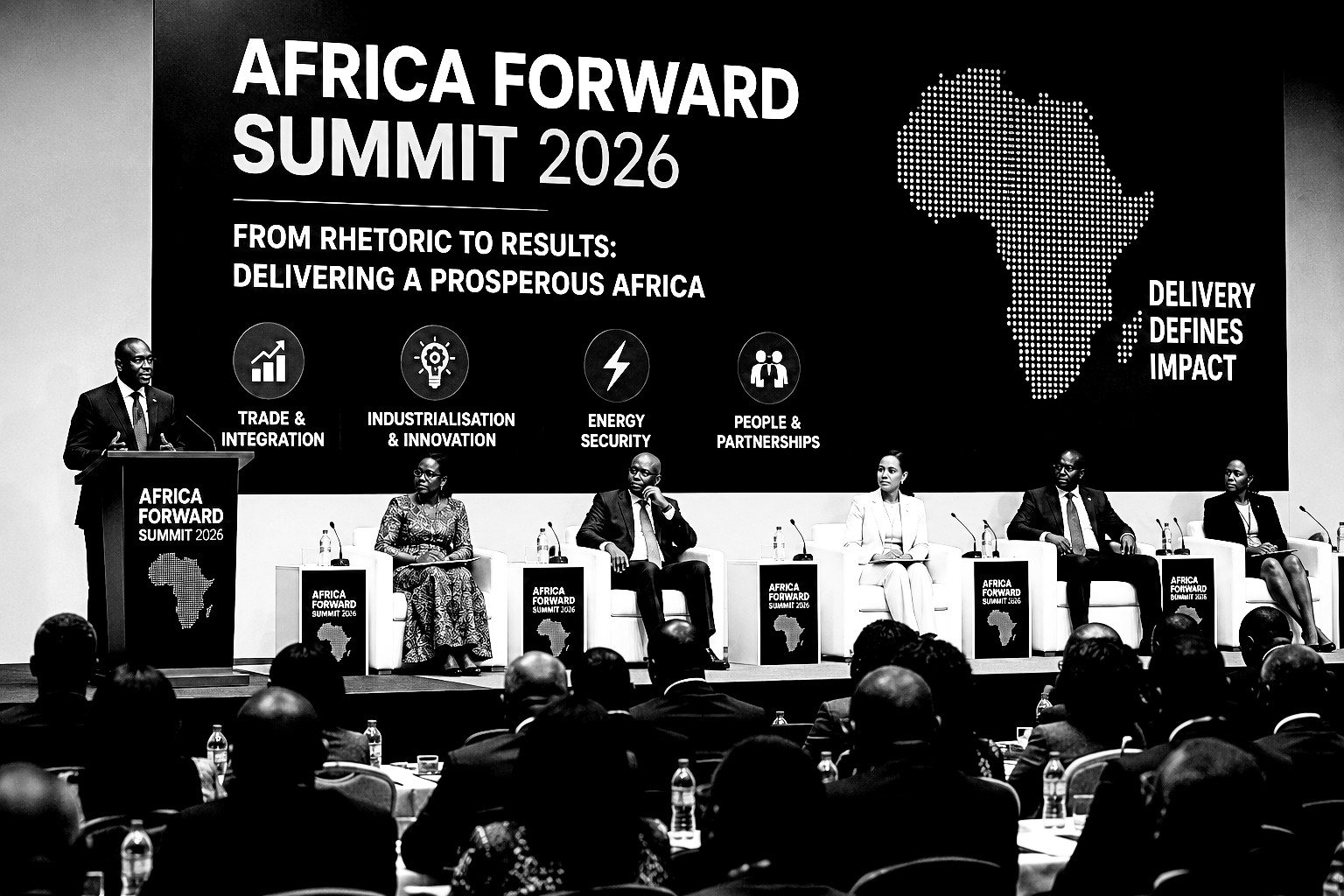
The upcoming Africa Forward Summit will ultimately be judged not by speeches or declarations, but by its ability to produce measurable outcomes and practical implementation, according to Korir Sing’Oei, principal secretary in Kenya’s Ministry of Foreign Affairs. His remarks reflect growing calls across the continent for African development forums to move beyond political rhetoric and focus more directly on execution, investment and long-term institutional delivery.
Writing ahead of the summit, Sing’Oei argued that African governments, investors and international partners increasingly recognise that the continent’s development challenges require practical cooperation mechanisms rather than repeated symbolic commitments.
The summit is expected to bring together political leaders, policymakers, investors, development institutions and business representatives to discuss issues including infrastructure, trade integration, industrialisation, technology, energy and regional economic cooperation.

However, expectations surrounding the event appear increasingly shaped by a broader continental debate over implementation gaps that have historically limited the effectiveness of many high-level African policy initiatives.
Focus shifts towards execution and accountability
Across Africa, governments and businesses are placing growing emphasis on delivery-oriented economic policy amid rising demographic pressure, infrastructure demand and intensifying global competition for investment capital.
Sing’Oei suggested that future African growth will depend less on large-scale declarations and more on the ability of institutions to execute projects efficiently, attract investment and strengthen regional coordination.
Infrastructure financing, energy security and industrial development remain among the most pressing issues facing many African economies. Analysts note that while the continent possesses significant demographic and resource advantages, implementation delays and institutional inefficiencies have often slowed development progress.
The Africa Forward Summit therefore arrives at a time when many African policymakers are seeking to reposition the continent as an increasingly serious global investment and manufacturing destination rather than primarily a recipient of development assistance.
Regional integration remains central theme
Economic integration is expected to remain one of the summit’s dominant themes, particularly regarding the continued development of the African Continental Free Trade Area framework.
Supporters of the agreement argue that reducing trade barriers and strengthening cross-border infrastructure could significantly accelerate industrial growth and intra-African commerce. However, progress has varied considerably between countries and sectors.
Kenya has increasingly positioned itself as one of East Africa’s major diplomatic and economic hubs, playing a growing role in continental discussions surrounding trade, digital transformation and regional cooperation.
Sing’Oei’s comments also reflect wider efforts by African governments to promote a more self-directed economic narrative centred around competitiveness, production capacity and strategic partnerships.
Africa’s global position continues evolving
The summit takes place amid increasing international competition for influence and investment across Africa. The United States, China, European Union, Gulf states and India have all expanded economic engagement with African markets in recent years.
At the same time, African governments are increasingly seeking partnerships that emphasise industrialisation, technology transfer and long-term economic value creation rather than purely extractive or aid-driven relationships.
Analysts note that the continent’s growing population, expanding urbanisation and rising digital adoption continue strengthening Africa’s long-term economic significance within global markets.
However, many observers also warn that credibility will increasingly depend on whether political commitments translate into operational projects and tangible economic improvements.
For that reason, Sing’Oei argued that the Africa Forward Summit’s long-term reputation may depend less on headline announcements and more on whether governments and institutions can demonstrate visible progress after the summit concludes.
As Africa continues positioning itself within a rapidly changing global economy, the demand for practical delivery and institutional accountability appears likely to become an increasingly defining theme in continental diplomacy and development strategy.
Newshub Editorial in Africa – May 12, 2026

If you have an account with ChatGPT you get deeper explanations,
background and context related to what you are reading.
Open an account:
Open an account
Recent Comments