
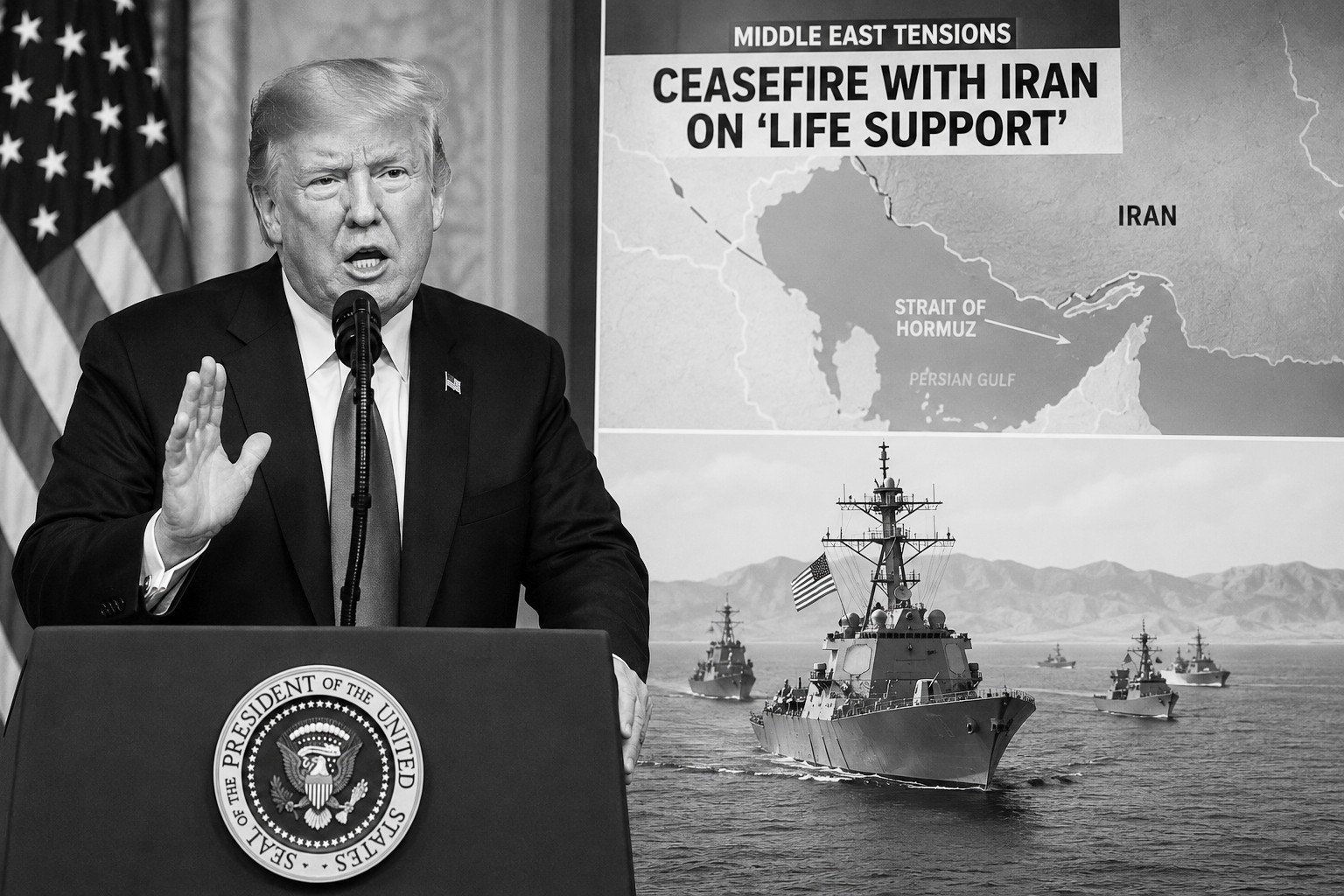
U.S. President Donald Trump has warned that the fragile ceasefire with Iran is now on “life support” after rejecting Tehran’s latest peace proposals, raising fears that tensions in the Middle East could escalate once again. Trump also said his administration is considering restarting U.S. naval escort operations in the Strait of Hormuz in an effort to break Iran’s blockade and restore commercial shipping access through one of the world’s most strategically important energy corridors.
The remarks followed Washington’s dismissal of Iran’s response to a recent U.S.-backed peace proposal. Trump described Tehran’s position as “totally unacceptable” and indicated that negotiations had failed to produce sufficient concessions regarding Iran’s nuclear programme and regional military posture.
The growing uncertainty surrounding the ceasefire has intensified concerns across global energy and financial markets, particularly given the central importance of the Strait of Hormuz for international oil transport. Roughly one-fifth of global oil shipments normally pass through the narrow waterway linking the Persian Gulf to international markets.

Hormuz blockade raises global economic concerns
Iran’s blockade and continuing maritime tensions have disrupted shipping traffic throughout the region, leaving hundreds of vessels delayed and contributing to renewed volatility in global energy prices. Several governments and shipping operators are now reassessing security conditions in the Gulf as the possibility of renewed military confrontation increases.
Trump indicated that Washington may revive expanded naval escort operations designed to protect commercial shipping moving through Hormuz. Previous U.S. operations in the region were temporarily paused in recent days as diplomatic efforts continued.
Analysts note that any escalation involving the Strait of Hormuz would carry major implications for inflation, energy markets and global trade routes. Rising oil prices have already placed additional pressure on several import-dependent economies across Asia and Europe.
Saudi Arabia and Gulf states are also closely monitoring developments, with regional governments balancing security concerns against fears of broader military escalation.
Negotiations remain deeply divided
The latest Iranian proposal reportedly included demands related to sanctions relief, recognition of Iranian sovereignty claims and broader regional security arrangements. Washington rejected the proposals, arguing they failed to adequately address concerns surrounding Iran’s nuclear activities and military operations.
Iranian officials, meanwhile, have maintained that their demands represent legitimate national interests and accused the United States of escalating tensions through military pressure and economic restrictions.
Despite Trump’s increasingly confrontational language, the ceasefire has not formally collapsed. U.S. officials continue describing the truce as technically still in effect, although repeated military incidents and diplomatic setbacks have severely weakened confidence in the agreement’s stability.
Global powers watch closely
The standoff has also become increasingly intertwined with broader geopolitical dynamics involving China, Gulf states and European governments. Beijing remains one of Iran’s most important economic partners, particularly in energy trade, while Western allies continue discussing maritime security coordination in the Gulf region.
Observers believe the coming days could prove critical in determining whether diplomacy can still prevent renewed military confrontation. Much may depend on whether indirect negotiations resume and whether major international actors can pressure both sides towards compromise.
For now, however, Trump’s warning that the ceasefire is on “life support” has reinforced fears that the Middle East may once again be moving closer to a broader regional crisis.
Newshub Editorial in North America – May 12, 2026

If you have an account with ChatGPT you get deeper explanations,
background and context related to what you are reading.
Open an account:
Open an account
Recent Comments