
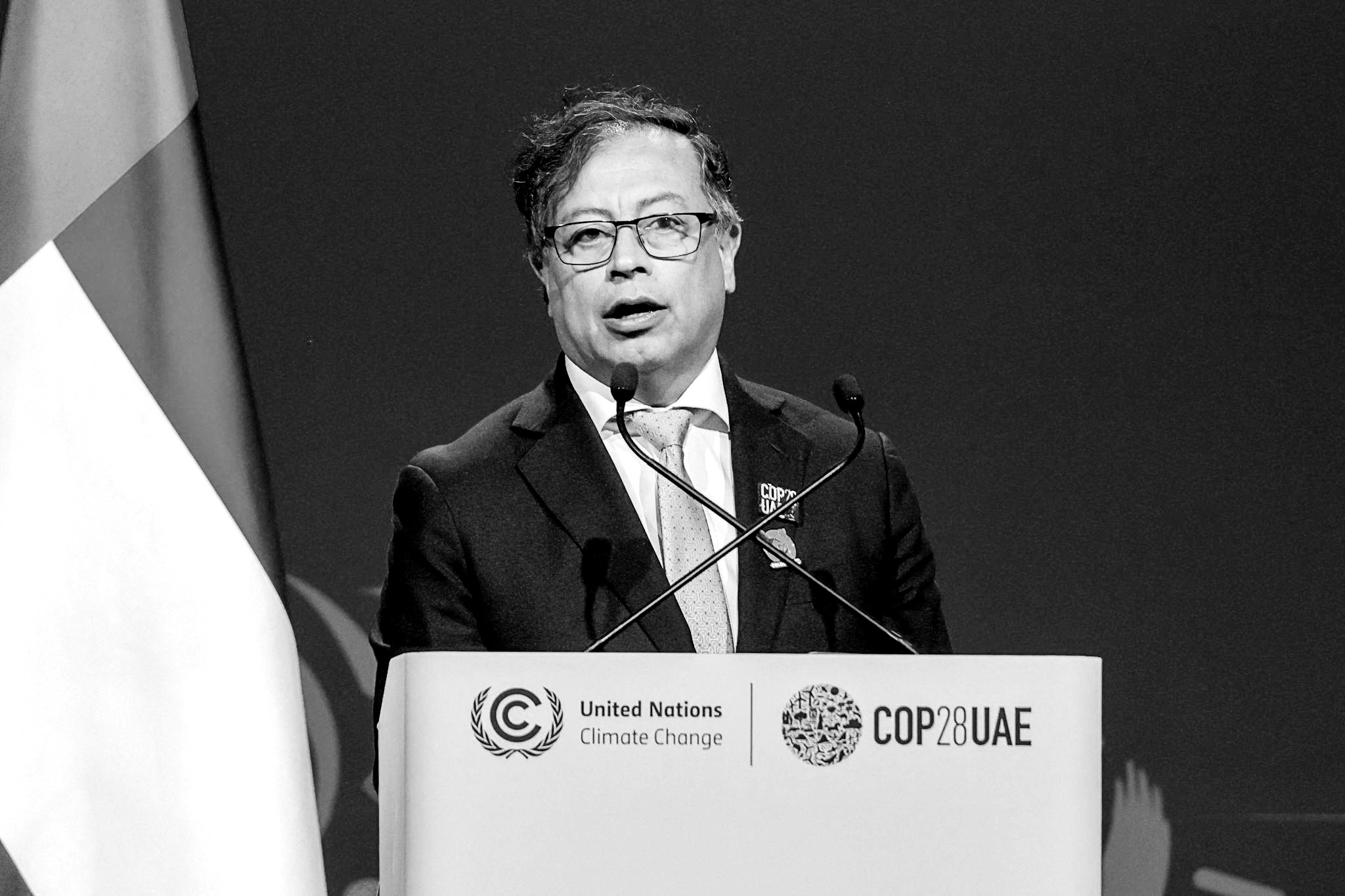
Colombian President Gustavo Petro has warned that what he described as a “suicidal” model of capitalism driven by fossil fuel dependence risks pushing the world toward war, authoritarianism and environmental collapse. Speaking at a 57-country summit focused on accelerating the global green energy transition, Petro argued that entrenched fossil fuel interests could ultimately threaten humanity itself.
Sharp criticism of the global economic model
Addressing delegates from dozens of countries, Petro delivered one of the summit’s most politically charged speeches, linking climate change, geopolitical conflict and economic inequality to the continued dominance of fossil fuel industries.
The Colombian president argued that major global powers remain trapped in an economic system dependent on resource extraction, military competition and short-term financial interests rather than long-term sustainability.

According to Petro, the world is witnessing increasing instability partly because governments continue prioritising oil, gas and coal interests despite escalating climate risks and environmental damage.
He warned that societies facing rising inequality, resource shortages and ecological stress could become more vulnerable to political extremism and authoritarian movements.
Climate and geopolitics becoming increasingly connected
The summit comes during a period of severe geopolitical tension and renewed energy insecurity caused by conflicts in the Middle East and broader disruptions to global oil markets.
Several speakers at the conference highlighted how dependence on fossil fuels continues to expose economies to both environmental and geopolitical shocks.
Petro argued that global climate policy can no longer be separated from international security and economic justice, describing the energy transition as both an environmental necessity and a political transformation.
The Colombian leader has increasingly positioned himself as one of Latin America’s most outspoken advocates for reducing fossil fuel dependence and expanding renewable energy investment.
Developing nations demand financial fairness
A major focus of the summit involved calls from developing countries for greater financial support from wealthier nations to fund climate adaptation and renewable infrastructure.
Representatives from Africa, Latin America and parts of Asia argued that many emerging economies remain disproportionately affected by climate change despite contributing far less historically to global emissions.
Petro stressed that poorer nations should not be forced to choose between economic development and environmental responsibility, calling instead for a restructuring of international financing systems.
The conference also examined investment in solar power, green hydrogen, battery infrastructure and sustainable transport systems as part of a broader global transition strategy.
Fossil fuel debate intensifies globally
Petro’s remarks reflect a growing divide between governments pushing for faster decarbonisation and those prioritising energy security and industrial competitiveness.
While renewable energy investment continues to grow rapidly worldwide, global fossil fuel consumption remains historically high, particularly following recent geopolitical disruptions and supply shocks.
Oil-producing nations and energy companies argue that a rapid abandonment of fossil fuels could destabilise economies and energy systems, while climate activists insist the current pace of transition remains dangerously slow.
The debate has become even more politically sensitive as rising energy costs continue affecting households, industry and inflation across multiple regions.
Climate transition framed as a survival issue
For Petro and several leaders attending the summit, the green transition is increasingly being framed not simply as environmental policy, but as a broader struggle over the future structure of the global economy.
The Colombian president concluded that humanity faces a defining choice between continued resource-driven conflict or a transition toward more sustainable economic systems.
As governments prepare for another critical period of international climate negotiations, the summit highlighted how climate policy, energy security and geopolitical stability are now deeply interconnected challenges shaping the future global order.
Newshub Editorial in South America – 30 April 2026

If you have an account with ChatGPT you get deeper explanations,
background and context related to what you are reading.
Open an account:
Open an account
Recent Comments