
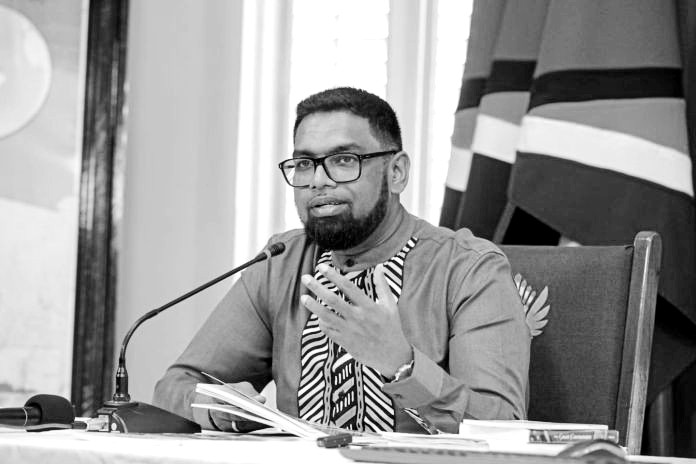
The Caribbean Community (CARICOM) has responded to a formal objection from Guyanese President Mohamed Irfaan Ali after Venezuelan officials publicly displayed symbols portraying Guyana’s Essequibo region as part of Venezuela. The regional bloc reaffirmed its support for Guyana’s sovereignty and warned against using official engagements to legitimise territorial claims currently before the International Court of Justice (ICJ).
Dispute reignited during regional visits
The latest diplomatic tension emerged after Venezuela’s acting President Delcy Rodríguez appeared at official meetings within Caribbean member states wearing a brooch depicting a map of Venezuela that included Guyana’s resource-rich Essequibo region.
President Ali formally wrote to CARICOM Chairman Terrance Drew expressing “grave concern” over the display, arguing that such symbolism could be interpreted as tolerance or acceptance of Venezuela’s territorial claim.

The Essequibo region constitutes roughly two-thirds of Guyana’s territory and has been administered by Guyana for decades, although Venezuela continues to claim the area based on historical arguments dating back to the colonial era.
CARICOM reiterates support for Guyana
In its response, CARICOM acknowledged Ali’s concerns and stressed that official regional platforms should not be used, directly or indirectly, to promote claims subject to ongoing judicial proceedings.
The organisation reaffirmed its “longstanding and unequivocal support” for the sovereignty and territorial integrity of Guyana while continuing to support a peaceful resolution through international law and the ICJ process.
Ali also warned that Venezuela’s increasing use of maps, symbols and official imagery incorporating Essequibo risks undermining confidence in diplomatic efforts and peaceful negotiations.
Oil discoveries transformed the dispute
Although the territorial disagreement dates back more than a century, tensions intensified dramatically after major offshore oil discoveries near Guyana in 2015. The country has since become one of the world’s fastest-growing oil producers, attracting major international energy investment.
Venezuela argues that the 1899 arbitration defining the border was unfair and invalid, while Guyana insists the ruling remains legally binding. The matter is currently being examined by the International Court of Justice in The Hague.
In recent years, Caracas has escalated its rhetoric by organising referendums, issuing maps including Essequibo as Venezuelan territory and threatening administrative integration of the region.
Regional stability remains a major concern
CARICOM and several international governments have repeatedly called for restraint amid fears that the dispute could destabilise the wider Caribbean and northern South American region.
Guyana has strengthened diplomatic and security cooperation with partners including the United States, Brazil and the United Kingdom as tensions with Venezuela have increased.
Analysts say the latest disagreement highlights the delicate balance CARICOM faces between maintaining regional diplomacy and defending the territorial integrity of member states.
For Guyana, the issue is viewed not only as a legal dispute, but also as a test of international support for sovereignty, international law and regional stability in an increasingly strategic energy-producing region.
Newshub Editorial in South America – 30 April 2026

If you have an account with ChatGPT you get deeper explanations,
background and context related to what you are reading.
Open an account:
Open an accountThe Caribbean Community (CARICOM) has responded to a formal objection from Guyanese President Mohamed Irfaan Ali after Venezuelan officials publicly displayed symbols portraying Guyana’s Essequibo region as part of Venezuela. The regional bloc reaffirmed its support for Guyana’s sovereignty and warned against using official engagements to legitimise territorial claims currently before the International Court of Justice (ICJ).
Recent Comments