
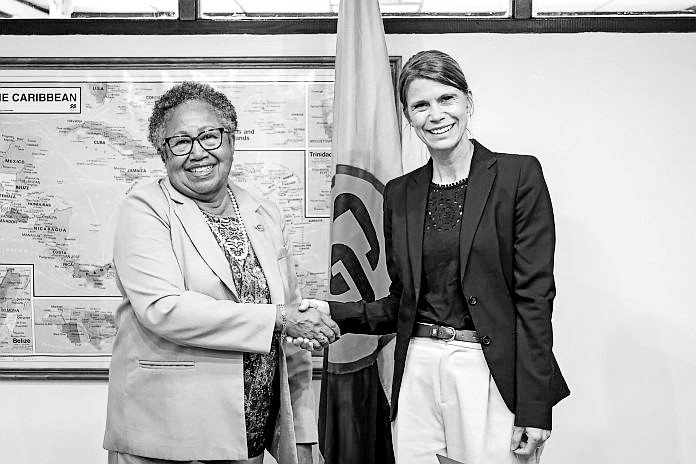
The Caribbean Community has strengthened its development framework after signing a new memorandum of understanding with Germany, unlocking €31.9 million in technical cooperation to support regional priorities across multiple sectors.
Six agreements formalise expanded cooperation
The CARICOM Secretariat and Deutsche Gesellschaft für Internationale Zusammenarbeit GmbH signed six Implementation Agreements on 23 April, establishing the operational foundation for a broad, Germany-funded programme across the Caribbean.
The agreements define how funding will be deployed, focusing on technical expertise, institutional strengthening and programme execution rather than direct financial transfers. This model is designed to enhance capacity within regional institutions while ensuring measurable delivery outcomes.

Focus on resilience, climate and economic systems
The cooperation programme is expected to target key regional priorities, including climate resilience, sustainable economic development, governance frameworks and digital transformation. Caribbean economies face structural vulnerabilities, particularly exposure to climate-related risks, making external technical support a critical component of long-term planning.
Germany’s development approach typically emphasises practical implementation, combining advisory support, training and systems development. In the Caribbean context, this is likely to translate into support for climate adaptation strategies, public sector efficiency and regional integration mechanisms.
Strategic alignment with regional goals
For CARICOM, the agreement reinforces ongoing efforts to coordinate policy across member states and strengthen institutional cohesion. Regional integration remains a central objective, particularly in areas such as trade, energy, and infrastructure development.
The programme also aligns with broader international development priorities, including sustainability and resilience. By working through established regional bodies, the cooperation framework aims to maximise impact while avoiding fragmentation across smaller national systems.
Implications for development and investment
The €31.9 million commitment signals continued European engagement in the Caribbean at a time when global competition for development influence is increasing. Technical cooperation of this nature often acts as a catalyst for further investment, improving regulatory environments and project readiness.
For investors and stakeholders, strengthened institutional capacity and improved governance frameworks can enhance confidence and reduce execution risk. This is particularly relevant in sectors such as renewable energy, infrastructure and digital services, where the Caribbean is seeking to accelerate development.
Long-term partnership approach
The agreement reflects a long-term partnership model rather than a one-off funding initiative. By focusing on technical expertise and systems development, the programme aims to create sustainable improvements that extend beyond the immediate funding cycle.
As implementation begins, the effectiveness of the programme will depend on coordination between regional institutions, national governments and delivery partners. If executed effectively, the initiative could play a meaningful role in strengthening the Caribbean’s economic resilience and institutional capacity in the years ahead.
Newshub Editorial in North America – April 28, 2026

If you have an account with ChatGPT you get deeper explanations,
background and context related to what you are reading.
Open an account:
Open an account
Recent Comments