
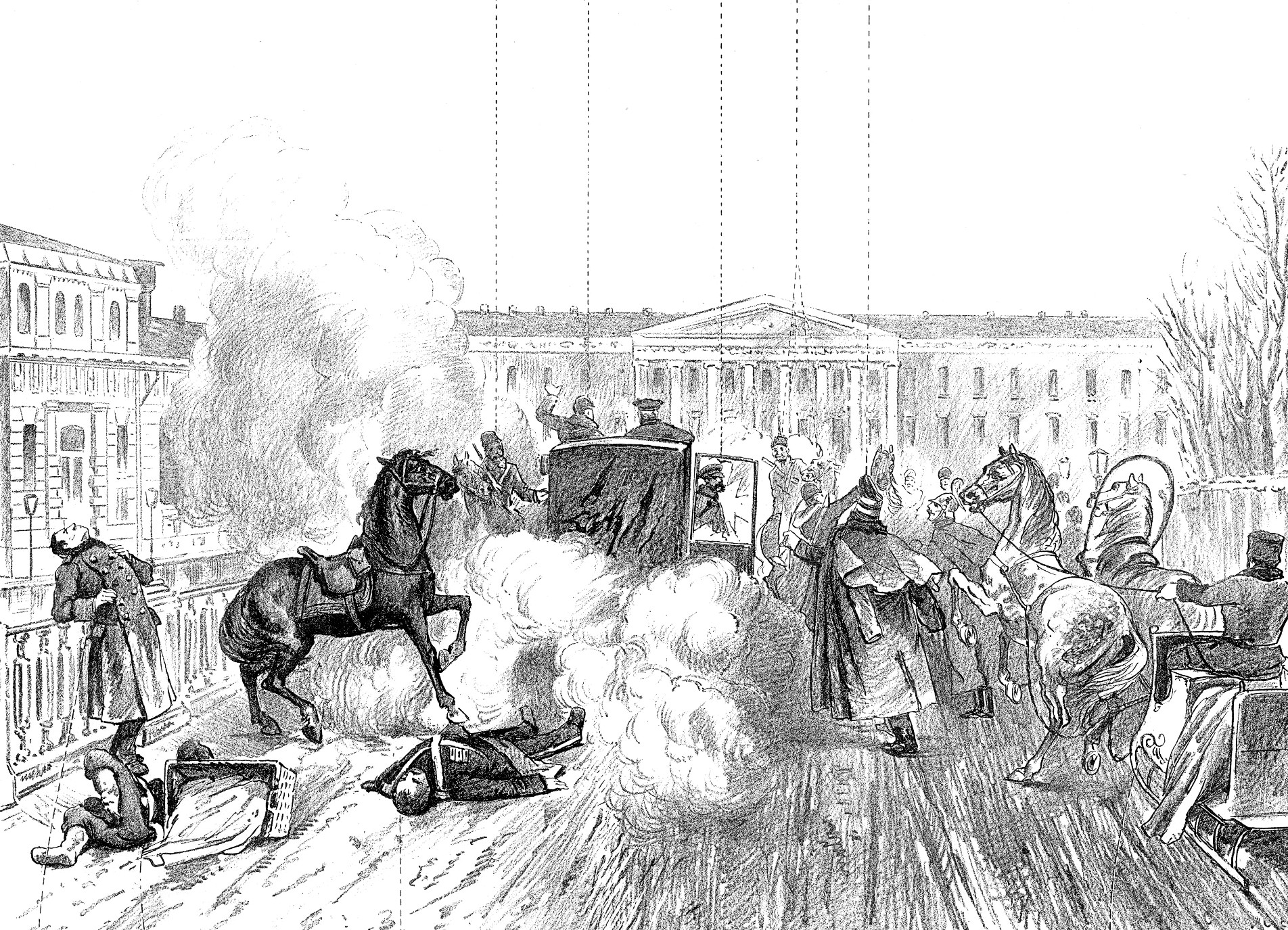
Tsar Alexander II of Russia was assassinated in St. Petersburg on 13 March 1881, a violent end to the reign of the monarch widely known as the “Tsar Liberator.” The killing, carried out by members of the revolutionary organisation Narodnaya Volya (People’s Will), marked a dramatic turning point in Russian political history and foreshadowed the revolutionary upheavals that would eventually topple the Romanov dynasty decades later.
A reformer who changed Russia
Alexander II ascended the Russian throne in 1855 during the final stages of the Crimean War, inheriting a vast empire struggling with economic backwardness and social inequality. Determined to modernise Russia, he introduced a series of sweeping reforms that reshaped the structure of the state.
His most famous act came in 1861 with the Emancipation Reform, which freed more than 20 million serfs from centuries of bondage. The move fundamentally altered Russian society, granting peasants legal freedom and limited rights to land ownership.

Beyond emancipation, Alexander II implemented major changes in the judicial system, the military, and local government. New courts introduced trial by jury and legal equality before the law, while local administrative councils known as zemstvos were established to manage regional affairs.
Despite these reforms, the changes did not fully satisfy either conservatives or radicals. Land reforms left many peasants burdened with payments for land they received, while revolutionary groups believed the reforms did not go far enough to dismantle autocratic rule.
The rise of revolutionary violence
By the late 1870s, radical political movements had become increasingly active across the Russian Empire. Organisations such as Narodnaya Volya concluded that meaningful political transformation could only be achieved through direct action against the autocracy.
Alexander II became the primary target of repeated assassination attempts. Several plots were foiled in the years leading up to 1881, including attempts involving explosives planted along railway lines and within imperial buildings.
On the afternoon of 13 March 1881, the tsar was travelling through St. Petersburg in a horse-drawn carriage after reviewing troops. As his convoy passed along the Catherine Canal, a member of Narodnaya Volya threw a bomb at the imperial carriage.
The explosion damaged the vehicle but left the tsar largely unharmed. Against the advice of his guards, Alexander II stepped out of the carriage to inspect the injured.
Moments later, a second conspirator detonated another bomb at close range. The blast fatally wounded the tsar, who died shortly afterwards in the Winter Palace.
A turning point for the Russian Empire
The assassination shocked the empire and reverberated across Europe. Ironically, Alexander II had been considering further constitutional reforms at the time of his death, including proposals that could have introduced limited representative institutions.
Instead, his successor, Alexander III, abandoned these liberalising initiatives and ushered in a period of political repression and intensified autocratic rule. Revolutionary movements were driven underground, but the tensions that had fuelled them remained unresolved.
Many historians regard the assassination as a critical moment in Russian history. The violent clash between reformist monarchy and radical revolutionaries revealed the deep structural instability of the empire.
Less than four decades later, those pressures would erupt in the Russian Revolution of 1917, bringing an end to more than 300 years of Romanov rule.
Newshub Editorial in Europe – March 13, 2026

If you have an account with ChatGPT you get deeper explanations,
background and context related to what you are reading.
Open an account:
Open an account
Recent Comments