
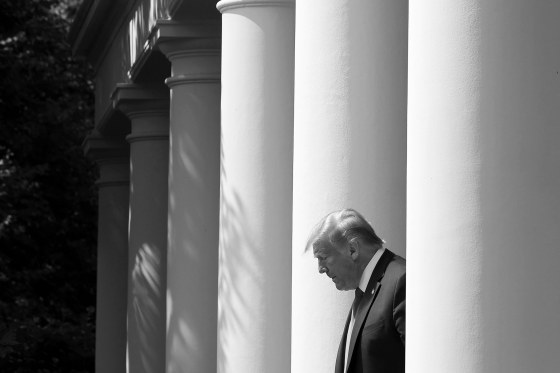
Several of US President Donald Trump’s own advisers are urging him to find an “exit ramp” from the escalating conflict with Iran, warning that a prolonged military confrontation could trigger growing political and economic consequences, according to a report by The Wall Street Journal.
Internal pressure grows inside the White House
According to the report, a number of advisers close to the president believe the United States should begin planning a pathway to wind down the confrontation while it still has the opportunity to frame the operation as a strategic success.
Those advisers reportedly fear that if the conflict drags on, it could fuel domestic political backlash and undermine support among voters already concerned about economic uncertainty and rising energy prices.

The proposal circulating within Trump’s circle suggests declaring victory on key objectives already achieved in the campaign against Iran and transitioning toward diplomatic or strategic containment measures.
Such a move, supporters argue, would allow the administration to maintain political control of the narrative while avoiding the risks of deeper military escalation in the Middle East.
Trump signals mixed messages on next steps
President Trump himself offered mixed signals during remarks to reporters on Monday when asked about the possible direction of the conflict.
Speaking after a briefing, Trump suggested the United States could already claim success based on the objectives achieved so far.
“We could call it a tremendous success right now, as we leave here,” he said when responding to questions about the future of the military operation.
However, the president immediately left open the possibility of further escalation.
“Or we could go further,” he added, indicating that the administration had not yet fully decided how to proceed.
The contrasting remarks highlight the uncertainty surrounding Washington’s strategy as military operations and geopolitical tensions continue to evolve.
Political and economic risks mounting
Advisers concerned about the trajectory of the conflict reportedly point to both domestic political risks and broader economic consequences. Rising energy prices, market volatility and fears of disruption to global oil supply routes have already unsettled financial markets.
If the conflict intensifies or expands geographically, analysts warn that the economic effects could grow significantly. Higher oil prices could push inflation upward, complicating monetary policy and adding pressure on consumer spending.
Within the United States, prolonged overseas military engagement has historically carried political risks for administrations, particularly when economic conditions become unstable.
Some officials therefore believe an early strategic exit could limit potential fallout while allowing the administration to present the operation as having achieved its core objectives.
Strategic crossroads for Washington
The debate inside the administration reflects a broader strategic dilemma. Continuing military pressure on Iran could potentially weaken Tehran’s position, but it also risks triggering wider regional instability.
Meanwhile, an early de-escalation could reduce economic and geopolitical risks but might also be perceived by critics as an incomplete resolution.
For now, the White House has not formally outlined a clear long-term strategy, leaving markets and international observers watching closely for signals about Washington’s next move.
As the situation develops, the balance between military objectives, political considerations and global economic stability is likely to shape the decisions facing the Trump administration in the coming days.
Newshub Editorial in North America – March 10, 2026

If you have an account with ChatGPT you get deeper explanations,
background and context related to what you are reading.
Open an account:
Open an account
Recent Comments