
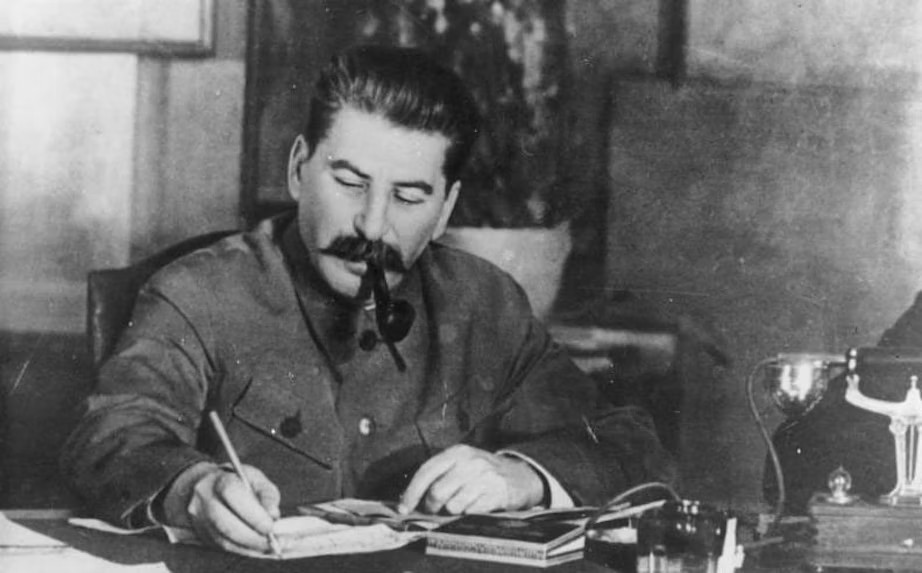
Josef Stalin remains one of the most consequential and controversial leaders of the twentieth century. As the dominant figure in the Soviet Union from the late 1920s until his death in 1953, Stalin oversaw the country’s transformation into an industrial and military power while presiding over one of the most repressive political systems of the modern era.
From Georgian revolutionary to Soviet power broker
Josef Stalin was born Ioseb Jughashvili in 1878 in the town of Gori in present-day Georgia, then part of the Russian Empire. Raised in modest circumstances, he initially studied at a religious seminary before turning to revolutionary politics and joining Marxist groups opposed to the Tsarist regime.
By the early twentieth century, Stalin had aligned himself with the Bolshevik faction led by Vladimir Lenin. His activities included organising strikes, distributing propaganda and participating in efforts to finance the revolutionary movement. These actions led to repeated arrests and periods of exile within the Russian Empire.

Following the Bolshevik seizure of power in the Russian Revolution of 1917, Stalin gradually climbed the ranks of the Communist Party. His appointment as General Secretary in 1922 gave him control over party appointments and internal administration, enabling him to build a powerful political network.
After Lenin’s death in 1924, Stalin manoeuvred against rivals including Leon Trotsky, Grigory Zinoviev and Lev Kamenev. By the late 1920s he had consolidated his authority and emerged as the Soviet Union’s undisputed leader.
Industrial transformation and forced collectivisation
Once in power, Stalin launched a sweeping programme to modernise the Soviet economy. Beginning in 1928, a series of Five-Year Plans aimed to rapidly expand heavy industries such as steel, coal and machinery. The Soviet leadership believed that industrial strength was essential to secure the country’s independence and military capability.
At the same time, Stalin initiated the forced collectivisation of agriculture. Millions of small private farms were merged into large state-controlled collectives. The policy sought to increase agricultural output and secure grain supplies for urban workers and export.
Collectivisation, however, caused widespread disruption in rural areas. Resistance from farmers, combined with poor planning and harsh enforcement, contributed to severe food shortages and devastating famines across parts of the Soviet Union during the early 1930s.
Stalin’s rule was also defined by intense political repression. The period known as the Great Purge in the late 1930s saw hundreds of thousands of party officials, military officers and civilians arrested, imprisoned or executed as the regime sought to eliminate perceived political threats.
War leadership and the birth of a superpower
The Second World War became the defining conflict of Stalin’s leadership. In 1941 Nazi Germany invaded the Soviet Union in one of the largest military offensives in history. Stalin assumed direct control of the war effort as the country mobilised its vast resources to repel the invasion.
The war on the Eastern Front was among the most brutal theatres of the conflict. Soviet forces eventually halted the German advance and pushed westward, culminating in the capture of Berlin in 1945. The Soviet Union’s role in defeating Nazi Germany elevated it to the status of a global superpower.
After the war, Stalin oversaw the establishment of communist governments across Eastern Europe, creating a Soviet sphere of influence that became central to the geopolitical divide of the Cold War.
Stalin died on 5 March 1953 after nearly three decades at the centre of Soviet power. His legacy remains sharply debated, reflecting both the Soviet Union’s rapid industrial and military development and the immense human cost associated with his rule.
Newshub Editorial in Europe — March 5, 2026

If you have an account with ChatGPT you get deeper explanations,
background and context related to what you are reading.
Open an account:
Open an account
Recent Comments