
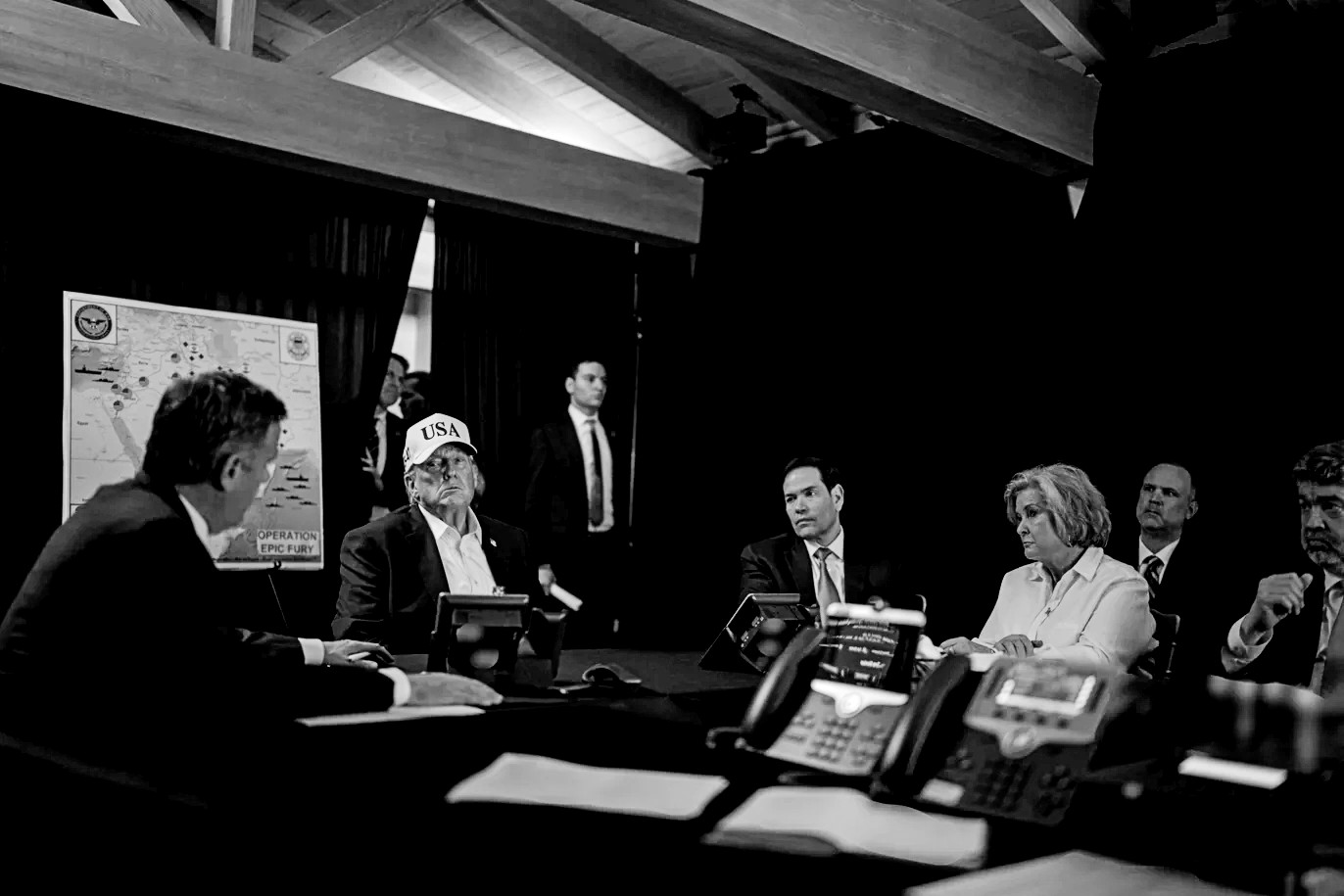
US President Donald Trump reportedly oversaw the opening phase of the joint United States–Israel military strikes on Iran from his Mar-a-Lago resort in Florida, where a temporary command setup was established as the operation unfolded across the Middle East.
A makeshift command centre at a private resort
According to officials and media reports, Trump followed the military operation overnight from his Mar-a-Lago estate alongside members of his national security team. The White House confirmed that the president remained in close contact with senior advisers and regional leaders as the strikes were carried out.
Images released after the operation showed Trump seated with advisers around a temporary operations table inside the resort, where curtains separated the area from surrounding rooms. The unusual setting quickly drew attention, with critics questioning the optics of directing a major military campaign from a private residence rather than the official White House Situation Room.

Officials said the Florida location functioned as a temporary monitoring centre, allowing the president to receive real-time intelligence briefings and communicate with defence officials and allied leaders.
Split command between Florida and Washington
While Trump monitored the mission from Florida, other key members of the administration remained in Washington. Vice President JD Vance and senior security officials reportedly tracked the operation from the White House Situation Room as the military campaign progressed.
The strikes formed part of a large-scale operation targeting Iranian military infrastructure, missile facilities and command centres. US Central Command later confirmed that hundreds of targets had been hit across Iran as part of the campaign.
Officials described the coordination between Washington and Mar-a-Lago as continuous, with the president receiving briefings from military commanders and intelligence agencies while maintaining communication with Israeli leadership.
Operation intensifies regional tensions
The attacks represent one of the most significant escalations in Middle East tensions in years. Iranian missile and drone strikes soon followed, targeting US and allied positions across the region while raising fears of a broader regional conflict.
The confrontation has already drawn in other actors, including the Iran-aligned group Hezbollah in Lebanon, which launched rockets toward Israel in retaliation for the killing of Iranian Supreme Leader Ayatollah Ali Khamenei during the initial wave of strikes.
The rapidly expanding conflict has disrupted air travel, energy markets and shipping routes, while global leaders have urged restraint to prevent further escalation.
Political debate intensifies in Washington
The decision to conduct the operation — and the circumstances under which it was monitored — has sparked debate within the United States. Some lawmakers have questioned the legal basis for the strikes and have called for congressional briefings on the military campaign and its long-term objectives.
At the same time, supporters of the administration argue that the strikes were necessary to neutralise Iranian military capabilities and reduce threats posed by Tehran’s regional network of proxy forces.
As the situation continues to evolve, analysts warn that the strategic consequences of the operation may extend far beyond the immediate military campaign, potentially reshaping security dynamics across the Middle East for years to come.
Newshub Editorial in North America – March 2, 2026

If you have an account with ChatGPT you get deeper explanations,
background and context related to what you are reading.
Open an account:
Open an account
Recent Comments