
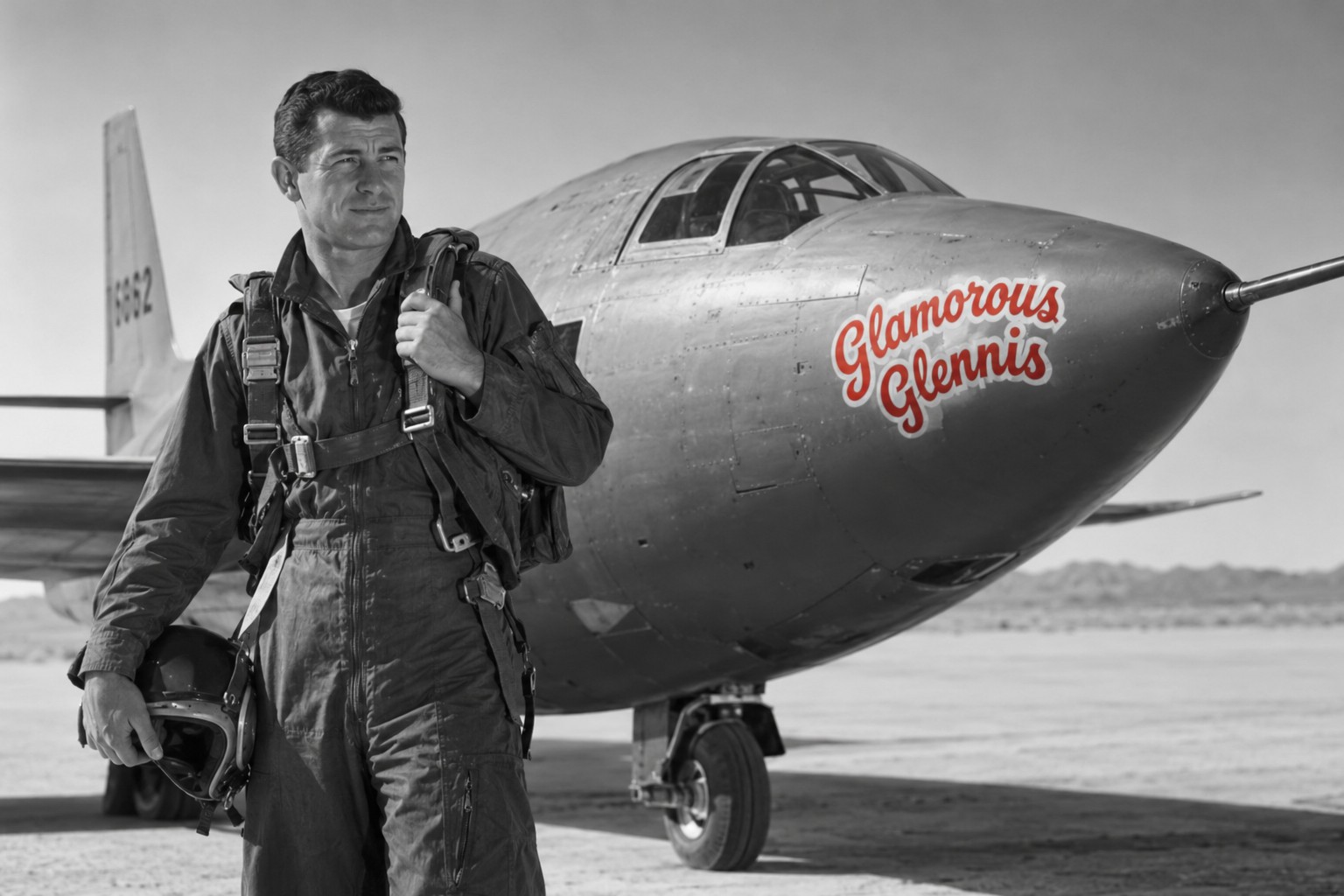
On 14 October 1947, American test pilot Chuck Yeager achieved what many aviation engineers had feared might be impossible. Flying a rocket-powered Bell X-1 above the California desert, he became the first person officially recorded to exceed the speed of sound in level flight, opening a new chapter in aviation history.
The world was still recovering from the Second World War when a remarkable technological breakthrough took place over the Mojave Desert.
Captain Chuck Yeager climbed into a small experimental aircraft called the Bell X-1, nicknamed Glamorous Glennis after his wife. The aircraft was carried into the sky beneath a modified B-29 bomber before being released at high altitude.


What followed would change aviation forever.
Breaking an invisible barrier
At the time, aircraft approaching the speed of sound encountered dangerous aerodynamic effects, including severe vibrations, instability and a dramatic increase in drag.
Some engineers questioned whether an aircraft could safely pass through this region.
The Bell X-1 was specifically designed to investigate these challenges. Its streamlined fuselage resembled a machine-gun bullet, while its rocket engine provided the extraordinary thrust required for the experiment.
On that October morning, Yeager accelerated to approximately 1,127 kilometres per hour, reaching Mach 1.06 at an altitude of around 13,000 metres.
The sound barrier had been broken.
A dangerous mission
The achievement was even more extraordinary because Yeager had suffered two broken ribs in a horse-riding accident just days before the flight.
Rather than withdraw, he continued with the mission, concealing his injuries from most of the ground crew.
The flight itself proved unexpectedly smooth, demonstrating that supersonic aviation was technically achievable with the appropriate aircraft design.
The programme was a collaboration between the United States military, Bell Aircraft and the National Advisory Committee for Aeronautics, the predecessor of NASA.
A revolution in aviation
Yeager’s achievement transformed the future of aircraft development.
Supersonic military aircraft subsequently became central to Cold War aviation, while continued research contributed to the technologies that eventually made supersonic passenger travel possible.
The British-French Concorde, which entered commercial service in 1976, represented one of the most recognisable civilian applications of supersonic technology.
The experimental programme also helped establish the technical foundations for future high-speed aerospace research and space exploration.
A legacy beyond the skies
Seventy-nine years later, the flight remains one of aviation’s defining milestones.
It demonstrated how scientific research, industrial engineering and human determination could overcome a barrier once considered almost insurmountable.
On 14 October 1947, Chuck Yeager did more than fly faster than sound. He helped redefine the limits of human flight.
NewsHub Finance | Historical Perspective | 14 October 2026
On 14 October 1947, American test pilot Chuck Yeager achieved what many aviation engineers had feared might be impossible. Flying a rocket-powered Bell X-1 above the California desert, he became the first person officially recorded to exceed the speed of sound in level flight, opening a new chapter in aviation history.
Recent Comments