
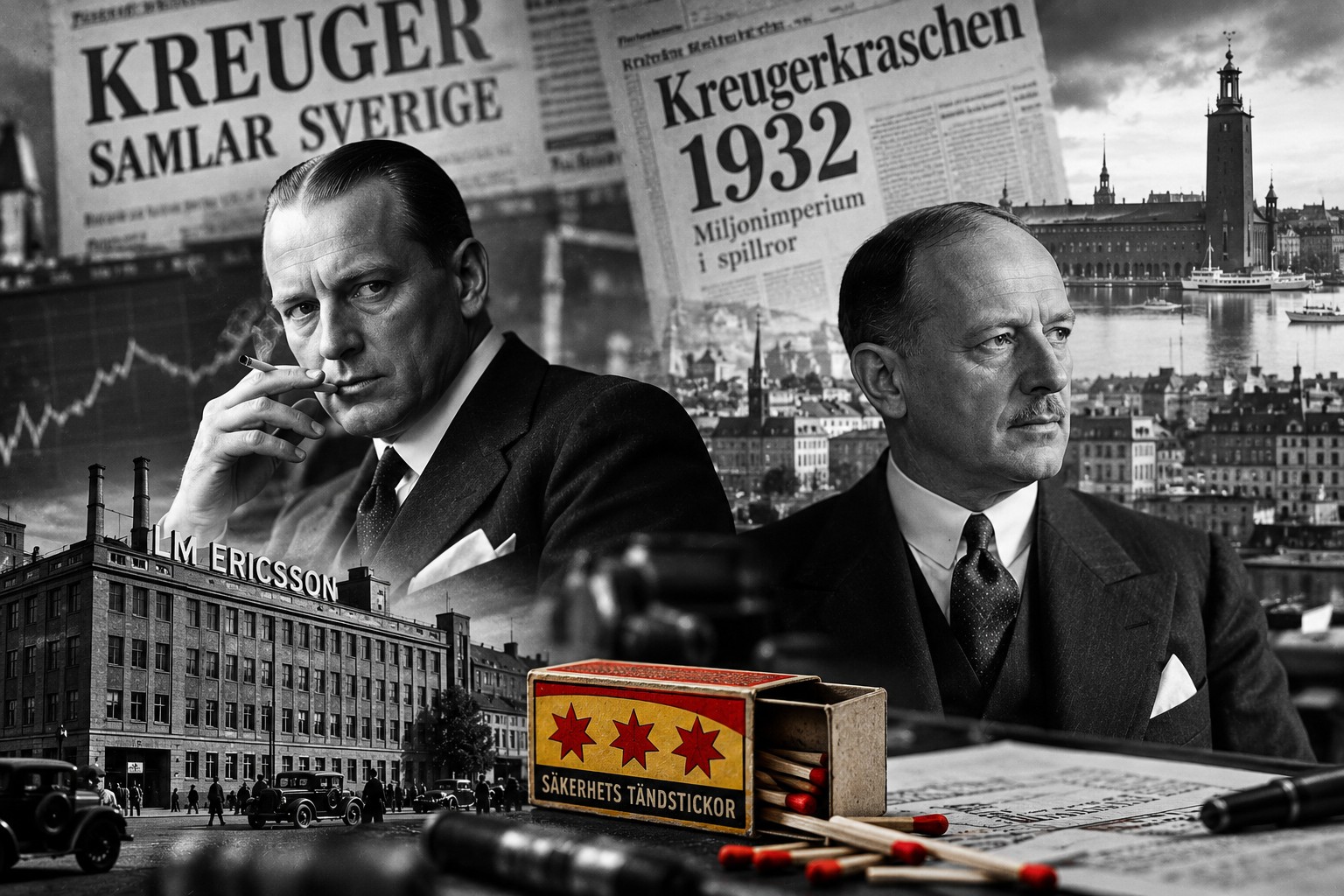
By the beginning of the 1930s, Sweden had two extraordinary centres of financial power. Ivar Kreuger had created an international empire built around matches, industrial holdings and global capital markets. The Wallenberg family had built something different: a banking and industrial network based on Stockholms Enskilda Bank and Investor. When Kreuger’s empire collapsed in 1932, the balance of Swedish industrial power changed dramatically.
Two competing systems
Kreuger’s rise during the 1920s was spectacular. Through Kreuger & Toll and Svenska Tändsticks AB, he combined industrial ownership with international lending. Governments received loans while Kreuger secured valuable match concessions and monopolies.
His interests eventually stretched far beyond matches. The Kreuger sphere included major positions in companies connected to telecommunications, mining, forestry and engineering, including LM Ericsson, Boliden and interests surrounding what became SCA.


The Wallenberg model was more conservative. Stockholms Enskilda Bank provided the financial foundation, while Investor – established in 1916 – became the vehicle for long-term industrial ownership.
The two spheres therefore represented different approaches to capitalism: Kreuger depended heavily on international financing and continuous access to capital, while Wallenberg increasingly emphasised control, consolidation and long-term ownership.
The empire begins to crack
The Wall Street crash of 1929 changed everything.
International capital became increasingly difficult to obtain, while Kreuger’s enormous financial commitments remained. By 1931–32, he had borrowed around SEK 800 million from Swedish commercial banks – an amount equivalent to approximately 10 per cent of Sweden’s GDP at the time.
The system required liquidity to survive.
When that liquidity disappeared, the structure began to collapse.
On 12 March 1932, Ivar Kreuger was found dead in Paris. What followed was one of the greatest financial shocks in Swedish history.
Ericsson becomes the crucial battlefield
LM Ericsson demonstrated how complicated the collapse became.
Kreuger & Toll had gained control of Ericsson and subsequently sold a controlling block of shares to the American telecommunications group ITT. At the same time, Ericsson had been drained of liquidity and held a claim of approximately SEK 65 million against the Kreuger estate.
The company faced both an ownership crisis and severe financial pressure.
Marcus Wallenberg became central to the reconstruction. Through negotiations with banks, creditors and ITT, Ericsson was gradually stabilised. Wallenberg eventually became one of the dominant figures in the company, beginning an association that would last for decades.
A transfer of industrial power
The Kreuger crash did not simply destroy fortunes. It redistributed influence over Swedish industry.
Assets and companies previously connected to the Kreuger sphere had to find new owners, financiers and structures. In the aftermath, Ericsson and Svenska Tändsticksaktiebolaget became associated with the Wallenberg sphere, substantially increasing its industrial importance.
Kreuger’s system had expanded faster and further than almost any Swedish financial empire before it.
Its collapse left a vacuum.
The Wallenbergs were positioned to fill part of it.
The events of 1932 therefore became more than the story of one financier’s downfall. They marked a decisive shift in Swedish capitalism – away from Kreuger’s highly leveraged international financial empire and towards a model of concentrated, long-term industrial ownership that would help define the Wallenberg sphere for generations.
NewsHub Finance
By the beginning of the 1930s, Sweden had two extraordinary centres of financial power. Ivar Kreuger had created an international empire built around matches, industrial holdings and global capital markets. The Wallenberg family had built something different: a banking and industrial network based on Stockholms Enskilda Bank and Investor. When Kreuger’s empire collapsed in 1932, the balance of Swedish industrial power changed dramatically.
Recent Comments