
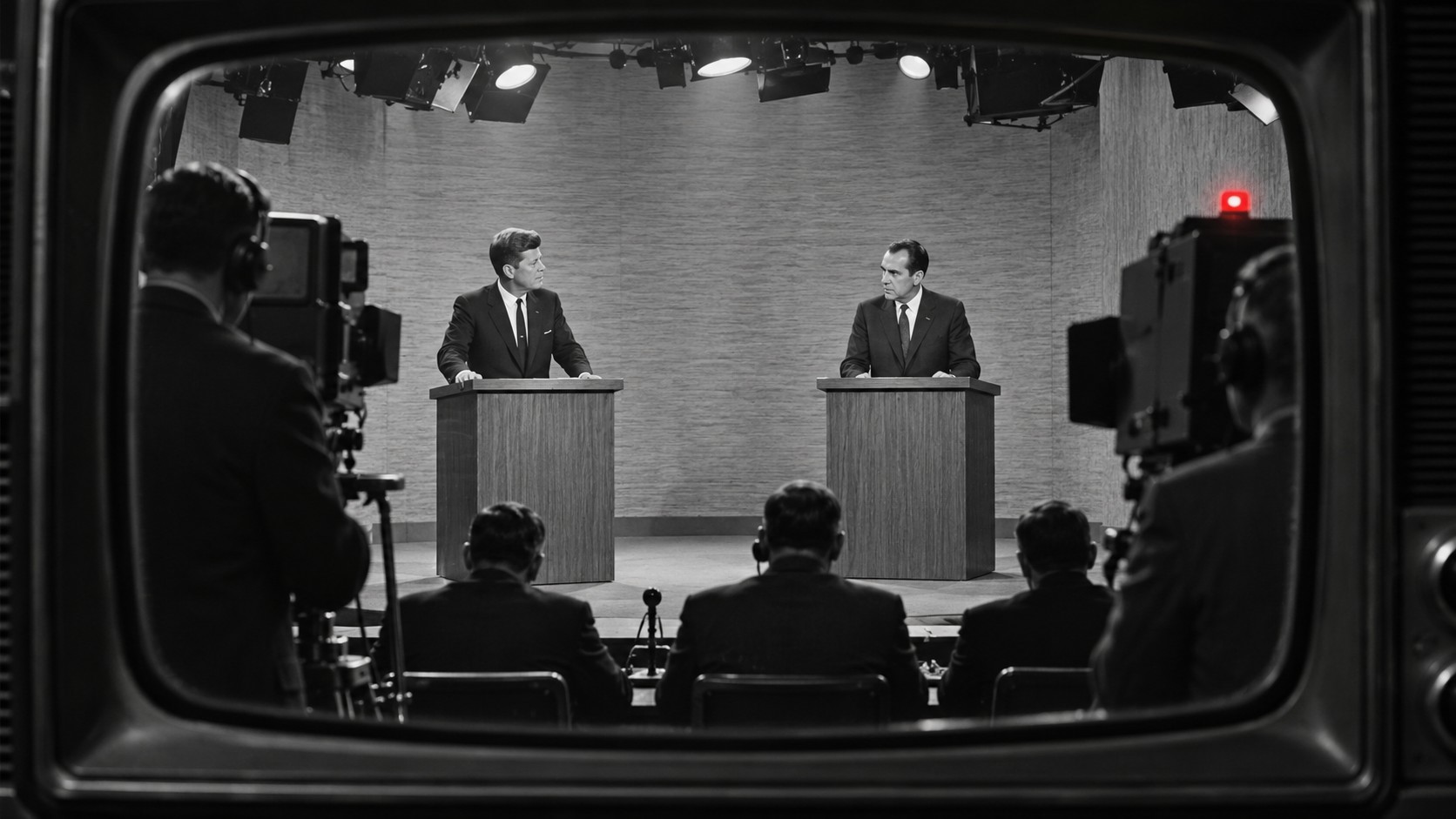
On 26 September 1960, John F. Kennedy and Richard Nixon faced each other in the first nationally televised debate between US presidential candidates. More than 60 million Americans watched a political contest in which appearance and delivery became part of the message.
A new kind of campaign event
The Democratic senator from Massachusetts and the Republican vice president met in a Chicago television studio. Both had experience in national politics, but neither had previously faced a presidential opponent in this format. Voters could hear their answers and, at the same time, study how they responded under pressure.
The debate addressed the direction of the country, including the economy and America’s position in the world. It also gave viewers something a newspaper report or radio broadcast could not: an immediate impression of each candidate’s expression, posture and confidence.


Two candidates, one screen
Kennedy appeared composed and spoke directly towards the camera. Nixon, who had been ill, looked tired under the studio lights. On black-and-white television, those differences were conspicuous.
The contrast has become central to the debate’s history. A familiar account holds that television viewers favoured Kennedy while radio listeners preferred Nixon. The evidence for such a clear division is limited, however. What the broadcast demonstrated was that viewers could judge a candidate’s performance on more than words alone.
An audience of unprecedented scale
The first debate brought the candidates into homes across the United States simultaneously. Its audience exceeded 60 million, giving both men an opportunity to reach voters on a scale that rallies and speeches could not match.
Three further debates followed during the 1960 campaign. Kennedy eventually won a close election, but historians cannot isolate the first broadcast and say precisely how many votes it changed. Its influence on campaigning is easier to see: television had become a setting candidates needed to prepare for.
Politics through the camera
The 1960 debate made presentation a practical campaign concern. Lighting, camera angles and the ability to speak naturally to viewers at home could affect how a political message was received. Substance remained essential, but a candidate now had to communicate it through a visual medium.
That shift extended beyond debates. Television offered campaigns a way to reach large audiences with speeches, interviews and advertising, while giving voters a more direct view of the people seeking office.
The lasting lesson
The Kennedy–Nixon debate did not make television the sole force in presidential elections. It marked the moment when its power became impossible for campaigns to overlook. On 26 September 1960, Americans watched two candidates debate; future candidates learned that the nation would also be watching them.
Newshub Editorial in North America – September 26, 2026

Ask NF GPT
If you have an account with ChatGPT you get deeper explanations,
background and context related to what you are reading.
On 26 September 1960, John F. Kennedy and Richard Nixon faced each other in the first nationally televised debate between US presidential candidates. More than 60 million Americans watched a political contest in which appearance and delivery became part of the message.
Recent Comments