
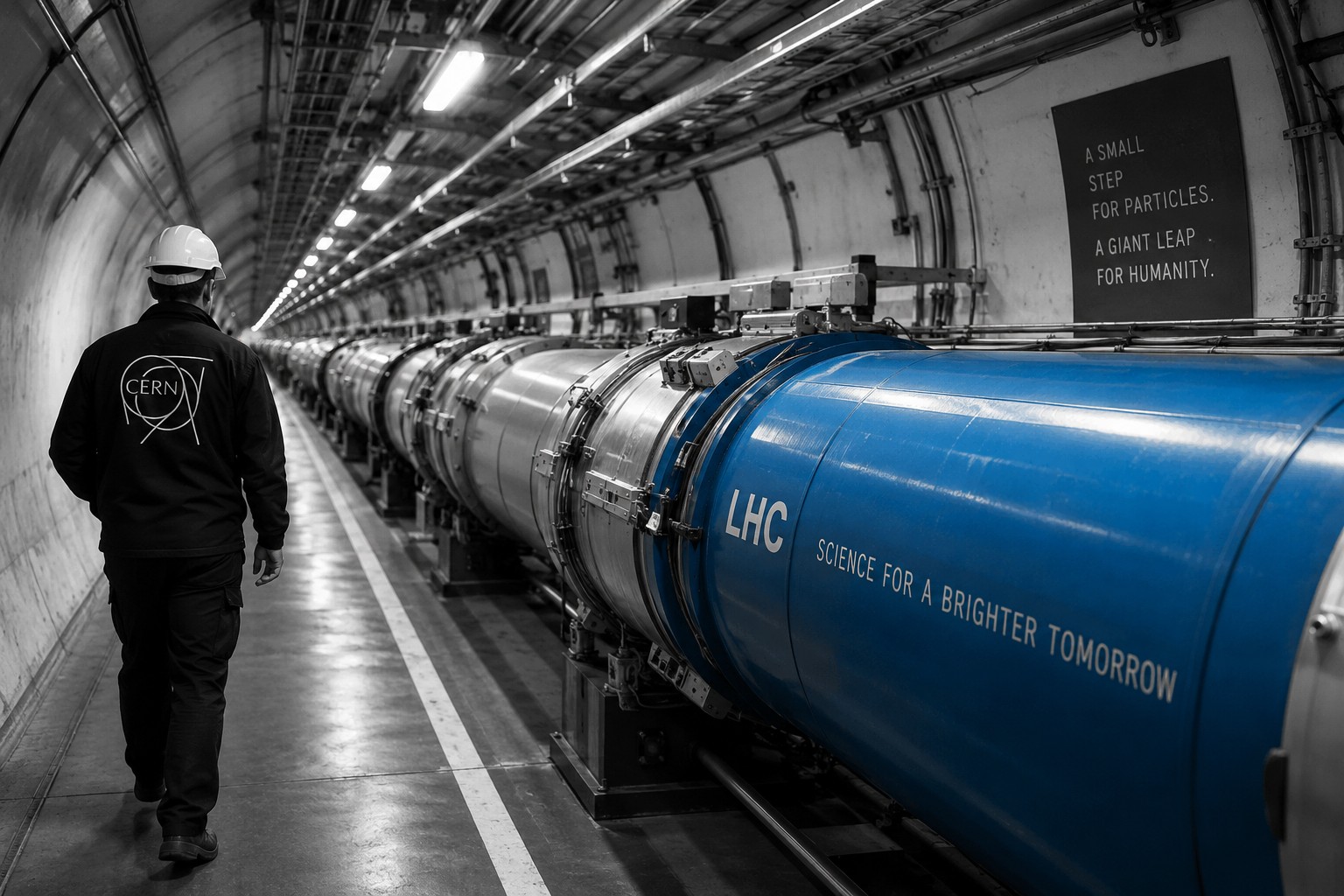
On 10 September 2008, the world’s most powerful particle accelerator successfully completed its first major operational test, sending a beam of protons around the entire 27-kilometre Large Hadron Collider at CERN and opening a new chapter in the search to understand the fundamental structure of the universe.
A machine unlike anything built before
Located underground beneath the border between Switzerland and France, the Large Hadron Collider, or LHC, was the result of more than two decades of planning, engineering and construction.
At 10:28 local time, scientists successfully guided the first proton beam around the accelerator’s full 27-kilometre ring. The achievement demonstrated that the enormous network of superconducting magnets, vacuum systems, electronics and control equipment could steer particles around the machine as designed.


Later that day, a beam travelling in the opposite direction also completed the circuit. By the evening, it had made hundreds of turns around the machine.
Searching for the building blocks of nature
The LHC was designed to accelerate particles to extraordinary energies before bringing beams travelling in opposite directions into collision.
By examining the debris created in those collisions, scientists hoped to investigate some of physics’ biggest unanswered questions: why particles have mass, why matter dominates over antimatter and what the largely invisible universe may be made of.
The first circulation of protons was therefore not itself a physics experiment involving high-energy collisions. It was the critical commissioning step showing that the accelerator could successfully control a beam around its enormous ring.
A difficult road after the celebration
The excitement of September 2008 was soon interrupted. Nine days after the successful first beam, a faulty electrical connection between magnets caused serious damage and released helium into part of the tunnel. The accelerator had to be shut down for extensive repairs.
The LHC returned to operation in November 2009, and on 30 March 2010 CERN achieved its first collisions at 7 TeV, taking experimental particle physics into previously unexplored territory.
The machine would ultimately help deliver one of modern science’s greatest discoveries: the Higgs boson in 2012.
But the journey towards that achievement can be traced back to 10 September 2008, when a beam of protons completed its first full circuit and demonstrated that one of humanity’s most ambitious scientific machines could work.
Newshub Editorial in Europe – 10 September 2026

Ask NF GPT
If you have an account with ChatGPT you get deeper explanations,
background and context related to what you are reading.
On 10 September 2008, the world’s most powerful particle accelerator successfully completed its first major operational test, sending a beam of protons around the entire 27-kilometre Large Hadron Collider at CERN and opening a new chapter in the search to understand the fundamental structure of the universe.
Recent Comments