
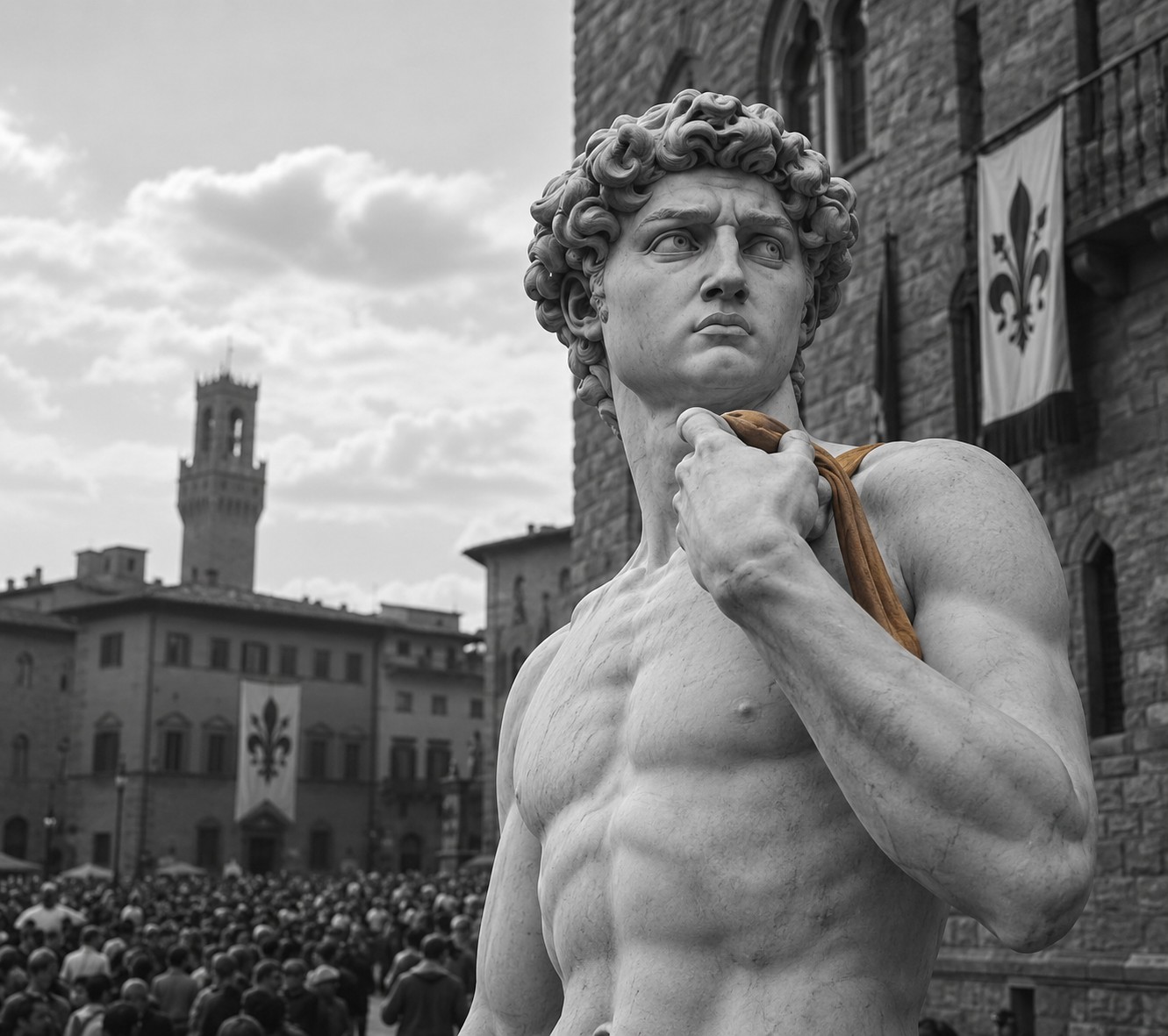
On this day in 1504, Michelangelo’s David was unveiled outside Florence’s town hall in the Piazza della Signoria, revealing a monumental sculpture that would become one of the defining works of the Renaissance and one of the most recognisable statues in the world.
A giant emerges in Florence
Carved from a single block of Carrara marble, David stands more than five metres tall and depicts the biblical hero moments before his confrontation with Goliath. Unlike earlier interpretations, Michelangelo chose not to show David after his victory. Instead, the young man is alert and tense, his sling resting almost unnoticed over his shoulder as he prepares for the fight.
Michelangelo was only in his twenties when he began the work in 1501. The block of marble had already been worked on and abandoned by previous sculptors, leaving him with the difficult task of creating a monumental figure from material others had considered problematic.

More than a biblical hero
The finished sculpture quickly acquired a political meaning in Florence. The city saw itself as a small but determined republic surrounded by more powerful rivals, making David — the young man who defeated the giant Goliath — a potent symbol of independence, courage and resistance.
Rather than placing the statue high on Florence Cathedral as originally intended, officials decided that Michelangelo’s achievement deserved a more prominent location. It was installed beside the entrance to the Palazzo della Signoria, today known as the Palazzo Vecchio.
The location placed David at the centre of Florentine political life, where its message could hardly be missed.
A Renaissance masterpiece
Michelangelo’s treatment of the human body demonstrated his extraordinary understanding of anatomy. The enlarged hands, intense gaze and carefully balanced posture contribute to a sense of controlled strength rather than simple physical perfection.
The statue remained outside for more than three centuries, exposed to weather, political unrest and occasional damage. In 1873, it was moved to Florence’s Galleria dell’Accademia to protect it. A marble replica was later placed in its former position in the Piazza della Signoria.
More than five centuries after its unveiling, David remains both an artistic masterpiece and an enduring symbol of Florence — a work created from an abandoned block of marble that came to embody the ambition of the Renaissance.
Newshub Editorial in Europe – 8 September 2026

Ask NF GPT
If you have an account with ChatGPT you get deeper explanations,
background and context related to what you are reading.
Recent Comments