
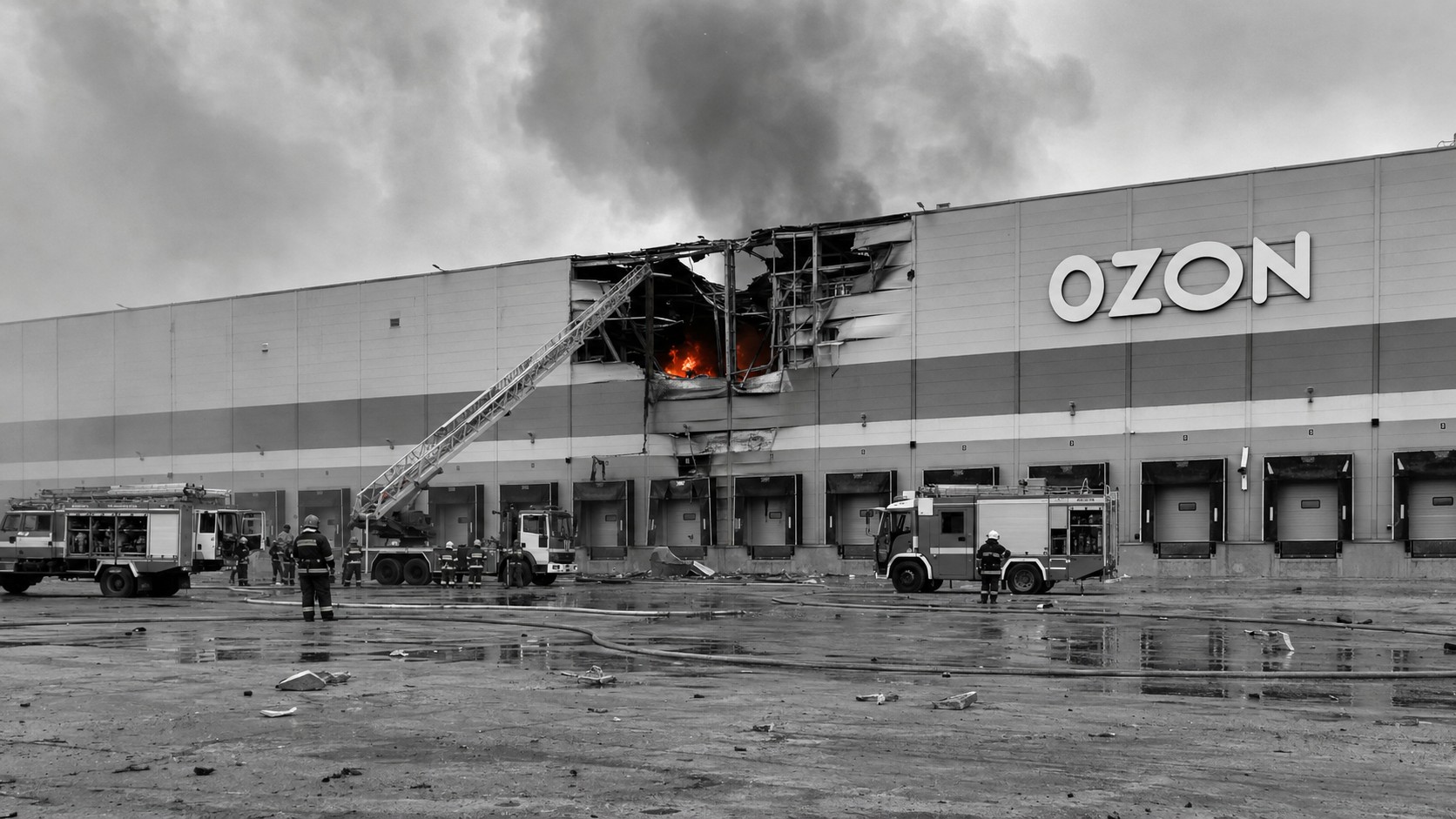
Shares in Ozon fell by almost 30% on the Moscow Exchange on Monday after Ukraine targeted four more logistics hubs belonging to Russia’s second-largest online retailer. The latest attacks brought the number of Ozon facilities targeted within three days to six, extending Kyiv’s campaign against commercial infrastructure that it says supports Russia’s war economy.
Six facilities targeted in three days
Ozon said a logistics centre in Makhachkala, Dagestan, caught fire and suspended operations following a drone strike. Several people were reported injured.
A second fire broke out at a hub in Enem, near Krasnodar. Workers were also evacuated from facilities in Adygeysk and Nevinnomyssk, although Ozon said those two buildings were not damaged.


The attacks followed strikes against logistics centres in the Samara and Orenburg regions during the weekend. Operations at the Samara facility were halted after the first confirmed attack on Ozon, while more than 300 people were evacuated from the company’s Orenburg hub.
Market reaction exposes the financial cost
Ozon’s shares fell by almost one-third during Monday’s trading, while shares in its largest shareholder, investment group AFK Sistema, declined by more than 13%.
The fall was particularly significant because Ozon had been one of the strongest-performing Russian shares since the market disruption that followed the invasion of Ukraine in 2022. Its stock had gained nearly 300% before the latest attacks.
Unlike privately owned Wildberries, which has the support of state-controlled bank VTB, Ozon’s largest shareholder carries substantial debt and may have limited capacity to finance major reconstruction or operational disruption.
Wildberries attacks set the pattern
Ukraine had previously concentrated its campaign on Wildberries, Russia’s largest online retailer. At least two dozen of its warehouses have reportedly been attacked since July, damaging a substantial part of the company’s storage network and forcing it to redistribute goods between remaining facilities.
Kyiv argues that the logistics centres form part of the infrastructure supporting Russia’s military operations, including the movement of equipment and drone components. The Kremlin and Wildberries have denied that the company handles military supplies, while accusing Ukraine of targeting civilian workers and consumer services.
The competing claims cannot be independently verified in every case.
Russia prepares state intervention
The attacks have prompted an increasingly direct response from Moscow. President Vladimir Putin has authorised the Russian state to assume temporary control of infrastructure considered inadequately protected against drone attacks.
The decree covers logistics, transport, energy, communications and industrial facilities deemed important to economic stability and national security. Russian officials insist that the measure does not represent nationalisation.
The government has also proposed tax relief for affected businesses, while Russia’s central bank has urged lenders to support companies suffering losses from warehouse attacks.
A new front in the economic war
E-commerce has been one of the fastest-growing sectors of an otherwise weak Russian economy. Disrupting its warehouses affects not only large retailers but also thousands of independent sellers, delivery companies and consumers.
The collapse in Ozon’s share price provides an unusually visible measure of the economic damage. Ukraine’s drone campaign is no longer focused solely on refineries, weapons plants and military installations. Russia’s commercial distribution networks have now become part of the expanding battlefield.
Newshub Editorial in Europe – 25 August 2026

Ask NF GPT
If you have an account with ChatGPT you get deeper explanations,
background and context related to what you are reading.
Shares in Ozon fell by almost 30% on the Moscow Exchange on Monday after Ukraine targeted four more logistics hubs belonging to Russia’s second-largest online retailer. The latest attacks brought the number of Ozon facilities targeted within three days to six, extending Kyiv’s campaign against commercial infrastructure that it says supports Russia’s war economy.
Recent Comments