
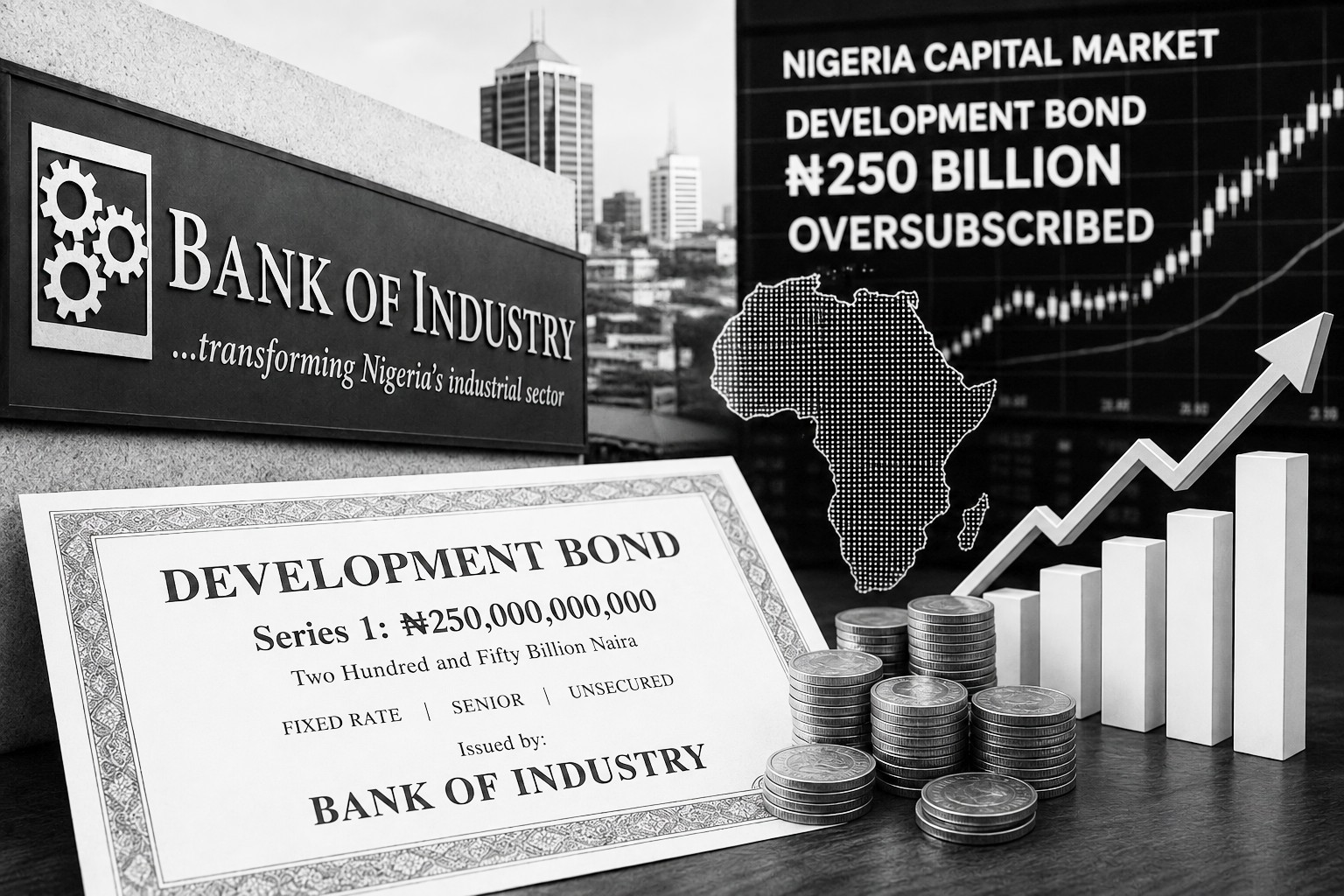
Nigeria’s Bank of Industry has recorded a significant capital-market success after its maiden ₦250 billion development bond attracted subscriptions above the amount offered within just five working days. The strong demand provides a fresh indication that Nigerian institutional investors remain willing to commit substantial capital to long-term domestic financing despite inflation, currency pressures and wider uncertainty across global financial markets.
Investors pile into ₦250 billion issue
The Bank of Industry, one of Nigeria’s principal development finance institutions, launched the Series 1 fixed-rate senior unsecured development bond as part of a broader programme designed to increase funding available to Nigerian businesses and industrial projects.
The ₦250 billion issue was oversubscribed within five working days, demonstrating substantial demand from institutional investors for the development bank’s debt.

The transaction is particularly significant because it represents BOI’s first development bond in Nigeria’s domestic capital market and establishes another potential channel through which long-term private capital can be directed towards productive investment.
Domestic capital becomes increasingly important
Nigeria, like many African economies, faces a continuing challenge in financing infrastructure, manufacturing and private-sector expansion while keeping government borrowing costs under control.
Development finance institutions can play an important intermediary role by raising capital from pension funds, asset managers, banks and other institutional investors before directing that funding towards businesses and projects that may struggle to obtain sufficiently long-term commercial financing.
The response to BOI’s bond suggests that substantial pools of Nigerian capital are available when investors are offered instruments with an acceptable combination of yield, credit quality and structure.
A wider shift in African finance
The transaction also fits into a broader movement across Africa towards mobilising domestic capital rather than depending overwhelmingly on foreign borrowing and development assistance.
African financial institutions have increasingly examined bonds, guarantees and other capital-market structures capable of bringing pension and insurance assets into infrastructure and development projects.
The potential pool is considerable. African financial institutions estimate that trillions of dollars are held across the continent in pension funds, insurance companies, sovereign wealth funds and other domestic investment vehicles.
Unlocking even a relatively small proportion of those assets could significantly expand the amount of capital available for infrastructure and industrial development.
Nigeria seeks deeper capital markets
For Nigeria, developing a larger domestic bond market could provide benefits beyond individual transactions.
A deeper market can broaden funding options for financial institutions and companies, reduce dependence on foreign-currency borrowing and create additional long-term investment instruments for pension funds and institutional investors.
That diversification has become increasingly important as African borrowers contend with volatile global interest rates, currency risks and changes in international development financing.
Nigeria has also been implementing economic reforms intended to attract domestic and international capital, although inflation, exchange-rate volatility and high borrowing costs remain significant challenges.
Strong demand sends positive signal
The oversubscription does not eliminate those broader economic risks, but it provides evidence that investors are prepared to commit significant capital when the structure and underlying institution are considered sufficiently attractive.
For the Bank of Industry, the successful debut could provide a foundation for additional capital-market issuance and potentially expand its capacity to finance Nigerian companies.
More broadly, the transaction demonstrates the growing potential of Africa’s domestic financial markets to fund economic development from within the continent.
If that momentum can be sustained, development bonds and similar instruments could become an increasingly important part of how Africa finances its next phase of industrial and infrastructure growth.
Newshub Editorial in Africa – 17 August 2026

Ask NF GPT
If you have an account with ChatGPT you get deeper explanations,
background and context related to what you are reading.
Open article chatOpen an account
Recent Comments