
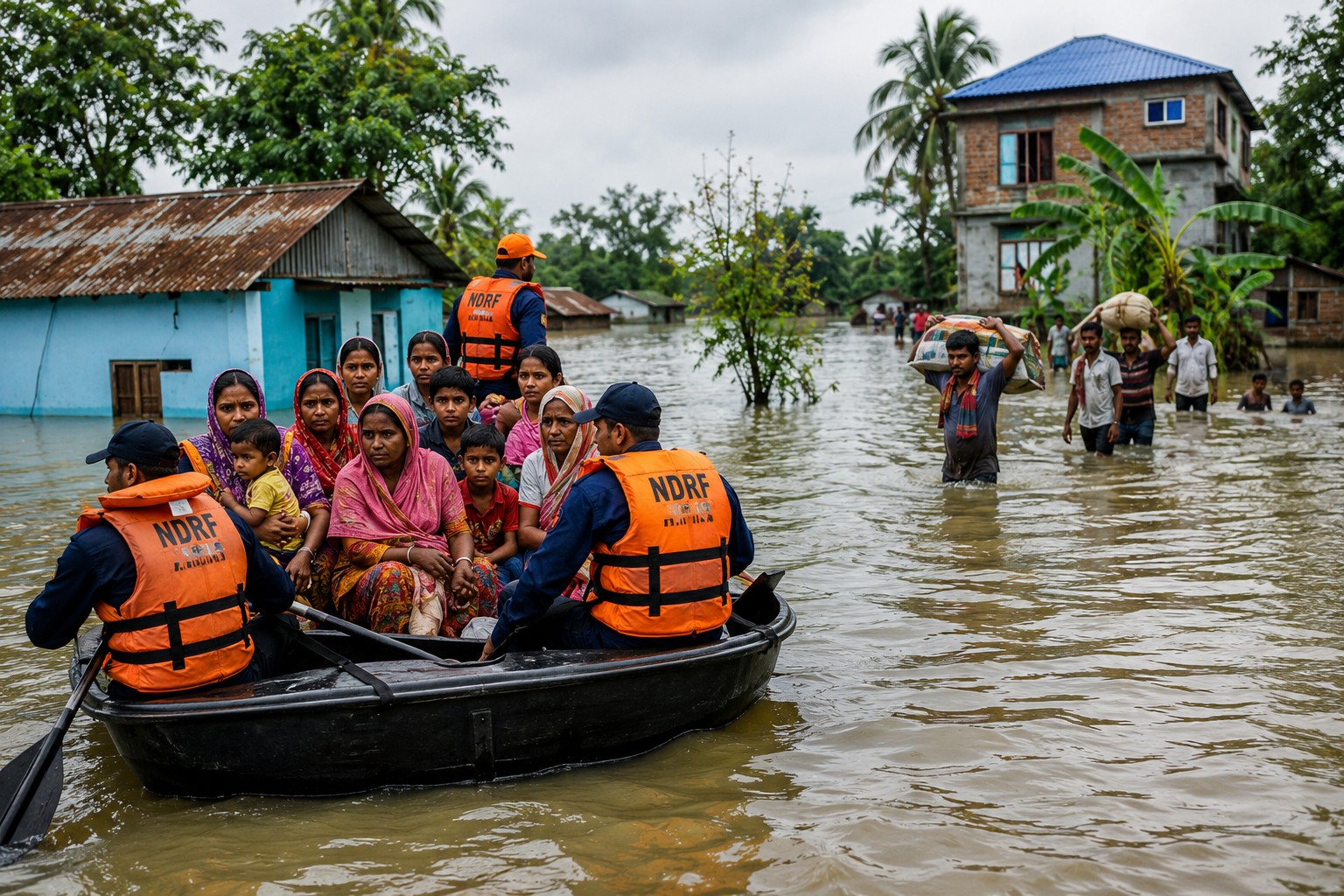
More than 100 people have died in catastrophic flooding across the north-eastern Indian state of Assam, where overflowing rivers have submerged thousands of communities and forced hundreds of thousands from their homes. Residents have described terrifying nights watching the water rise around them, while the disaster has renewed concerns that increasingly erratic monsoon rainfall, combined with environmental degradation, is making one of India’s most flood-prone regions even more vulnerable.
Death toll reaches 104
The official death toll from Assam’s floods had risen to 104 by Friday, according to the Assam State Disaster Management Authority, with more than 78,000 people still affected across seven districts. More than 5,000 remained in relief camps as authorities continued recovery and assistance operations.
The scale of the disaster has been far greater over the course of the monsoon. At its height, flooding displaced more than 700,000 people, with nearly 300,000 taking refuge in government-operated relief camps.


More than 2,600 villages across Assam have been flooded this year, illustrating the extraordinary geographical reach of the disaster.
The Brahmaputra overwhelms communities
At the centre of the crisis is the Brahmaputra, one of Asia’s largest rivers. Originating on the Tibetan plateau, it travels roughly 900 kilometres through Assam before continuing towards Bangladesh.
Heavy monsoon rainfall pushed the river and its tributaries above danger levels, inundating villages, farmland and roads. Homes have been destroyed or filled with mud and silt, livestock lost and agricultural land submerged.
For many rural families, the consequences are therefore economic as well as humanitarian. Agriculture remains fundamental to livelihoods across Assam, meaning the loss of cattle, crops and productive land can eliminate years of accumulated household wealth.
Climate and environmental pressures intensify risk
Flooding is a natural part of Assam’s ecosystem, but scientists have increasingly warned that human-driven climate change is making South Asia’s monsoon more unpredictable. Instead of rainfall arriving in relatively established patterns, extreme volumes can fall within shorter periods, increasing the probability of destructive flooding.
Environmental pressures inside Assam are also under scrutiny. Uncontrolled deforestation and mining have been identified among factors worsening the impact of flooding by damaging landscapes that would otherwise help regulate water and reduce erosion.
The combination presents a difficult long-term challenge: Assam cannot prevent the Brahmaputra from flooding, but decisions concerning forests, development, drainage, housing and infrastructure can determine how destructive those floods become.
Reconstruction bill continues to rise
The economic cost is already substantial. Assam Chief Minister Himanta Biswa Sarma has estimated that more than ₹1,000 crore could be required for infrastructure repairs and rehabilitation following the latest floods.
That expenditure comes alongside the private losses suffered by families whose houses, animals, crops and possessions have disappeared beneath the water.
As flood levels recede, attention is therefore moving from emergency rescue towards reconstruction. Roads must be repaired, homes rebuilt and agricultural communities restored.
Yet the deeper challenge remains unresolved. Assam has endured devastating floods for generations, but a changing climate and increasing environmental pressure threaten to make future disasters harder to predict and more expensive to survive.
For thousands of families now returning to damaged villages, the immediate task is simply rebuilding what the water left behind.
Newshub Editorial in Asia – 15 August 2026

Ask NF GPT
If you have an account with ChatGPT you get deeper explanations,
background and context related to what you are reading.
Open article chatOpen an account
More than 100 people have died in catastrophic flooding across the north-eastern Indian state of Assam, where overflowing rivers have submerged thousands of communities and forced hundreds of thousands from their homes. Residents have described terrifying nights watching the water rise around them, while the disaster has renewed concerns that increasingly erratic monsoon rainfall, combined with environmental degradation, is making one of India’s most flood-prone regions even more vulnerable.
Recent Comments