
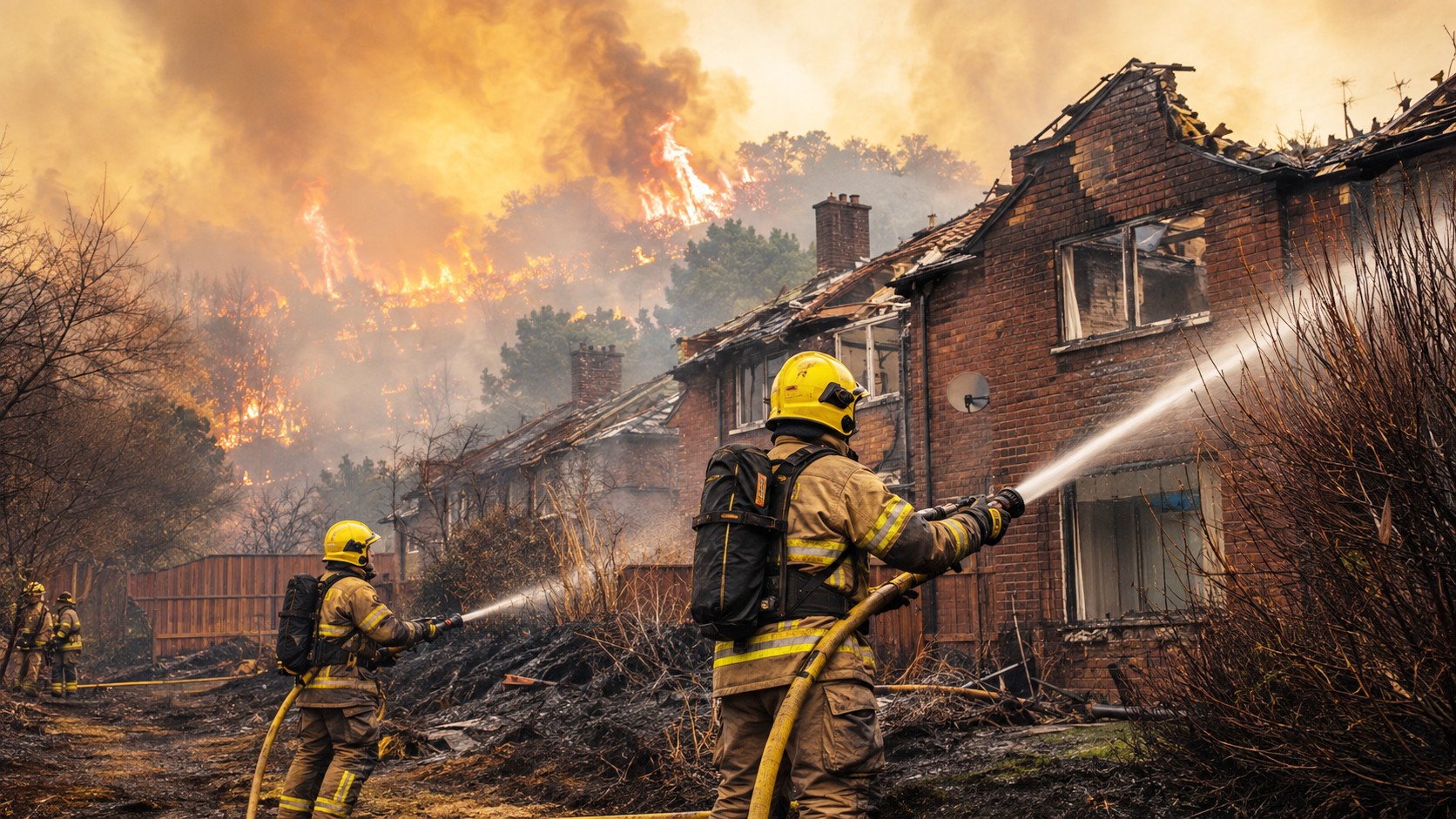
Firefighters in England are assessing extensive devastation after a major grass fire swept into residential areas of Stourbridge in the West Midlands, destroying and seriously damaging homes. The disaster came as approximately 150 million people across Europe were expected to experience temperatures of at least 35C on Friday.
Homes destroyed in Stourbridge
The fire began near Stourbridge Golf Club before spreading rapidly through dry grass and into nearby streets. Residents were forced to leave their homes as flames crossed roads and reached properties around Norton Road, Quarry Park Road and Brunswick Gate.
At least six homes were initially confirmed as damaged, although local reports indicated that the final number could reach into the tens. Several buildings partially collapsed, leaving charred walls and structurally unsafe remains.

A child and three firefighters were taken to hospital, while other people received treatment for smoke inhalation. Thousands of emergency calls were made as the fire intensified.
West Midlands Fire Service described the blaze as one of the most significant incidents it had ever faced. Fourteen fire engines remained at the scene on Friday morning, with crews damping down hotspots and monitoring areas at risk of reigniting.
Record heat created dangerous conditions
The blaze followed the hottest day of 2026 in Britain. A provisional temperature of 38.1C was recorded at Kew Gardens in London on Thursday, exceeding the previous annual high of 38C recorded in June.
The fire occurred during Britain’s fifth heatwave of the summer. Nearly three-quarters of England and all of Wales are experiencing drought conditions after exceptionally low rainfall left grass, woodland and vegetation dangerously dry.
Temperatures were expected to ease slightly on Friday, but London could still reach 34C. Stourbridge faced temperatures of around 29C and wind gusts exceeding 25mph, creating a continued risk of flare-ups.
Heat spreads across Europe
An analysis estimated that 150 million Europeans would experience temperatures of 35C or higher on Friday. Around 350 million people, representing approximately three out of every five European residents outside Turkey, were expected to face temperatures above 30C.
France continued to battle forest fires after temperatures reached as high as 41C. More than 500 people were evacuated from the Landes region in the south-west.
In western Germany, around 1,800 residents were ordered to leave their homes after a forest fire expanded from approximately 25 hectares to 300 hectares overnight. Helicopters and military equipment were deployed to support firefighting operations.
Croatia also faced a major emergency near the coastal town of Omiš, where around 1,000 people were evacuated. Thirty-six people were injured, 14 required hospital care and seven were reported to be in life-threatening condition.
Extreme summers place Europe under pressure
The combination of heat, drought and wildfire is placing increasing pressure on emergency services, healthcare systems, agriculture, transport networks and electricity production.
Scientists have established that greenhouse gases released by burning fossil fuels are raising global temperatures and making severe heatwaves and droughts more frequent and intense. Dry vegetation then allows fires to ignite more easily and spread with greater speed.
The destruction in Stourbridge demonstrates that wildfire is no longer primarily a southern European danger. Communities across northern and western Europe are increasingly being forced to prepare for conditions once associated with much hotter regions.
Newshub Editorial in Europe – 14 August 2026

Ask NF GPT
If you have an account with ChatGPT you get deeper explanations,
background and context related to what you are reading.
Recent Comments