
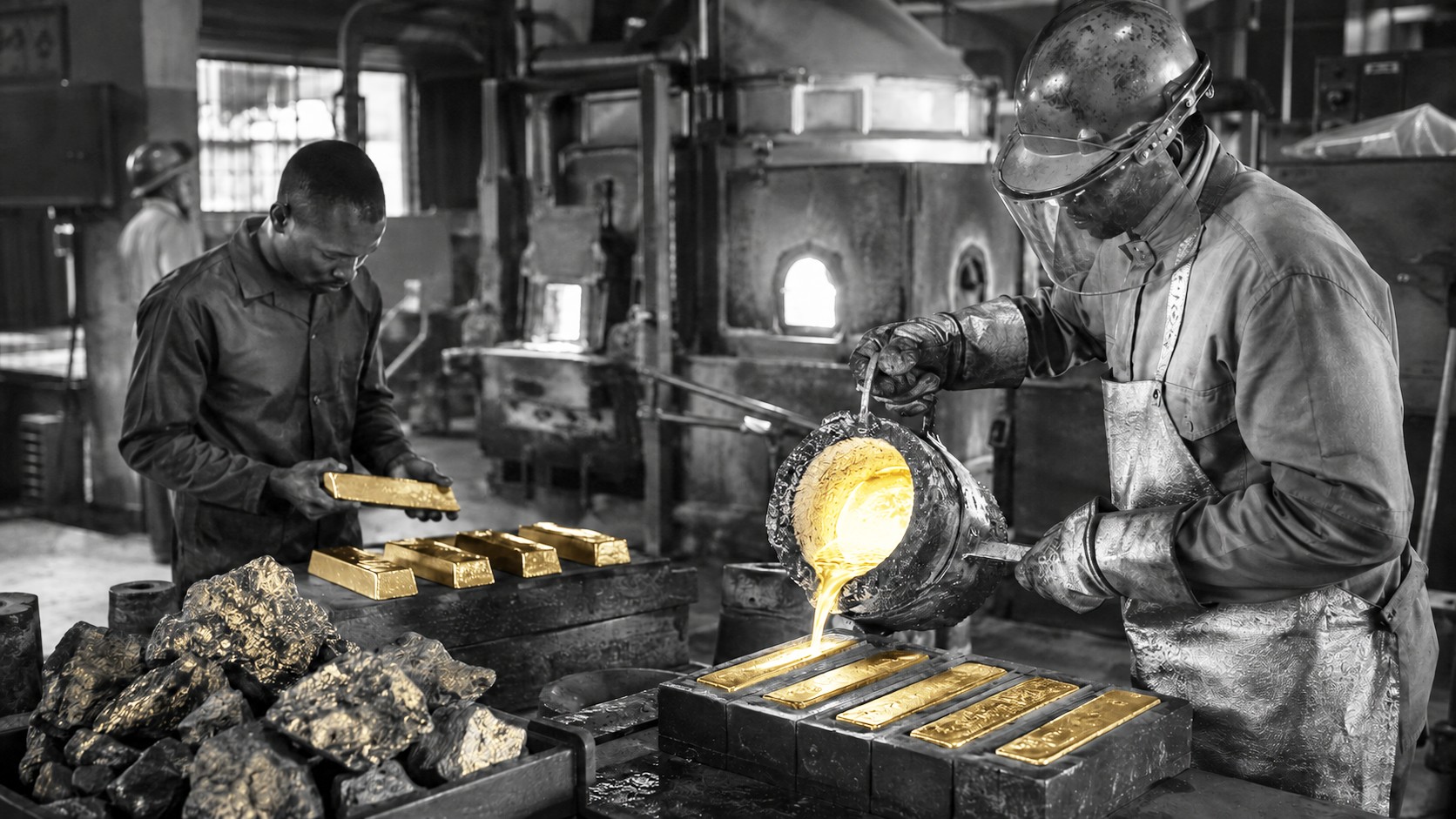
Guinea has banned exports of unrefined gold as part of an effort to retain more mineral wealth, create industrial employment and increase government revenue. The decision places the West African country among a growing number of African commodity producers demanding that minerals undergo domestic processing before they are sold internationally.
A break with the traditional export model
President Mamady Doumbouya announced the prohibition on 19 June, declaring that gold extracted in Guinea must now be refined, certified and converted into bullion inside the country before export.
Mining companies and gold traders that violate the directive risk having their operating licences suspended or withdrawn. The government has also warned that mining agreements could be terminated if companies continue exporting raw or insufficiently processed gold.

The measure is intended to end a longstanding system in which valuable minerals leave Guinea with little domestic processing. Although the country is a significant West African gold producer, much of the refining, certification and associated commercial activity has traditionally taken place overseas.
Conakry refinery central to the plan
The policy coincides with the development of a major gold refinery in Conakry. Its planned capacity is substantially higher than Guinea’s current official production, reflecting ambitions to process gold from neighbouring countries and establish Guinea as a regional refining centre.
The facility is expected to handle output from both industrial mines and the country’s extensive artisanal mining sector. Domestic refining could improve traceability, allow the authorities to obtain more accurate production figures and reduce the under-declaration of gold exports.
However, questions remain over how quickly the refinery can reach full commercial operation. Mining companies have also raised concerns about capacity, pricing, certification standards and the practical arrangements required to move gold from remote production areas to Conakry.
A wider mining strategy
Gold is only one part of Guinea’s attempt to extract greater value from its natural resources. The country possesses some of the world’s largest bauxite reserves and hosts the Simandou deposit, one of the largest sources of high-grade iron ore.
The government wants mining companies to invest in alumina refineries, iron-ore processing facilities and supporting infrastructure. Guinea is targeting the construction of several alumina plants by 2030, reducing its reliance on exports of raw bauxite.
Authorities have demonstrated that they are prepared to act against companies accused of failing to meet processing commitments. The state previously took control of Guinea Alumina Corporation after alleging that the company had not fulfilled its obligation to construct an alumina refinery, although the dispute has continued through negotiations and legal proceedings.
Africa pushes for greater value addition
Guinea’s approach reflects a wider shift across Africa. Ghana plans to restrict exports of unprocessed gold, while Mali and Burkina Faso are investing in domestic refining capacity. Tanzania and Uganda have also introduced restrictions on exports of unprocessed minerals.
The Democratic Republic of Congo has imposed controls on exports of copper and cobalt concentrates, seeking to encourage more processing within the country. These policies are intended to generate employment, strengthen tax collection and prevent African economies from remaining dependent on the export of low-value raw materials.
Execution will determine the outcome
Domestic refining offers Guinea an opportunity to capture more value from its gold, but an export ban alone cannot guarantee industrial development. Reliable electricity, transport infrastructure, internationally recognised certification and competitive refining charges will be essential.
If those conditions are not established quickly, the restriction could disrupt legitimate mining operations or encourage gold smuggling through neighbouring countries. Guinea’s challenge will be to enforce the new rules while maintaining investor confidence and ensuring that its refinery is commercially competitive.
Newshub Editorial in Africa – 11 August 2026

Ask NF GPT
If you have an account with ChatGPT you get deeper explanations,
background and context related to what you are reading.
Recent Comments