
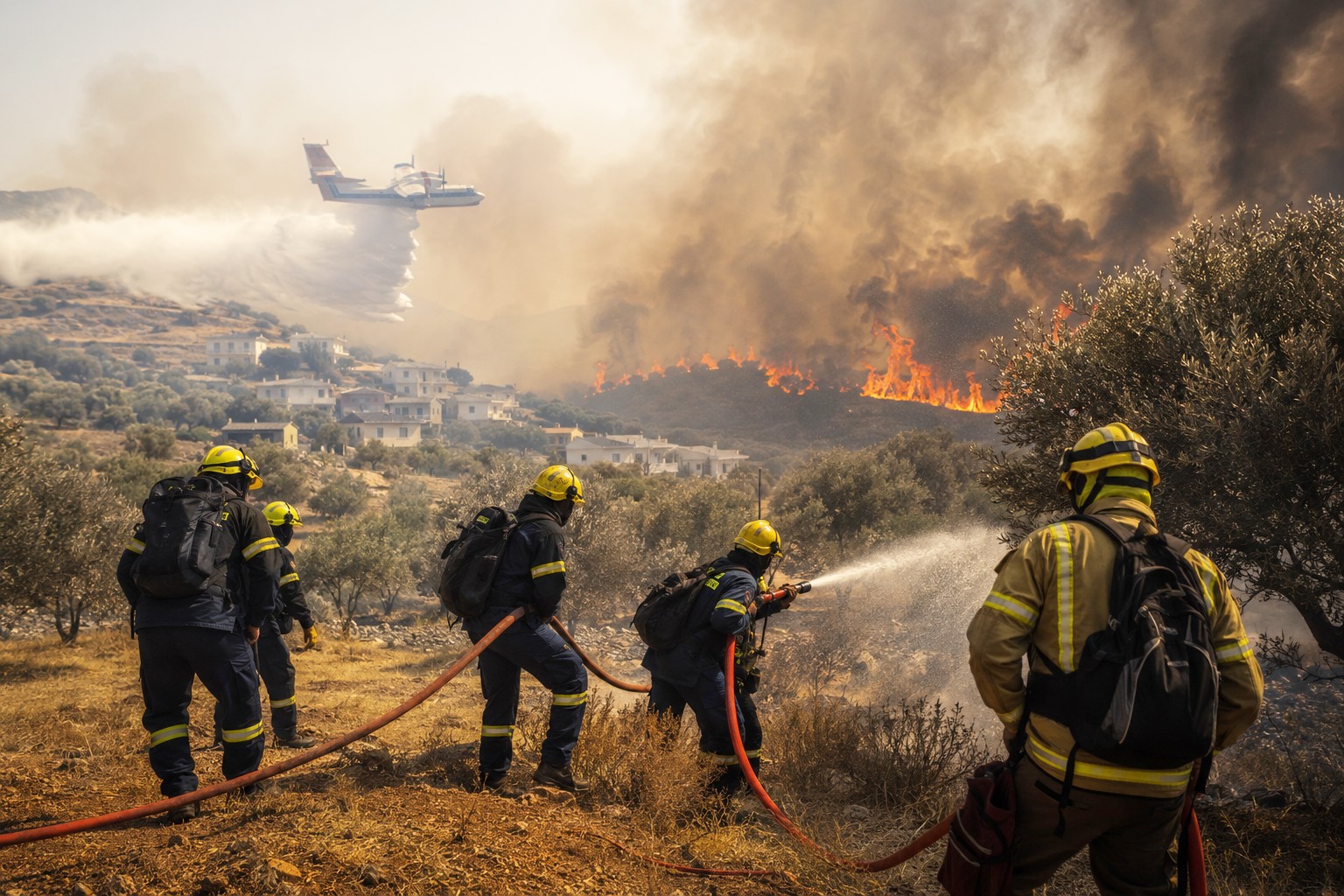
Three Greek firefighters have been killed while battling wildfires on Crete and the country’s mainland, as extreme temperatures, dry vegetation and powerful winds intensify a fire emergency spreading across Europe. The deaths came while emergency crews in Greece, France and Spain struggled to contain major blazes threatening villages, holiday resorts and vast areas of forest. Reuters
Firefighters trapped between flames on Crete
Two firefighters died near the village of Krya Vrysi in Crete’s Rethymno region after becoming trapped while driving between separate fire fronts. Strong winds caused the blaze to spread rapidly, reducing visibility and repeatedly changing the direction of the flames.
Residents and tourists were evacuated from Krya Vrysi and neighbouring communities as the fire moved south-east towards Agia Galini, a popular coastal town with hotels overlooking its harbour. Firefighting aircraft and helicopters supported crews on the ground, but severe winds made operations exceptionally dangerous.

A third firefighter died while tackling a separate blaze in the Peloponnese region of mainland Greece. The Greek fire service did not immediately release further details about the circumstances.
France fears renewed expansion of major fire
In south-western France, firefighters continued monitoring a vast blaze west of Bordeaux that has burned approximately 42,000 hectares of pine forest. Around 220,000 residents and holidaymakers were evacuated at the height of the emergency, although about 60,000 have since been permitted to return.
A temporary period of calmer weather allowed crews to stabilise several fire fronts. However, temperatures approaching 41C and strengthening dry winds increased the risk of renewed expansion and fresh outbreaks. Local authorities reported repeated flare-ups in areas where the fire had previously appeared contained.
Spanish communities remain under threat
Spanish firefighters made progress against the enormous fire affecting parts of Ávila and Madrid, allowing some evacuation and shelter orders to be lifted. Officials nevertheless warned that several days of difficult conditions lay ahead as temperatures reached 40C in parts of the country.
A new fire in Zamora forced the evacuation of six towns and left around 1,000 people sheltering in place. In the eastern province of Castellón, another blaze remained out of control after burning more than 10,000 hectares. Approximately 10,000 residents were still unable to return home.
Heat and wind create dangerous conditions
Experts warn that repeated heatwaves are drying forests, grasslands and scrub until they can ignite and spread with exceptional speed. Strong winds then carry burning material across roads and firebreaks, creating new fire fronts faster than crews can contain them.
Europe is the world’s fastest-warming continent, and scientists say human-driven climate change is increasing the frequency and severity of the heat and drought conditions that support wildfires. EU officials have warned that the European fire season could continue into November.
Europe strengthens joint response
The European Union has coordinated aircraft, helicopters, vehicles and firefighting teams from several countries to support France and Spain. Further resources are being prepared as Greece and Italy face an increasing fire risk during the coming weeks.
Wildfire specialists say emergency deployments remain essential but cannot replace long-term prevention. Better forest management, controlled grazing, restored wetlands, improved fire data and stronger public evacuation planning are being proposed as Europe prepares for longer and more destructive fire seasons.
Newshub Editorial in Europe – 30 July 2026

Ask NF GPT
If you have an account with ChatGPT you get deeper explanations,
background and context related to what you are reading.
Recent Comments