
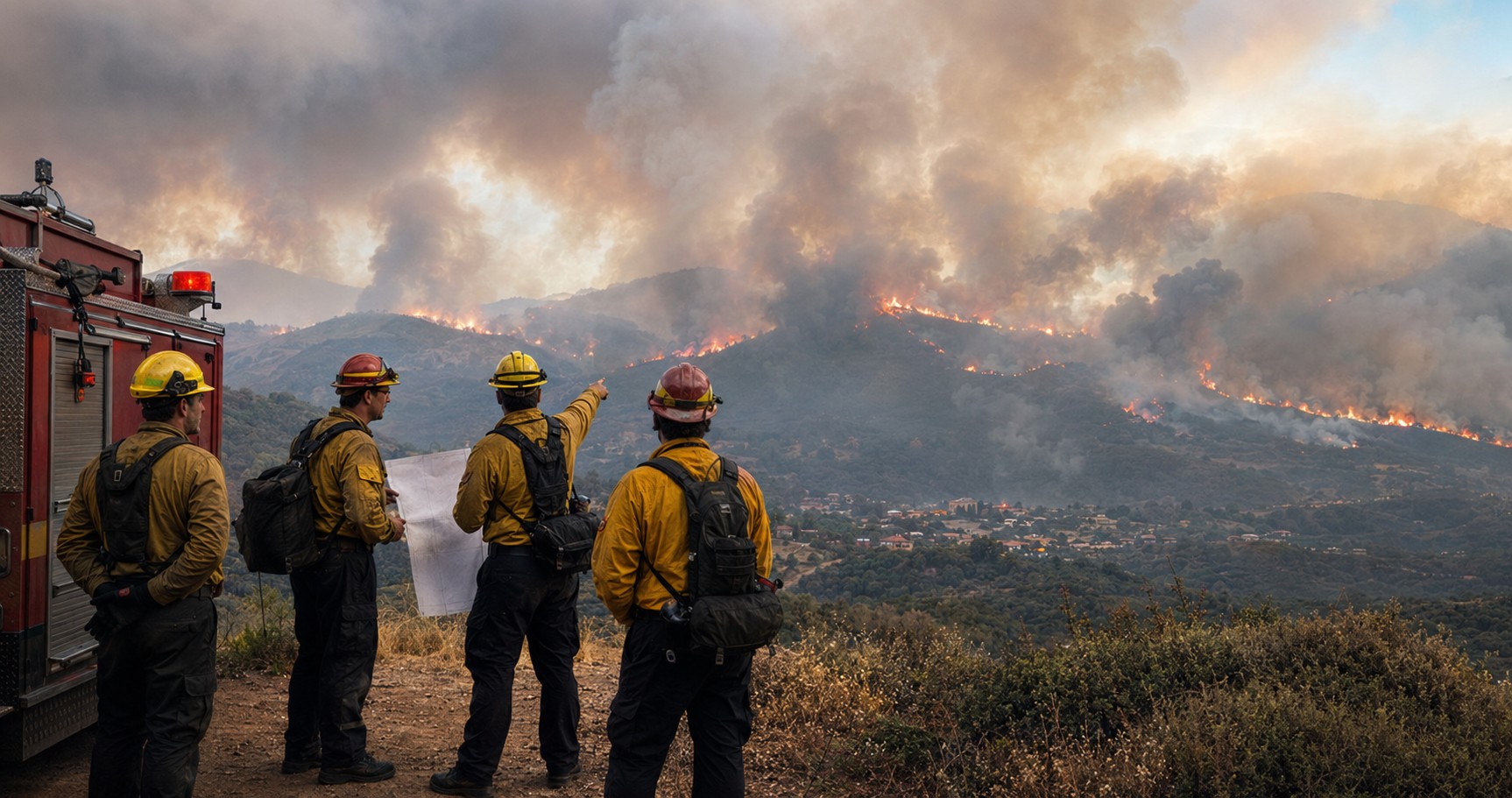
Firefighters confronting increasingly intense wildfires are being forced to make impossible decisions about which blazes to fight, which communities to defend and where limited aircraft, vehicles and crews can have the greatest effect. As climate change extends fire seasons and pushes extreme fires into previously unaffected regions, emergency services warn that conventional firefighting resources can no longer meet every threat.
Firefighting becomes emergency triage
Senior commanders increasingly compare large wildfire emergencies to hospital triage. When several fires develop simultaneously, incident controllers must decide where intervention is most likely to save lives and property.
Crews may be withdrawn from fires considered impossible to control and redirected towards populated areas, hospitals, transport routes or critical infrastructure. Aircraft cannot operate everywhere, while exhausted personnel, water shortages and rapidly changing winds limit the available choices.


César Alcaraz, a commander with the Alicante fire service in Spain, has described the situation as similar to treating patients after a major disaster: decisions must be made quickly, even when every affected community urgently needs assistance.
The strategy is not an admission that individual fires do not matter. It reflects the reality that extreme blazes can move faster, burn hotter and create their own weather systems, making direct suppression too dangerous.
Climate change expands the danger
Wildfires have always formed part of many natural ecosystems, but hotter temperatures and prolonged drought are drying vegetation more rapidly. Fire seasons are beginning earlier, lasting longer and increasingly overlapping between countries that once shared aircraft and personnel.
Europe has experienced exceptional fire activity during 2026. France and Spain have recorded extensive damage, while major fires have also appeared in Britain, traditionally considered less exposed to destructive wildfires.
Fires near Fontainebleau required the first deployment of water-bombing aircraft in the Greater Paris region. Spain has suffered deadly blazes and extensive evacuations, while Britain has faced simultaneous grass and moorland fires during repeated heatwaves.
In North America, the United States has raised national wildfire preparedness to its highest level as thousands of firefighters and aircraft remain committed. Smoke from Canadian fires has meanwhile affected air quality across major cities and exposed more than 100 million people to potentially hazardous pollution.
Resources cannot match every emergency
Fire agencies can request assistance from neighbouring regions or other countries, but that model becomes less reliable when many jurisdictions are burning simultaneously. Water-bombing aircraft, helicopters, specialist crews and incident commanders are all finite resources.
Several fire services have also struggled with staff shortages and ageing equipment. Longer deployments increase physical exhaustion, psychological pressure and the risk of injury among firefighters already working in extreme heat.
The growing danger means governments must invest beyond emergency response. Experts are calling for controlled burns, better forest management, vegetation clearance around communities and stronger building regulations in high-risk areas.
Indigenous fire-management practices, including carefully timed low-intensity burns, are increasingly recognised in Australia and Canada. European countries have adopted some similar measures, although implementation remains uneven.
Prevention becomes the central defence
No firefighting service can extinguish every extreme blaze once it reaches maximum intensity. Protecting communities therefore requires reducing combustible material before fires begin and designing towns that can withstand heat, smoke and advancing flames.
Without stronger prevention and faster reductions in greenhouse gas emissions, commanders expect the choices facing frontline crews to become increasingly severe. The central question may no longer be how every fire can be stopped, but which lives, homes and essential services can still be protected when several disasters arrive at once.
Newshub Editorial in Global Environment – 19 July 2026

Ask NF GPT
If you have an account with ChatGPT you get deeper explanations,
background and context related to what you are reading.
Firefighters confronting increasingly intense wildfires are being forced to make impossible decisions about which blazes to fight, which communities to defend and where limited aircraft, vehicles and crews can have the greatest effect. As climate change extends fire seasons and pushes extreme fires into previously unaffected regions, emergency services warn that conventional firefighting resources can no longer meet every threat.
Recent Comments