
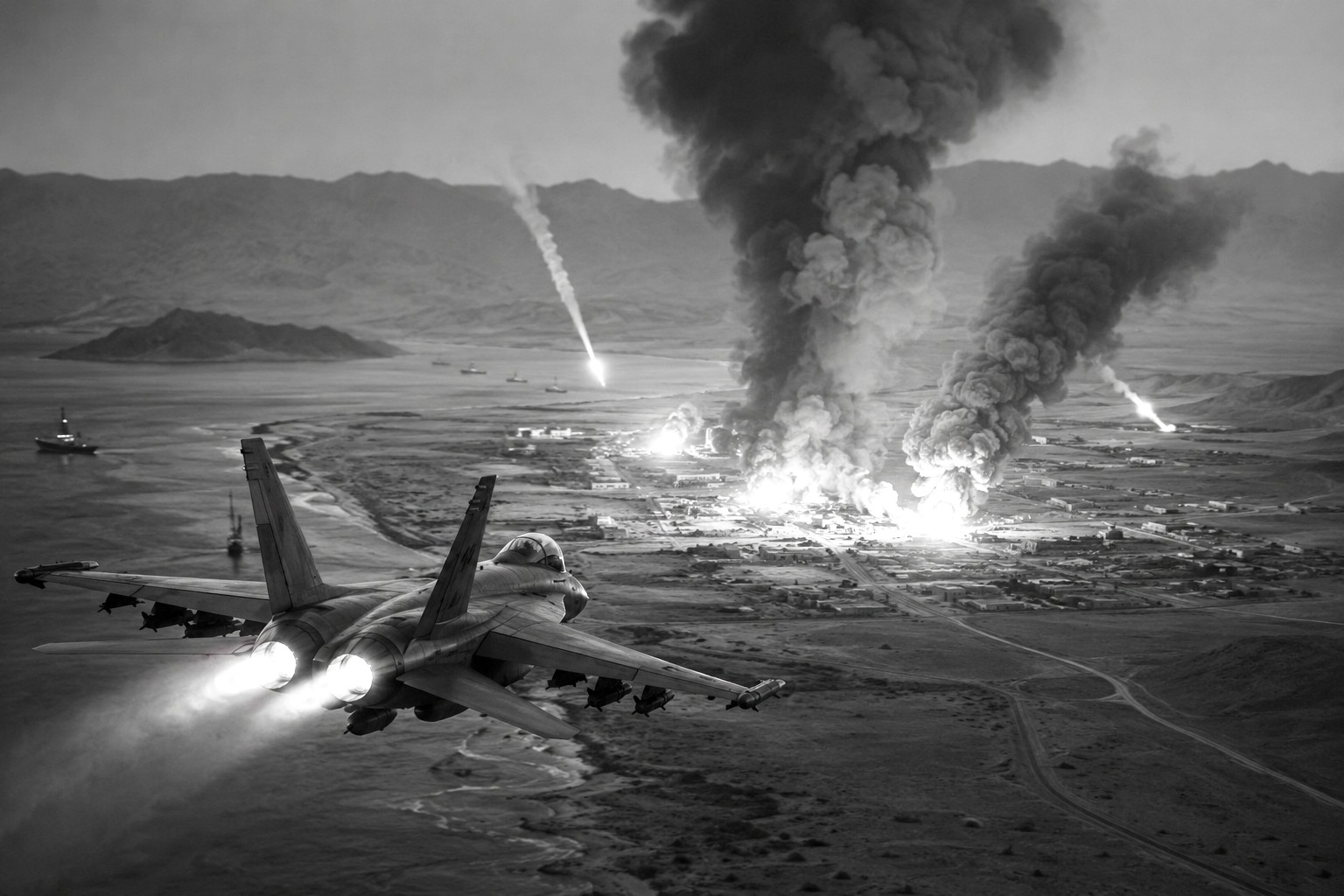
The United States and Iran have entered a dangerous new phase of military confrontation after US forces launched a series of strikes against Iranian military targets on Wednesday, prompting Tehran to retaliate with missile and drone attacks against American facilities in Bahrain and Kuwait. The exchanges mark the first confirmed direct US military action against Iran since last month’s brief conflict and raise fresh concerns about stability across the Gulf region.
US targets Iranian military infrastructure
According to US Central Command, American forces carried out coordinated strikes against a range of Iranian military assets. The targets included air defence systems, port facilities, coastal surveillance installations, ground-to-air missile batteries, as well as launch sites used for anti-ship cruise missiles and unmanned aerial vehicles.
US officials stated that the operation was a direct response to Iranian attacks the previous day on three commercial vessels transiting the Strait of Hormuz, one of the world’s most strategically important maritime shipping lanes.

In a statement, the US military described Iran’s actions as “unwarranted, dangerous, and a clear violation of the ceasefire”, arguing that the strikes were intended to protect international shipping and restore regional deterrence.
Sanctions pressure intensifies
Shortly before the military operation, Washington increased economic pressure on Tehran by revoking a temporary sanctions waiver covering Iranian oil exports.
The US Treasury cancelled a licence that had permitted Iran to produce, sell and deliver crude oil and related petroleum products until 21 August. Analysts said the decision could significantly weaken recent diplomatic understandings and further reduce prospects for renewed negotiations between the two countries.
Energy markets reacted immediately, with investors closely monitoring the potential impact on global oil supplies and shipping through the Gulf.
Iran launches retaliation
Iran responded within hours by launching what it described as a large-scale retaliatory operation targeting US military facilities across Bahrain and Kuwait.
The Islamic Revolutionary Guard Corps (IRGC) said its Navy and Aerospace Force conducted a coordinated missile and drone assault against 85 American military installations in the two Gulf states. Air raid sirens were reported in both Bahrain and Kuwait as defensive systems were activated.
Iran also claimed to have shot down an American MQ-9 Reaper surveillance drone during the operation. Independent verification of the full extent of the reported damage and casualties has not yet been made public.
Risk of wider regional conflict
The latest exchange represents a significant escalation after hopes that last month’s ceasefire had reduced the immediate risk of broader conflict. The Strait of Hormuz remains vital to global energy markets, with roughly one-fifth of the world’s traded oil passing through the narrow waterway.
Military analysts warn that continued attacks on shipping, regional bases or energy infrastructure could rapidly draw additional countries into the confrontation. Gulf states are already reinforcing security around key military installations and critical infrastructure while international naval forces continue to monitor commercial shipping.
Diplomatic efforts are expected to intensify in the coming days, but the latest military exchanges demonstrate how fragile the current ceasefire has become. Investors, governments and energy markets alike are now watching closely for signs of either renewed negotiations or a further expansion of hostilities that could have consequences far beyond the Middle East.
Newshub Editorial in Middle East – 8 July 2026

Ask NF GPT
a
If you have an account with ChatGPT you get deeper explanations,
background and context related to what you are reading.
Open an account:
Recent Comments