
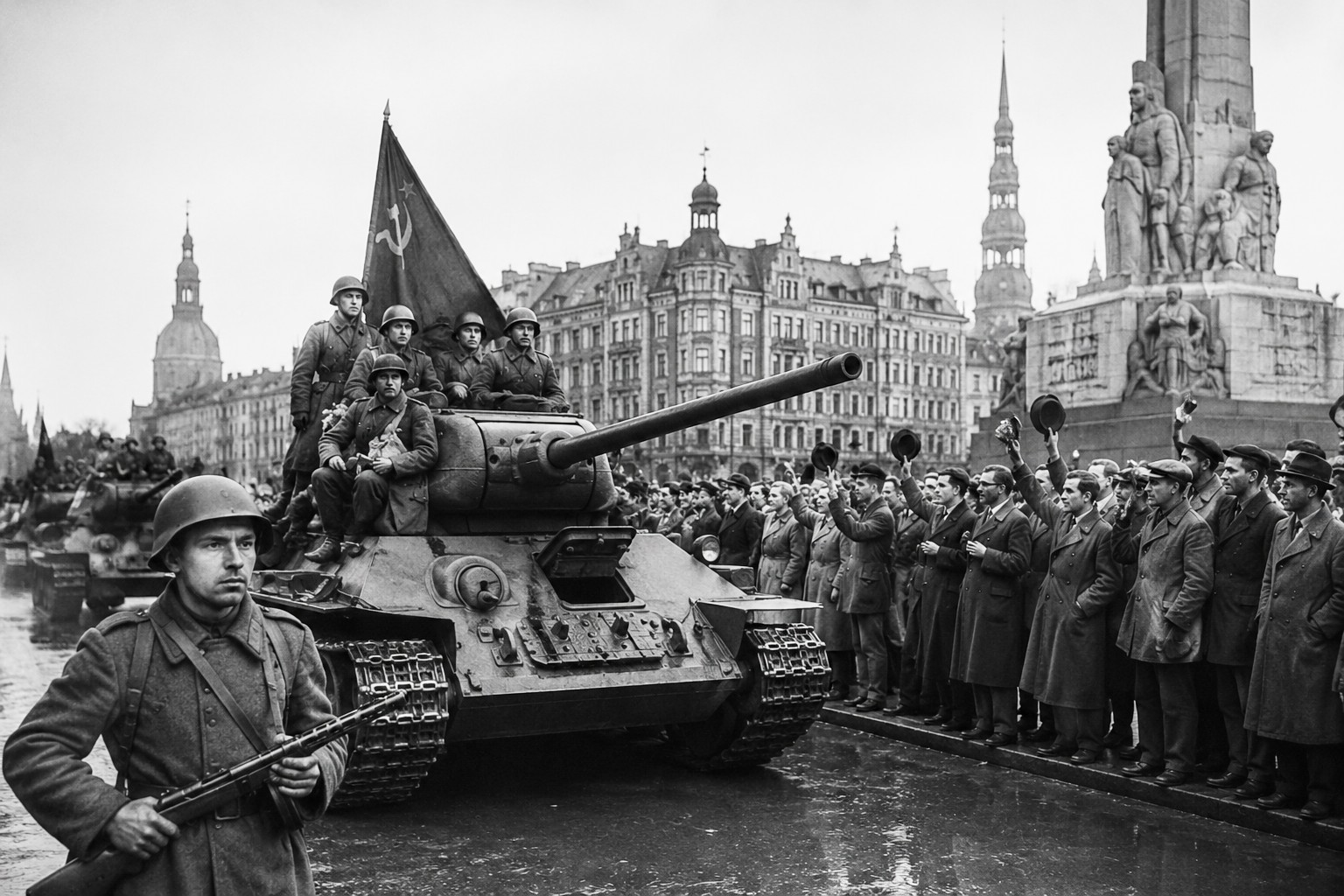
On 17 June 1940, the Soviet Red Army crossed into Latvia, marking the beginning of one of the darkest chapters in the nation’s modern history. Within weeks, Latvia’s democratic institutions had been dismantled, Soviet-backed authorities had assumed power, and the country was incorporated into the Union of Soviet Socialist Republics (U.S.S.R.). The occupation fundamentally reshaped Latvia’s political, economic and social landscape for more than five decades.
The road to occupation
The Soviet invasion was preceded by growing pressure from Moscow. In August 1939, Nazi Germany and the Soviet Union signed the Molotov-Ribbentrop Pact, a non-aggression treaty that secretly divided Eastern Europe into spheres of influence. Under its secret protocols, Latvia, together with Estonia and Lithuania, was assigned to the Soviet sphere.
In October 1939, Latvia was compelled to sign a “Mutual Assistance Pact” permitting Soviet military bases on Latvian territory. Although the country formally remained independent, the presence of thousands of Soviet troops significantly weakened its sovereignty.

By June 1940, as Western Europe was consumed by the Second World War, the Soviet Union issued an ultimatum accusing Latvia of violating the treaty. Facing overwhelming military force and lacking international support, the Latvian government accepted the demands rather than resist militarily.
A rapid political transformation
On 17 June 1940, Soviet troops entered Latvia without significant armed resistance.
A pro-Soviet government was installed under close supervision from Moscow, while political opponents were arrested and independent media was brought under state control. Elections held in July 1940 were tightly controlled, allowing only Soviet-approved candidates to stand.
Shortly afterwards, the newly elected parliament formally requested Latvia’s admission into the Soviet Union. On 5 August 1940, Moscow approved the request, and Latvia officially became the Latvian Soviet Socialist Republic.
Many historians and Western governments have consistently regarded these events as an illegal occupation rather than a voluntary accession.
Repression and deportations
The years that followed brought widespread political repression.
Thousands of Latvian politicians, military officers, civil servants, intellectuals and business leaders were arrested, imprisoned or executed. In June 1941, just one year after the occupation, more than 15,000 Latvians were deported to Siberia and other remote regions of the Soviet Union.
Additional deportations occurred after the Second World War as Soviet authorities sought to suppress resistance movements and consolidate communist rule.
Collectivisation of agriculture, nationalisation of private industry and restrictions on political freedoms transformed Latvian society. At the same time, large-scale migration from other parts of the Soviet Union altered the country’s demographic composition.
Restoring independence
Despite decades of Soviet rule, the desire for independence remained strong.
During the late 1980s, political reforms introduced under glasnost and perestroika created opportunities for peaceful resistance. One of the most powerful demonstrations occurred in August 1989, when approximately two million people joined hands across Estonia, Latvia and Lithuania in the Baltic Way, calling for freedom from Soviet rule.
Following the collapse of the Soviet Union, Latvia restored its independence on 21 August 1991. Since then, the country has rebuilt its democratic institutions and integrated with Western organisations, joining both the European Union and NATO in 2004.
Today, 17 June serves as a reminder of the fragility of national sovereignty and the enduring importance of democracy, self-determination and historical memory for the Latvian people.
Newshub Editorial in Europe – 17 June 2026

If you have an account with ChatGPT you get deeper explanations,
background and context related to what you are reading.
Open an account:
Open an account
Recent Comments