
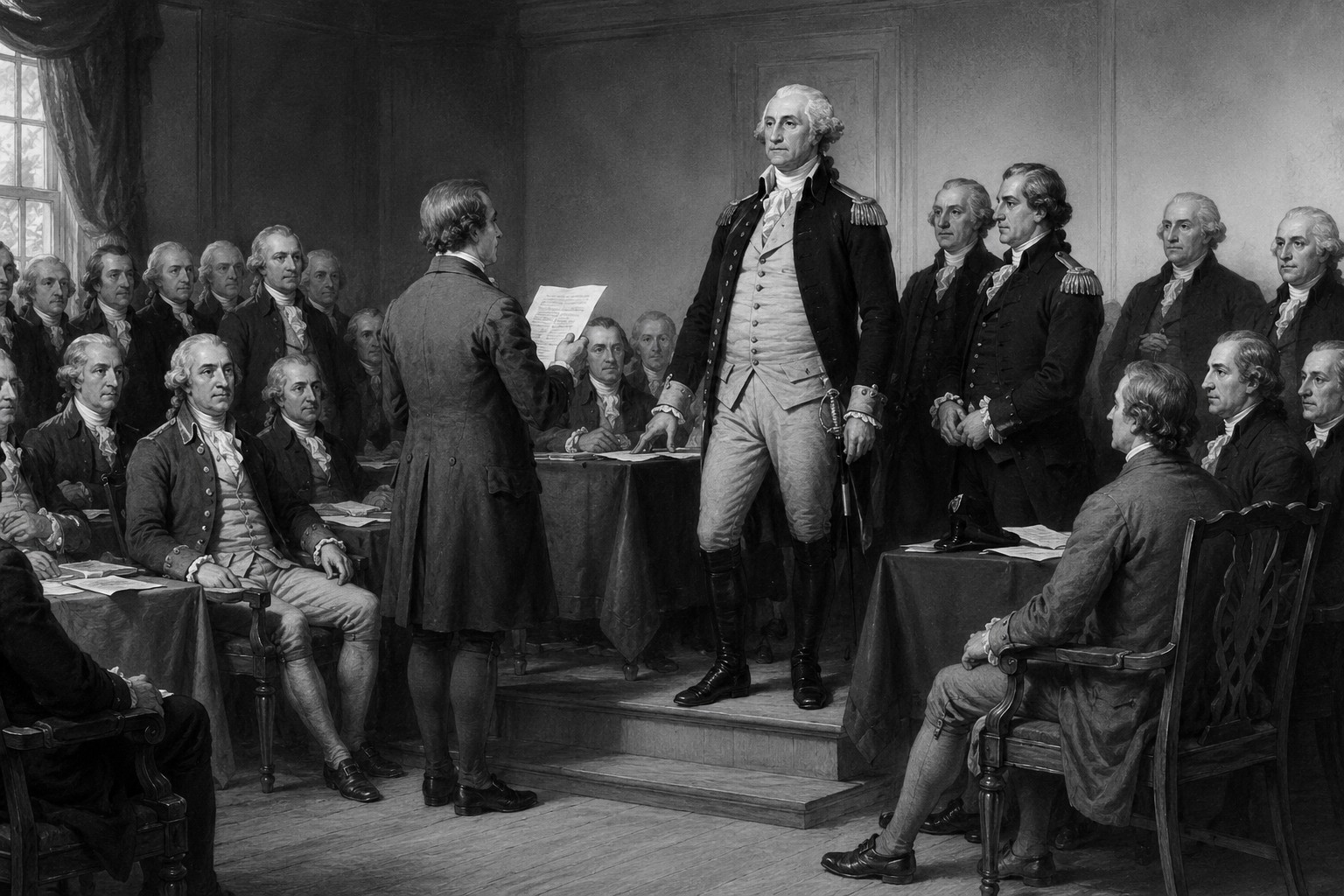
The appointment of George Washington as commander-in-chief of the Continental Army marked a defining moment in American history, transforming a collection of colonial militias into a unified military force. The decision, made by the Second Continental Congress on 15 June 1775, laid the foundation for the American Revolutionary War and ultimately the birth of the United States.
A nation at a crossroads
By the summer of 1775, tensions between Great Britain and its thirteen American colonies had escalated into open conflict. The Battles of Lexington and Concord in April had demonstrated that armed resistance was no longer a distant possibility but an unfolding reality. Colonial delegates gathering in Philadelphia recognised that victory against the British Army would require unified leadership rather than fragmented local militias.
George Washington, a respected Virginian planter and veteran of the French and Indian War, emerged as the natural choice. His military experience, reputation for discipline and leadership, and his status as a representative from the southern colonies helped unite delegates from across British America.

A unanimous and symbolic choice
The Continental Congress unanimously selected Washington to command the newly established Continental Army. The appointment carried strategic significance beyond his military credentials. Choosing a Virginian to lead forces that had initially formed in New England demonstrated that the colonies were committed to acting as one political and military entity.
Washington accepted the role with humility, reportedly expressing doubts about his own qualifications while pledging to devote himself fully to the cause. He also declined to accept a salary, requesting only reimbursement for his expenses throughout the campaign.
Forging an army from volunteers
When Washington arrived outside Boston to take command, he faced an enormous challenge. The Continental Army consisted largely of volunteer militias with varying levels of training, equipment and discipline. Supplies were scarce, funding was uncertain and the British Army remained one of the world’s most powerful military forces.
Washington immediately began organising the troops into a more disciplined fighting force. He introduced stricter command structures, improved logistics and emphasised military training, laying the groundwork for an army capable of sustaining a prolonged conflict.
Leadership through adversity
Over the following eight years, Washington endured numerous setbacks, including battlefield defeats, shortages of food and ammunition, and the harsh winter encampment at Valley Forge. Despite these challenges, his ability to preserve the Continental Army became one of his greatest achievements. Rather than seeking spectacular victories, Washington often focused on maintaining the army’s cohesion until opportunities arose.
The eventual surrender of British General Charles Cornwallis at Yorktown in 1781 effectively secured American independence and cemented Washington’s place in history.
A legacy beyond the battlefield
Washington’s appointment as commander-in-chief proved to be more than a military decision. It established him as the central figure of the American Revolution and later paved the way for his unanimous election as the first President of the United States in 1789.
More than two centuries later, his leadership remains closely associated with integrity, restraint and public service. The decision made by the Continental Congress in June 1775 not only shaped the outcome of a war but also influenced the principles upon which the United States would be founded.
Newshub Editorial in North America – June 15, 2026

If you have an account with ChatGPT you get deeper explanations,
background and context related to what you are reading.
Open an account:
Open an account
Recent Comments