
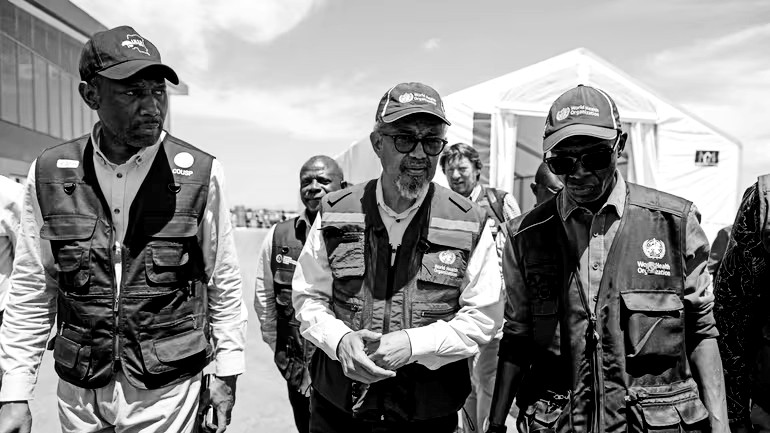
The head of the World Health Organization (WHO) has attended the opening of a new Ebola treatment centre in eastern Democratic Republic of Congo, underscoring international efforts to strengthen the region’s ability to detect, isolate and treat one of the world’s most dangerous infectious diseases. The visit comes as health authorities seek to bolster preparedness and improve access to care in areas vulnerable to future outbreaks.
The new facility has been established in a region that has experienced multiple Ebola outbreaks over the past decade. Eastern Congo remains one of the most challenging environments for disease control, with health authorities often operating in remote communities affected by insecurity, population displacement and limited healthcare infrastructure.
The WHO chief said the treatment centre represents an important step towards improving local healthcare capacity and ensuring that rapid response measures can be deployed whenever new cases emerge.

Building on lessons from previous outbreaks
The Democratic Republic of Congo has faced several Ebola outbreaks since the virus was first identified near the Ebola River in 1976. Some of the most severe outbreaks occurred in the country’s eastern provinces, where difficult terrain and armed conflict complicated efforts to contain transmission.
Lessons learned from previous emergencies have led to significant improvements in surveillance systems, laboratory capacity and vaccination programmes. The new treatment centre is designed to support these efforts by providing specialised facilities for patient care, isolation and infection prevention.
Health officials say early detection and rapid treatment remain critical in preventing isolated cases from developing into larger outbreaks.
International support remains essential
The WHO has worked closely with Congolese authorities, humanitarian organisations and international partners to strengthen outbreak preparedness. Investment in healthcare infrastructure is seen as a crucial component of preventing future health crises.
Experts note that Ebola outbreaks can place enormous pressure on already fragile healthcare systems, particularly in regions where access to medical services is limited. Dedicated treatment centres help ensure that patients receive specialised care while reducing the risk of transmission to healthcare workers and local communities.
The WHO chief emphasised the importance of maintaining long-term investment in public health systems rather than focusing solely on emergency responses once outbreaks occur.
A continuing global health challenge
Although advances in vaccines and treatments have significantly improved the ability to combat Ebola, the virus remains a serious threat in parts of Central and East Africa. Fatality rates can be high if patients do not receive timely medical care, making preparedness and community engagement essential components of disease control.
Public health officials also stress the importance of education and trust-building within affected communities, as misinformation and fear can hinder response efforts during outbreaks.
Strengthening resilience for the future
The opening of the new treatment centre reflects a broader strategy aimed at improving resilience against infectious diseases across the region. By expanding treatment capacity, training healthcare workers and improving surveillance networks, authorities hope to reduce the impact of future Ebola outbreaks and other emerging health threats.
As global health organisations continue to focus on preparedness, the new facility stands as a symbol of the ongoing commitment to protecting vulnerable communities and strengthening healthcare systems in one of Africa’s most challenging environments.
Newshub Editorial in Africa – 1 June 2026

If you have an account with ChatGPT you get deeper explanations,
background and context related to what you are reading.
Open an account:
Open an account
Recent Comments