
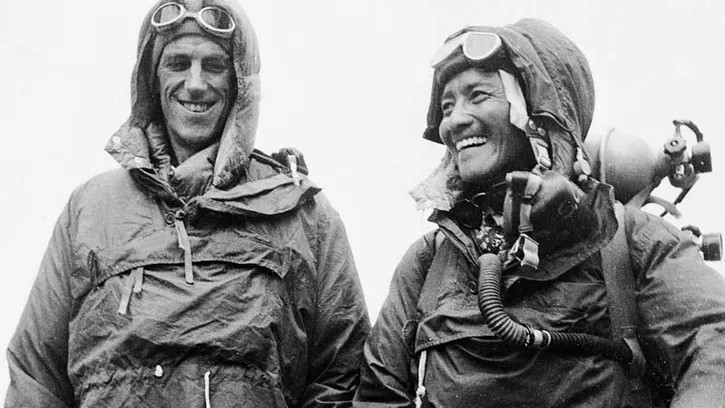
On 29 May 1953, two climbers achieved what had long been considered one of humanity’s greatest physical challenges. Edmund Hillary of New Zealand and Tenzing Norgay, a Sherpa mountaineer from Nepal, became the first confirmed people to reach the summit of Mount Everest, the world’s highest mountain. Their achievement marked a defining moment in exploration history and remains one of the most celebrated feats of endurance, teamwork and determination ever recorded.
The challenge of the world’s highest peak
Mount Everest rises 8,849 metres above sea level in the Himalayas, straddling the border between Nepal and China. For decades, explorers, geographers and mountaineers had dreamed of standing on its summit. Numerous expeditions attempted the climb during the early twentieth century, but extreme weather, thin air and dangerous terrain repeatedly prevented success.
Among the most famous earlier attempts was that of British mountaineer George Mallory, who disappeared with Andrew Irvine on Everest in 1924. Whether they reached the summit before their deaths remains one of mountaineering’s greatest mysteries.

A carefully planned expedition
The successful 1953 expedition was led by British Army officer John Hunt and involved a large team of climbers, Sherpas and support personnel. Months of preparation, logistics and acclimatisation were required before any summit attempt could be made.
After several teams established higher camps on the mountain, Hillary and Tenzing were selected for one of the final summit bids. Their route followed the mountain’s southeastern ridge, which remains one of the most commonly used approaches today.
The climbers faced brutal conditions, including freezing temperatures, strong winds and dangerously low oxygen levels. Despite these challenges, they continued their ascent towards the summit.
The final push to the top
On the morning of 29 May 1953, Hillary and Tenzing left their high camp for the final climb. One of the key obstacles was a steep rock face near the summit, later named the Hillary Step in honour of the New Zealander.
After overcoming the final barriers, the pair reached the summit at approximately 11:30 local time. They spent only a short period at the top, taking photographs, recording observations and leaving small items as symbols of their achievement before beginning the descent.
Their success was later announced to the world just days before the coronation of Queen Elizabeth II, adding to the celebratory atmosphere across Britain and the Commonwealth.
A partnership that inspired the world
One of the enduring aspects of the Everest story is the partnership between Hillary and Tenzing. Rather than focusing on individual glory, both men emphasised teamwork and mutual respect. Their achievement highlighted the vital role Sherpa climbers played in Himalayan expeditions, bringing international recognition to Nepal’s mountain communities.
Tenzing became a national hero throughout South Asia, while Hillary went on to devote much of his life to supporting Sherpa communities through schools, hospitals and infrastructure projects in Nepal.
A legacy that endures
More than seventy years later, the first successful ascent of Everest remains a symbol of human ambition and perseverance. Thousands of climbers have since reached the summit, aided by advances in equipment, weather forecasting and communications.
Yet the achievement of Edmund Hillary and Tenzing Norgay continues to stand apart. Their climb represented far more than reaching a geographical high point. It demonstrated what could be achieved through courage, preparation, cooperation and an unwavering determination to overcome seemingly impossible obstacles.
Newshub Editorial in Asia – 29 May 2026

If you have an account with ChatGPT you get deeper explanations,
background and context related to what you are reading.
Open an account:
Open an account
Recent Comments