
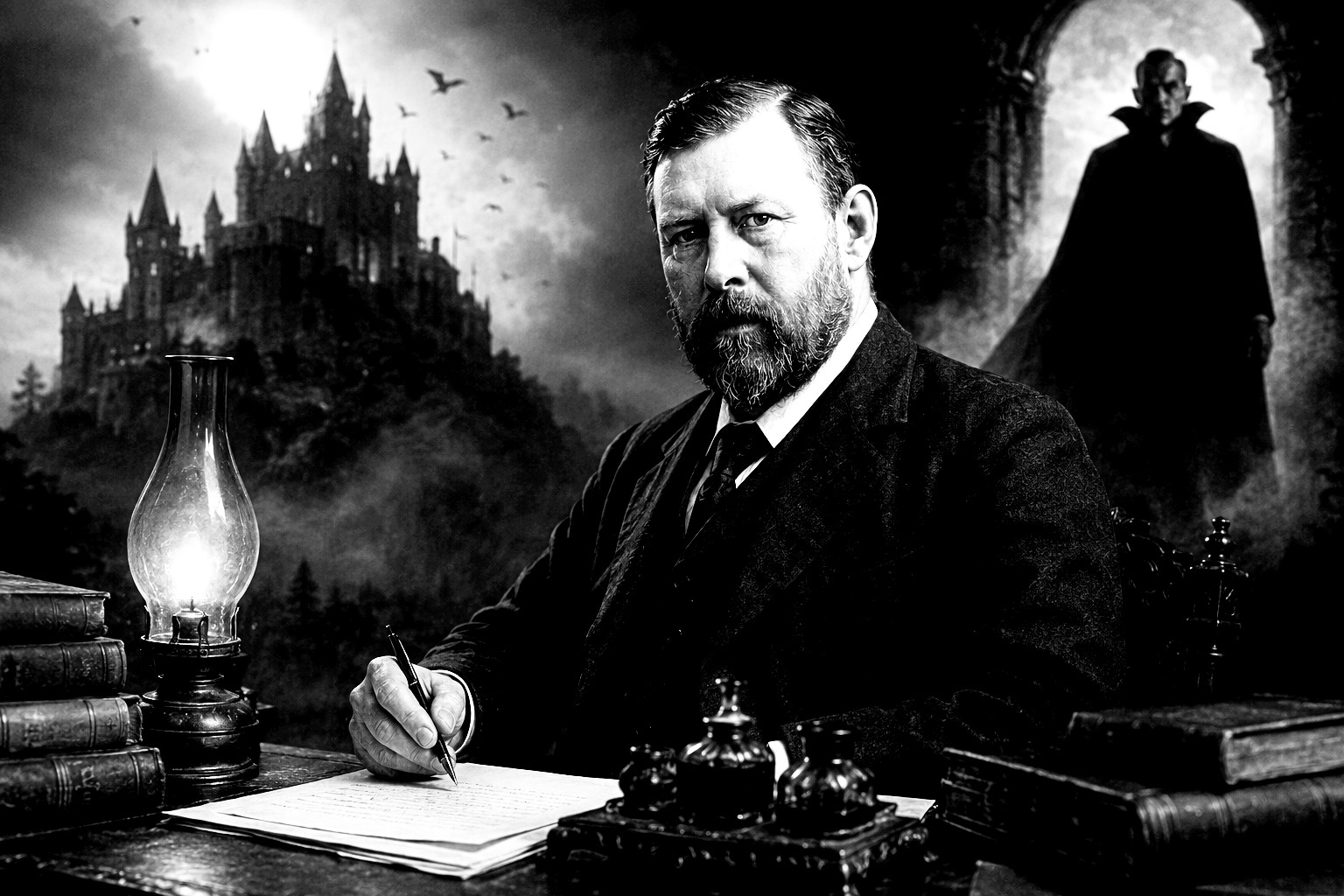
When Irish writer Bram Stoker published Dracula in 1897, he created far more than a vampire story. He gave modern culture one of its most durable figures: Count Dracula, the aristocratic predator from Transylvania whose shadow still stretches across literature, cinema, television and popular imagination.
A Victorian nightmare
The novel appeared at the end of the Victorian era, a period marked by rapid technological change, imperial anxiety, scientific confidence and deep social unease. Stoker used the Gothic tradition — castles, darkness, superstition and terror — but placed it against modern tools such as diaries, letters, telegrams and medical observation.
A story told through fragments
Dracula is written largely as an epistolary novel, using journals, letters and documents to build suspense. This structure made the horror feel immediate and credible, as if the reader were assembling evidence from a real case rather than simply following a fantasy.


The vampire as cultural symbol
Count Dracula became more than a monster. He represented invasion, disease, sexuality, decay, aristocratic power and the fear that the old world could corrupt the modern one. That symbolic flexibility explains why the character has survived for more than a century.
A foundation for horror
Although vampire legends existed long before Stoker, Dracula became the defining vampire text. It shaped the rules of the genre and influenced countless adaptations, including Nosferatu in 1922 and the famous 1931 film starring Bela Lugosi. Its legacy can still be seen in almost every vampire story that followed.
Why it still matters
The power of Dracula lies in its mixture of folklore and modern anxiety. Stoker turned ancient fear into a modern narrative machine. The result was not only a Gothic horror classic, but one of the most influential novels ever written in English.
Newshub Editorial in Europe – 26 May 2026

If you have an account with ChatGPT you get deeper explanations,
background and context related to what you are reading.
Open an account:
Open an accountWhen Irish writer Bram Stoker published Dracula in 1897, he created far more than a vampire story. He gave modern culture one of its most durable figures: Count Dracula, the aristocratic predator from Transylvania whose shadow still stretches across literature, cinema, television and popular imagination.
Recent Comments