
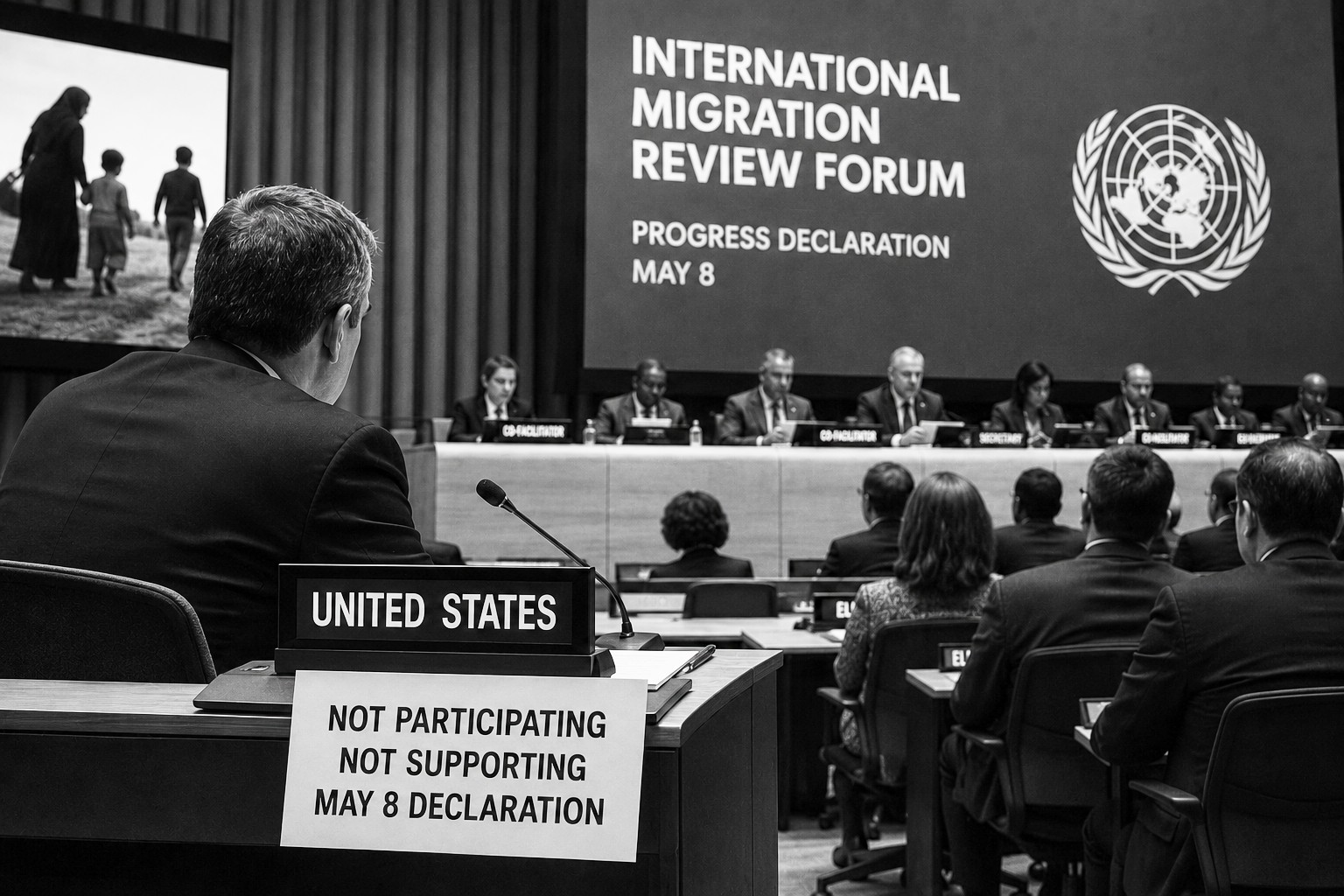
The United States has declined to participate in the latest International Migration Review Forum and announced that it will not support the May 8 declaration outlining progress on global migration cooperation. The move reflects continuing political sensitivity surrounding migration policy and highlights widening divisions among governments over international approaches to migration governance.
The International Migration Review Forum was organised under the framework of the United Nations to evaluate implementation of the Global Compact for Safe, Orderly and Regular Migration, a non-binding international agreement first adopted in 2018. The forum brought together governments, international organisations and policy experts to discuss migration management, refugee issues and cross-border cooperation.
However, U.S. officials confirmed that Washington neither participated in the latest review forum nor endorsed the resulting declaration document.

The decision underscores the long-standing caution within parts of the American political establishment regarding multilateral migration frameworks, particularly those perceived as potentially influencing national sovereignty over border and immigration policy.
Migration remains politically divisive
Immigration and border security continue to rank among the most contentious political issues in the United States. Debates over asylum policy, undocumented migration, border enforcement and refugee resettlement have remained central topics within domestic political discourse for years.
Successive American administrations have adopted differing approaches towards international migration cooperation. While some policymakers support broader coordination through multilateral institutions, others argue that migration policy must remain strictly under national control.
The U.S. refusal to support the declaration reflects concerns among critics that international migration frameworks could gradually create political pressure for policy alignment or expanded obligations, despite the non-binding nature of such agreements.
Supporters of international coordination, meanwhile, argue that migration challenges increasingly require cross-border cooperation given the global scale of displacement, labour mobility and humanitarian crises.
Global migration pressures continue rising
The migration issue has become increasingly significant internationally due to conflicts, economic instability, climate pressures and demographic changes affecting multiple regions simultaneously. Europe, North America, the Middle East and parts of Africa and Latin America continue experiencing complex migration flows linked to both economic opportunity and humanitarian emergencies.
International organisations have repeatedly warned that migration pressures may intensify further in coming decades as climate-related displacement and geopolitical instability increase.
The United Nations and various humanitarian groups maintain that coordinated international frameworks are important for managing migration safely while protecting human rights and reducing irregular migration risks.
However, critics in several countries have argued that global migration agreements sometimes fail to adequately address national political realities, border enforcement concerns or the economic impact of large-scale migration.
Washington signals preference for national policy control
By rejecting participation and refusing to endorse the declaration, the United States appears to be reinforcing a position that migration policy should primarily remain a sovereign national matter rather than an internationally coordinated political framework.
Analysts note that the decision may also reflect broader geopolitical trends in which governments are increasingly prioritising domestic political considerations over multilateral consensus-building on sensitive policy areas.
The absence of U.S. support nevertheless does not prevent ongoing cooperation between Washington and international partners on specific migration, refugee and border-security issues through bilateral or regional agreements.
The debate surrounding the migration forum illustrates the continuing global tension between international coordination and national sovereignty at a time when migration remains one of the defining political and humanitarian challenges facing governments worldwide.
Newshub Editorial in North America – May 12, 2026

If you have an account with ChatGPT you get deeper explanations,
background and context related to what you are reading.
Open an account:
Open an account
Recent Comments