
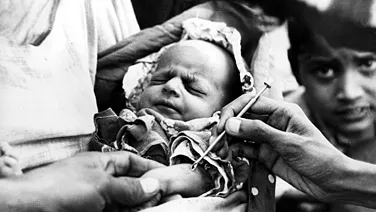
On this day in 1980, the World Health Organization officially declared that smallpox had been eradicated, marking one of the greatest medical achievements in human history. The announcement confirmed the end of a disease that had devastated populations for centuries, killed hundreds of millions of people and shaped the course of global history through repeated epidemics, social collapse and mass mortality.
A disease feared across centuries
Smallpox was one of the deadliest diseases ever known to humanity. Caused by the variola virus, the illness spread rapidly through close contact and infected populations across Asia, Europe, Africa and the Americas for centuries.
Victims commonly suffered high fever, severe pain and a characteristic rash that developed into fluid-filled pustules covering the body. Many survivors were left permanently scarred, while others lost their eyesight due to complications from the infection.

Historical estimates suggest that smallpox killed hundreds of millions of people during the twentieth century alone before eradication efforts succeeded. In some outbreaks, mortality rates exceeded 30 percent.
The disease also had enormous historical consequences, contributing to demographic collapse in indigenous populations following European colonisation of the Americas.
Vaccination transformed the fight
The breakthrough in combating smallpox began with the development of vaccination techniques during the late eighteenth century. English physician Edward Jenner is widely credited with pioneering the first successful vaccine after observing that exposure to cowpox appeared to protect individuals against smallpox infection.
Vaccination campaigns gradually expanded worldwide over the following centuries, although outbreaks continued occurring across large parts of the world well into the twentieth century.
In 1967, the World Health Organization launched an intensified global eradication campaign aimed at eliminating the disease entirely.
The programme relied on mass vaccination, rapid outbreak identification and containment strategies designed to isolate infections before they could spread further.
Final cases marked the end of an era
The final naturally occurring case of smallpox was recorded in Somalia in 1977. After years of global surveillance confirmed that transmission had ended, the World Health Organization formally announced eradication on May 8, 1980.
The declaration represented the first and so far only complete eradication of a major human infectious disease.
Health experts described the achievement as an unprecedented example of international scientific cooperation and coordinated public health action. Countries across political and ideological divisions participated in vaccination campaigns during the Cold War era, highlighting the global importance of eliminating the virus.
The eradication campaign is estimated to have saved countless millions of lives and prevented enormous economic and humanitarian costs worldwide.
Legacy still shapes modern public health
The success against smallpox continues influencing modern vaccination programmes and global disease-control strategies today.
Public health organisations frequently reference the eradication campaign when discussing efforts to eliminate diseases such as polio and reduce the spread of emerging infectious threats.
At the same time, the history of smallpox serves as a reminder of the devastating impact infectious diseases can have on societies lacking effective medical protection and coordinated healthcare systems.
More than four decades after the official declaration, the eradication of smallpox remains one of humanity’s clearest demonstrations of how science, medicine and international cooperation can overcome even the deadliest global threats.
Newshub Editorial in Europe – May 8, 2026

If you have an account with ChatGPT you get deeper explanations,
background and context related to what you are reading.
Open an account:
Open an account
Recent Comments