
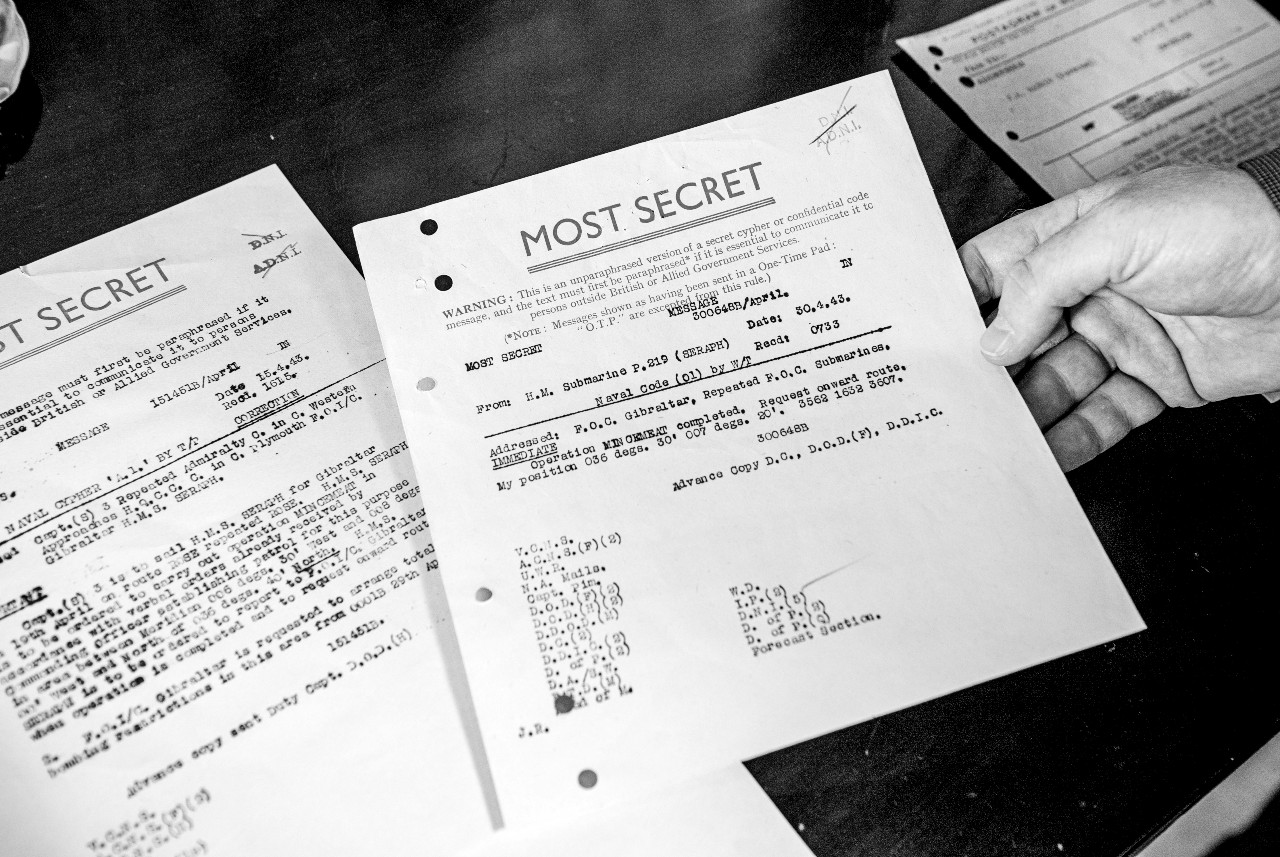
On this day in 1943, one of the most daring deception operations of the Second World War reached a critical stage when a body carrying fabricated military documents washed ashore near the southern coast of Spain. The event marked the operational climax of Operation Mincemeat, a British intelligence plan designed to convince Nazi Germany that the Allies intended to invade Greece and Sardinia instead of Sicily.
The operation was orchestrated by British naval intelligence and formed part of a broader Allied strategy to weaken German defensive preparations ahead of the planned invasion of Sicily, known as Operation Husky. By misleading Adolf Hitler’s military command about Allied intentions, British intelligence hoped to divert German troops and resources away from Sicily before the invasion began.
The plan relied on an extraordinary level of detail and deception. British operatives obtained the body of a deceased man and created an entirely fictional identity for him: Major William Martin of the Royal Marines. The body was dressed in military uniform and equipped with carefully forged personal belongings, identification papers and confidential-looking military correspondence.

Most importantly, the briefcase chained to the body contained fake top-secret documents suggesting that Allied forces planned to launch attacks elsewhere in southern Europe.
Spain becomes the key stage
Spain’s role in the operation was essential. Although officially neutral during the war, Spain maintained significant diplomatic and intelligence contacts with Nazi Germany. British planners believed that if the documents reached Spanish authorities, German intelligence would almost certainly gain access to them.
The body was released from a British submarine off the coast near Huelva in southern Spain. Local fishermen later discovered the corpse, and Spanish officials recovered the documents exactly as British intelligence had anticipated.
German agents quickly obtained copies of the papers and passed them to Berlin. Crucially for the success of the mission, the Germans appeared to accept the documents as genuine.
Historians later concluded that the deception contributed significantly to Hitler’s decision to reinforce Greece and Sardinia rather than Sicily, weakening Axis defensive concentration at the actual invasion target.
A turning point in wartime deception
When Allied forces landed in Sicily in July 1943, the operation’s impact became increasingly clear. Although Sicily was defended, the Germans had dispersed key military resources due to uncertainty over Allied intentions.
Operation Mincemeat has since become one of the most celebrated intelligence operations in military history. It demonstrated the growing sophistication of wartime espionage and strategic deception, areas that became increasingly decisive during the later stages of the war.
The story remained classified for years after the conflict before gradually becoming public through memoirs, official releases and historical research. It has since inspired books, documentaries and feature films, further cementing its place in popular military history.
Legacy of strategic deception
Military historians often cite Operation Mincemeat as a defining example of how intelligence operations can alter the course of war without direct combat. The success of the deception reflected not only careful planning but also an understanding of how adversaries interpret information under wartime pressure.
More than eight decades later, the operation continues to be studied by intelligence agencies and military academies worldwide as a masterclass in psychological and strategic warfare.
Newshub Editorial in Europe – 29 April 2026

If you have an account with ChatGPT you get deeper explanations,
background and context related to what you are reading.
Open an account:
Open an account
Recent Comments