
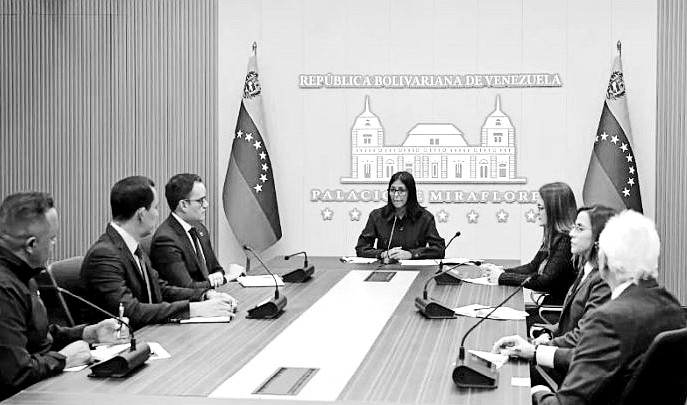
Venezuela has established a high-level commission to evaluate state-owned assets and consider potential sell-offs, signalling a significant shift in economic policy as the government seeks to boost productivity and attract investment. The move reflects a broader effort to modernise the economy and re-engage with global capital markets.
Commission to redefine state ownership
The newly formed body, led by acting president Delcy Rodríguez, has been tasked with assessing the “strategic” value of public assets and determining their future role within the economy.
According to official statements, state holdings will be divided into four categories: core strategic assets to remain under government control, partnerships with private operators, non-strategic assets earmarked for privatisation, and entities that may be liquidated or restructured.

The initiative is designed to streamline the state’s role and redirect resources towards sectors considered critical for national development.
From nationalisation to selective liberalisation
The policy marks a notable evolution from the extensive nationalisation programme launched under former president Hugo Chávez in the 2000s, which brought key industries such as oil, banking and telecommunications under state control.
In recent years, economic pressures—including sanctions, declining output and infrastructure challenges—have prompted a gradual shift towards more flexible arrangements with private sector partners. The new commission formalises this transition, opening the door to broader private participation.
Key sectors in focus
Analysts suggest that industries operating below capacity or generating limited returns are the most likely candidates for privatisation. These could include sectors such as steel, cement, agriculture and hospitality, where efficiency gains may be achieved through private investment.
At the same time, strategic sectors—particularly energy and natural resources—are expected to remain under tighter state oversight, though joint ventures and concession-style agreements may expand.
Investor interest returns cautiously
The policy shift comes as international interest in Venezuela begins to re-emerge, supported by partial sanctions relief and regulatory reforms aimed at improving the investment climate. Discussions with institutions such as the International Monetary Fund and World Bank further indicate a willingness to reintegrate into global financial systems.
However, investor confidence remains fragile. Concerns over legal certainty, governance and long-term policy stability continue to influence decision-making among potential entrants.
Balancing reform with political realities
While the commission represents a clear move towards economic liberalisation, its implementation will require careful navigation of domestic political dynamics. Privatisation has historically been a sensitive issue in Venezuela, particularly given its association with inequality and foreign influence.
The government has framed the initiative as a means to strengthen the state by focusing on strategic priorities while leveraging private sector efficiency where appropriate.
A turning point for the economy
The establishment of the commission underscores a broader recalibration of Venezuela’s economic model. If executed effectively, it could unlock new investment flows and revitalise underperforming industries.
At the same time, the success of the initiative will depend on transparency, regulatory clarity and the ability to build trust with both domestic and international stakeholders. As Venezuela repositions itself, the balance between state control and market participation will be central to shaping its economic future.
Newshub Editorial in South America – April 26, 2026

If you have an account with ChatGPT you get deeper explanations,
background and context related to what you are reading.
Open an account:
Open an account
Recent Comments