
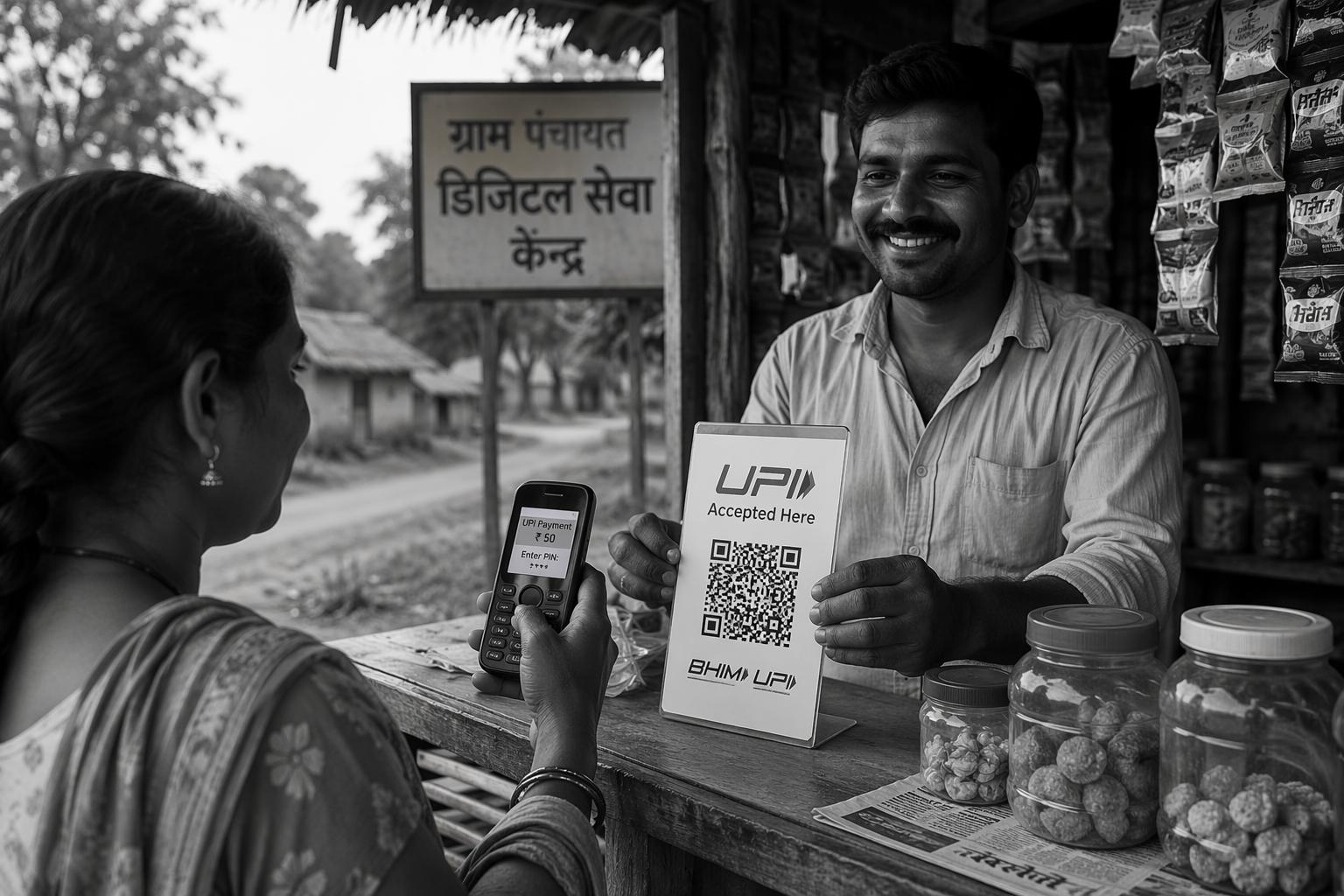
India is pushing the next stage of its digital payments build-out by extending offline-capable UPI tools into lower-connectivity areas, a move that could bring more rural consumers, merchants and micro-enterprises into the formal financial system without requiring full smartphone or always-on internet access.
Bridging the last-mile gap
India’s payments architecture has already reached enormous scale, with UPI processing more than 18 billion transactions in June 2025 and serving hundreds of millions of users and tens of millions of merchants. Yet the next growth frontier is not simply urban convenience. It is the last mile: villages, low-signal areas and feature-phone households that still face practical barriers to real-time digital commerce.
Offline functionality matters because patchy connectivity remains a real constraint in remote areas. The Reserve Bank of India has explicitly recognised that weak or erratic internet access can hold back digital payment adoption, and it has supported offline payment models using cards, wallets and mobile devices as a way to widen access.

How the model works
The infrastructure now being emphasised includes UPI 123PAY for feature-phone users and UPI Lite and LiteX for lower-value transactions. UPI 123PAY enables users without smartphones to make payments through channels designed for basic handsets, while government material in 2025 and 2026 has continued to position 123PAY, Lite and LiteX as tools for rural and semi-urban expansion.
UPI Lite is designed for small-value payments made more quickly and with less friction, while official NPCI material describes it as a low-value solution for transactions below ₹1,000. That design is particularly relevant for daily rural commerce such as food stalls, local transport, farm inputs and neighbourhood retail, where transaction sizes are small but frequency is high.
Policy support and rural merchant adoption
New Delhi is not treating this as a niche experiment. In March 2025, the Union Cabinet approved a ₹1,500 crore incentive scheme for low-value BHIM-UPI person-to-merchant transactions, with explicit reference to expanding infrastructure in rural and semi-urban areas through UPI 123PAY, Lite and LiteX. The scheme also maintained zero MDR on UPI transactions, which helps keep acceptance attractive for smaller merchants.
That matters because small merchants are often the gateway to behavioural change. If farmers, kirana stores, transport operators and informal traders can accept reliable digital payments without depending on strong mobile data coverage, then digital finance starts to look less like an urban app layer and more like everyday commercial infrastructure. This is where India’s public-digital model becomes especially significant for other emerging markets. The country already accounts for a very large share of global real-time payment volume, and its focus on low-cost, interoperable rails continues to strengthen its role as a reference point for inclusion-led fintech design.
A blueprint beyond India
For international fintech groups, the signal is clear: the future of inclusion will depend not only on apps, but on resilient payment rails that still work when connectivity does not. India’s offline UPI expansion shows how digital finance can be adapted to real-world conditions in cash-heavy and infrastructure-constrained environments. As that model matures, it is likely to influence payment strategies far beyond India’s borders.
Newshub Editorial in Asia – 16 April 2026

If you have an account with ChatGPT you get deeper explanations,
background and context related to what you are reading.
Open an account:
Open an account
Recent Comments