
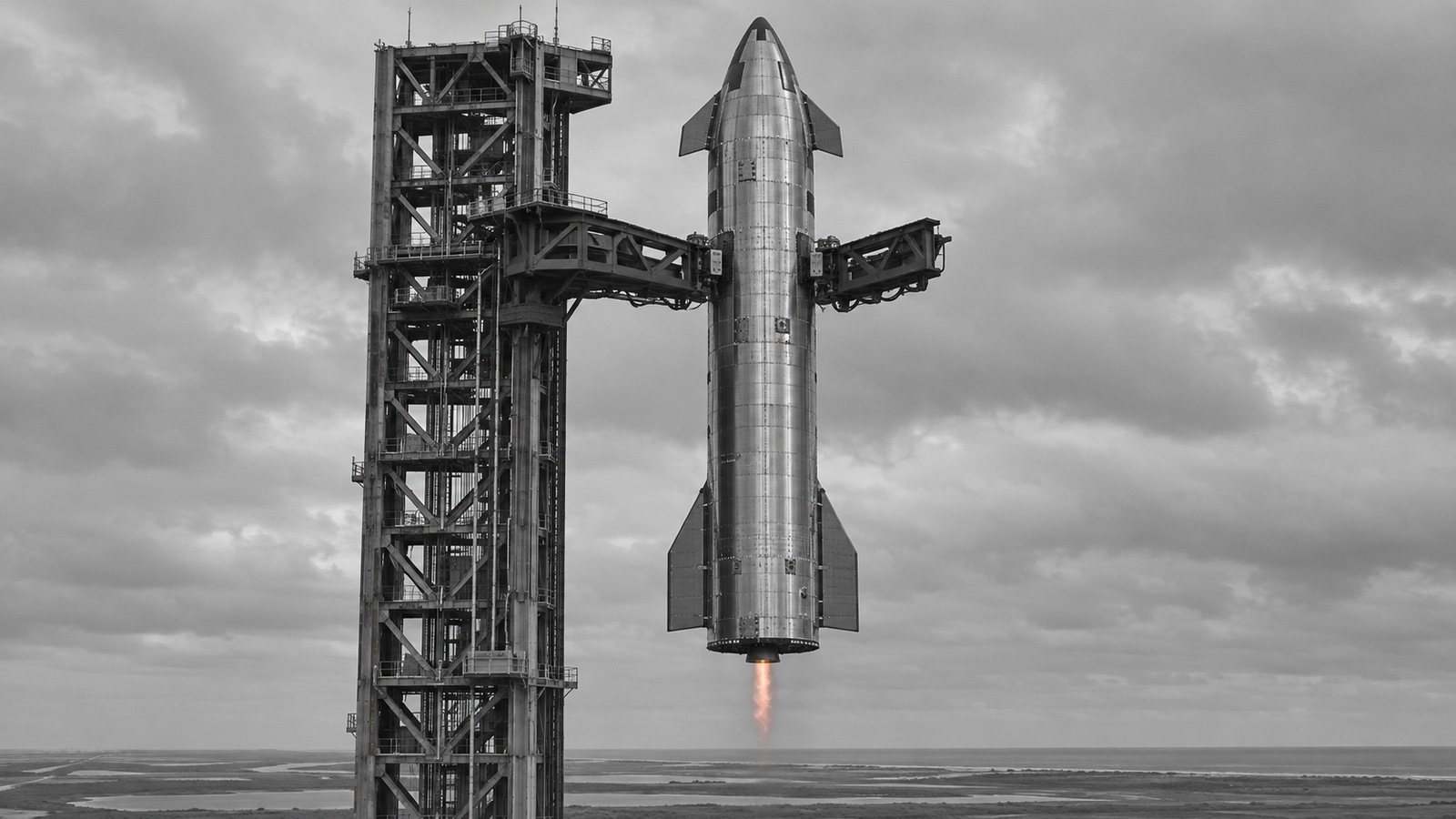
SpaceX caught its Starship spacecraft at its launch tower in southern Texas on Saturday, recovering the rocket’s upper stage for the first time after an orbital flight. The spacecraft spent about 22½ hours in space, circled Earth 14 times and deployed 26 Starlink satellites before returning to Starbase.
A catch nearly a day after lift-off
Starship lifted off from Starbase on Friday aboard its Super Heavy booster on the programme’s 15th test flight. On Saturday, the spacecraft fired an engine to leave orbit and re-entered the atmosphere over the Pacific. As it approached the Texas coast, it descended almost horizontally before reigniting its engines to swing upright beside the launch tower. Two steel arms closed around fittings on the vehicle, leaving it suspended above the ground.


SpaceX had planned to catch both stages during the same mission. Super Heavy aborted its return to the tower minutes after Friday’s launch and diverted towards the Gulf of Mexico. SpaceX said early indications pointed to a low fuel alarm and that it was investigating the underlying cause. The company had caught Super Heavy on previous flights. Saturday marked the first catch of the spacecraft that carries payloads into orbit.
The economics of flying again
SpaceX already reuses Falcon 9 boosters, while the upper stage is expended on each mission. Starship is designed to bring both stages back. If SpaceX can recover and relaunch them with limited refurbishment, it could reduce the cost of deploying satellites and increase the pace at which it builds out its Starlink broadband network.
The Texas recovery gives engineers a spacecraft they can inspect after an orbital return, including the ceramic tiles that shielded it during re-entry. The next tests are whether SpaceX can recover both stages on the same flight and how much work the ship needs before it can fly again. The company is also developing a lunar version of Starship for NASA’s Artemis programme.
NewsHub Finance | Space & Technology | 15 November 2026
SpaceX caught its Starship spacecraft at its launch tower in southern Texas on Saturday, recovering the rocket’s upper stage for the first time after an orbital flight. The spacecraft spent about 22½ hours in space, circled Earth 14 times and deployed 26 Starlink satellites before returning to Starbase.

Recent Comments