
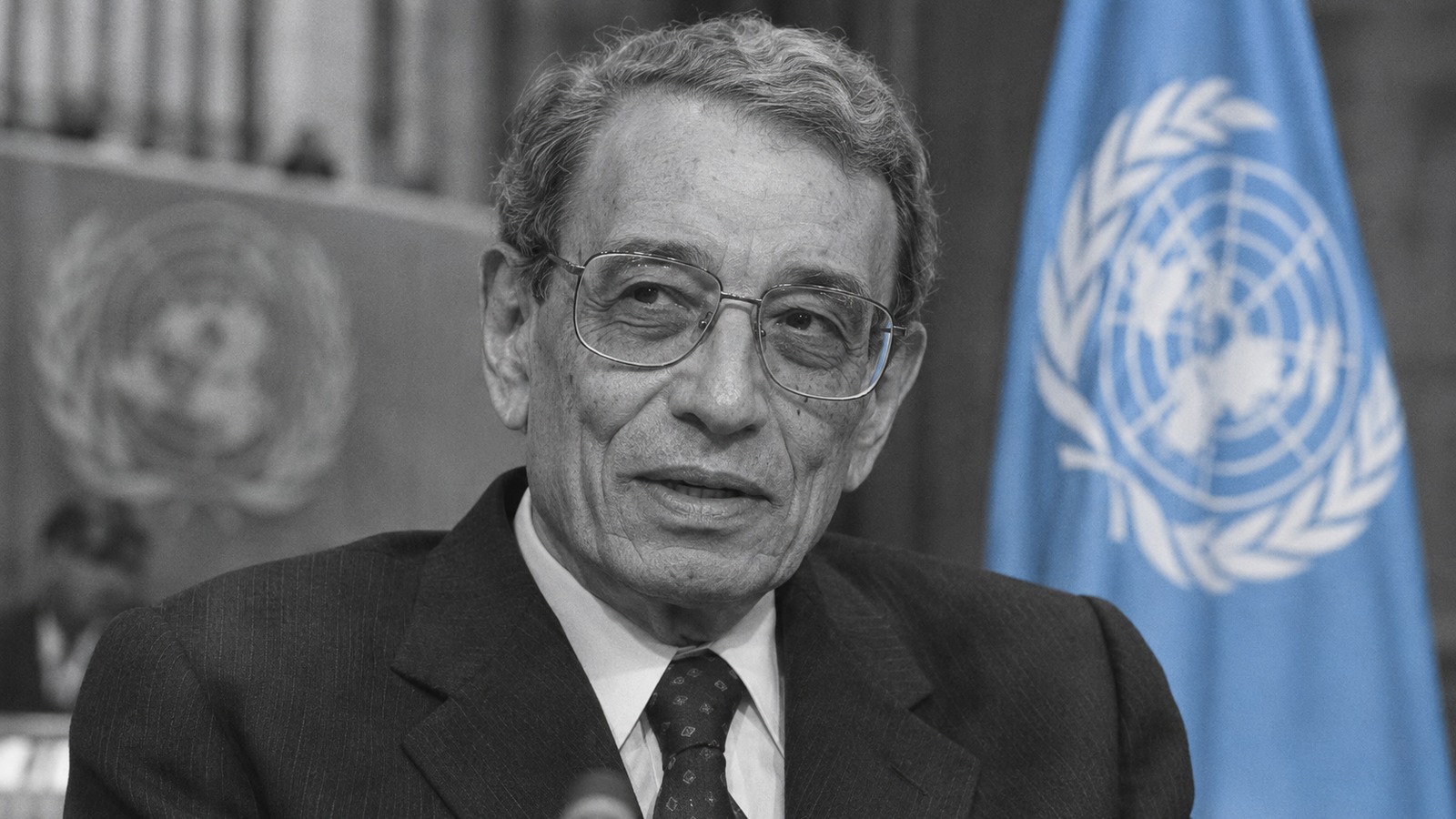
Boutros Boutros-Ghali, the Egyptian diplomat who became the first African to lead the United Nations, was born in Cairo on 14 November 1922. As secretary-general from 1992 to 1996, he urged the UN to intervene earlier in disputes and help countries rebuild after war. His tenure also saw the organisation fail to protect civilians in Rwanda and Bosnia.
From Cairo to Camp David
Boutros-Ghali taught international law and international relations at Cairo University before becoming Egypt’s minister of state for foreign affairs in 1977. The following year, he joined the Egyptian delegation at Camp David and helped negotiate the accords that laid the groundwork for the 1979 peace treaty between Egypt and Israel. He was Egypt’s deputy prime minister for foreign affairs when the UN General Assembly appointed him secretary-general in December 1991.
A wider role for the UN
Taking office weeks after the Soviet Union dissolved, Boutros-Ghali argued that the end of the Cold War gave the Security Council more room to act. In his 1992 report An Agenda for Peace, he called for earlier mediation to keep disputes from turning into wars. He also proposed that the UN help restore institutions and support political agreements after fighting ended, an approach that became known as post-conflict peacebuilding.


The UN’s failures in Rwanda and Bosnia exposed the limits of its peacekeeping operations. In 1994, the organisation failed to prevent the genocide against the Tutsi in Rwanda. In July 1995, Bosnian Serb forces overran Srebrenica, a UN-designated safe area, and killed thousands of Bosniak men and boys.
A US veto ends his tenure
The United States used its Security Council veto in 1996 to block Boutros-Ghali’s bid for a second term. He left office at the end of the year and was succeeded by Ghana’s Kofi Annan. Boutros-Ghali went on to become the first secretary-general of the International Organisation of La Francophonie. He died on 16 February 2016, aged 93.
Newshub Editorial in Africa – 14 November 2026
Boutros Boutros-Ghali, the Egyptian diplomat who became the first African to lead the United Nations, was born in Cairo on 14 November 1922. As secretary-general from 1992 to 1996, he urged the UN to intervene earlier in disputes and help countries rebuild after war. His tenure also saw the organisation fail to protect civilians in Rwanda and Bosnia.

Recent Comments