
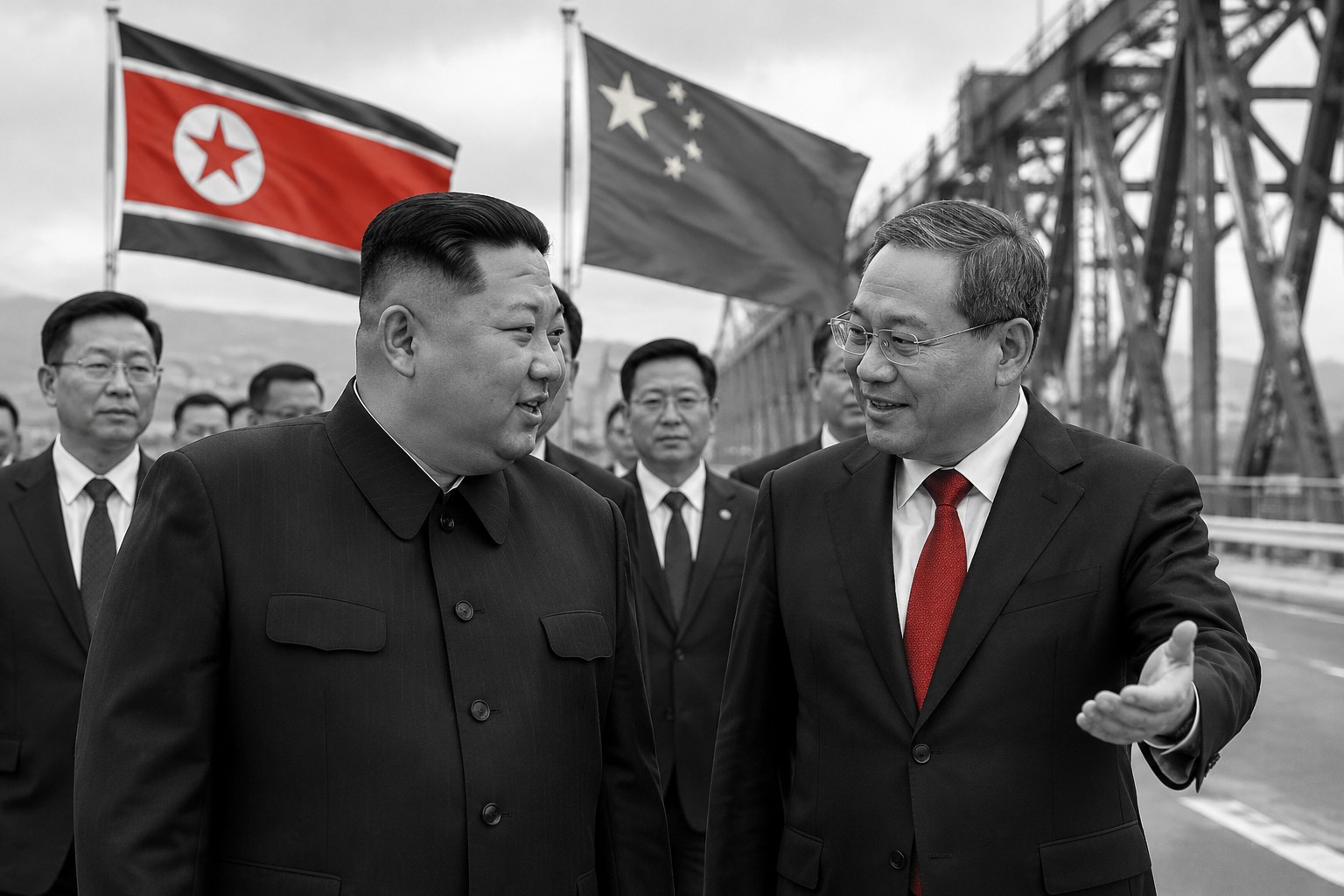
North Korean leader Kim Jong-un made a rare visit to China on Saturday, crossing the newly opened Yalu River Bridge into the Chinese border city of Dandong. The visit, his sixth to China since taking power, signals renewed efforts by Pyongyang and Beijing to strengthen their political and economic relationship amid rising geopolitical tensions in East Asia.
A symbolic crossing after 12 years
Kim travelled across the New Yalu River Bridge, connecting the North Korean city of Sinuiju with Dandong in China’s Liaoning province.


The four-lane bridge, measuring approximately three kilometres, was completed in 2014 at a cost of around $310 million, financed by China. However, its opening was delayed for more than a decade because connecting roads and customs infrastructure on the North Korean side remained unfinished.
Its inauguration in October represents an important development in cross-border infrastructure and trade.
Chinese Premier Li Qiang was initially reported to have welcomed Kim, while subsequent Chinese reporting confirmed a meeting with senior Communist Party official Wang Huning.
China remains North Korea’s economic lifeline
China has long been North Korea’s largest trading partner and principal source of economic support.
The new bridge is expected to improve the transportation of goods, including agricultural products, industrial materials and other commercial shipments.
For North Korea, which remains subject to extensive international sanctions over its nuclear weapons programme, stronger commercial connections with China could offer significant economic advantages.
However, the bridge does not remove existing sanctions or restrictions on prohibited trade.
Historical ties and strategic interests
Kim’s visit coincided with commemorations marking China’s intervention in the Korean War, which lasted from 1950 to 1953.
During his visit, Kim and Wang Huning toured an automobile factory and a memorial honouring Chinese soldiers killed during the conflict.
The anniversary serves as a reminder of the historical relationship between the two communist states, whose strategic cooperation has survived decades of international pressure.
Beijing regards stability on the Korean peninsula as an important national security interest, while Pyongyang increasingly relies on its relationships with China and Russia to counter Western influence.
A wider geopolitical calculation
The visit comes as China prepares to host the Asia-Pacific Economic Cooperation summit in Shenzhen next month, where US President Donald Trump is expected to attend.
Trump has expressed interest in renewed discussions with Kim, although North Korea has not committed to any meeting.
Meanwhile, closer cooperation between Beijing and Pyongyang could complicate Washington’s diplomatic efforts in the region.
For China, maintaining influence over North Korea also provides strategic leverage in its broader relationship with the United States.
More than a bridge
Although Kim’s visit was brief, its economic and political symbolism is considerable.
The reopening of a long-delayed transport connection suggests that both governments are seeking to expand practical cooperation after years of border restrictions and disrupted trade.
Whether this leads to substantial commercial growth will depend on customs operations, international sanctions and the willingness of both countries to facilitate greater cross-border activity.
For now, the new Yalu River Bridge represents a visible step towards closer relations between two neighbours whose strategic partnership continues to shape the political balance in Northeast Asia.
NewsHub Finance | Asia & Geopolitics | 25 October 2026
North Korean leader Kim Jong-un made a rare visit to China on Saturday, crossing the newly opened Yalu River Bridge into the Chinese border city of Dandong. The visit, his sixth to China since taking power, signals renewed efforts by Pyongyang and Beijing to strengthen their political and economic relationship amid rising geopolitical tensions in East Asia.

Recent Comments