
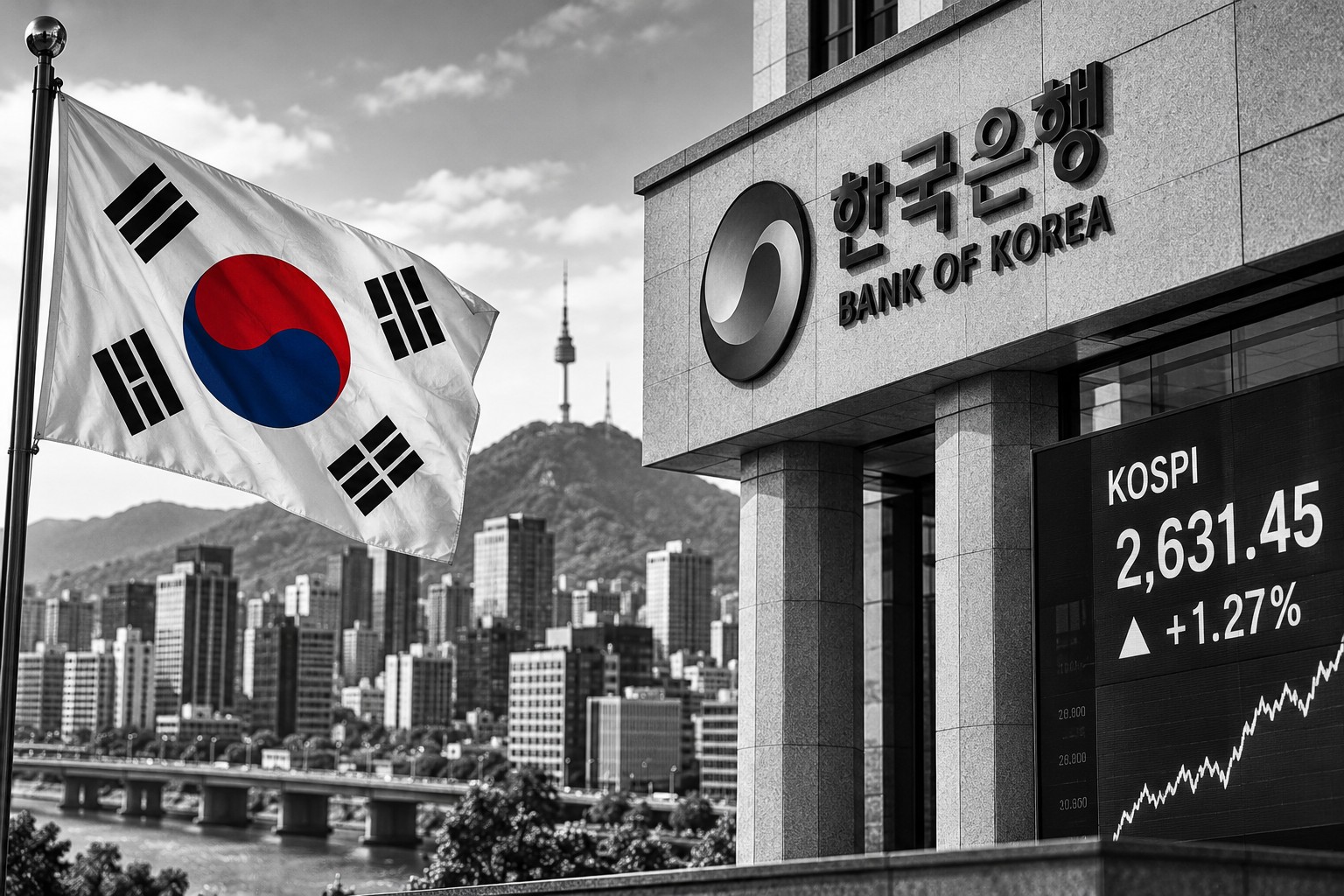
South Korea’s central bank kept its benchmark interest rate unchanged at 3.00% on Thursday, 22 October, pausing after two consecutive increases as strong semiconductor exports and investment in artificial intelligence support economic growth. However, policymakers warned that inflation remains above target, leaving the door open for further monetary tightening.
The Bank of Korea’s seven-member monetary policy board unanimously voted to maintain its seven-day repurchase rate, following quarter-point increases in July and August.
The decision matched expectations among all 34 economists surveyed by Reuters ahead of the meeting.


Artificial intelligence drives economic growth
South Korea has emerged as one of the principal beneficiaries of global investment in artificial intelligence infrastructure.
Demand for advanced memory chips, semiconductors and computing equipment has strengthened exports, supporting manufacturers and the wider economy.
The country’s exports reached a record $800 billion during the first nine months of 2026, reflecting substantial international demand for technology-related products.
The central bank indicated that growth could exceed its previous projections of 3.3% for 2026 and 2.9% for 2027.
Inflation remains a concern
Despite stronger economic activity, inflation continues to complicate monetary policy.
Consumer prices increased by 2.9% in September compared with a year earlier, easing from 3.1% in August but remaining above the central bank’s 2% target.
Elevated energy costs, resilient domestic demand and continued economic expansion could maintain upward pressure on prices.
The central bank must also consider household borrowing and property-market conditions when determining future interest rates.
Further increases remain possible
Governor Shin Hyun Song emphasised that future decisions would depend on incoming economic data rather than a predetermined interest-rate timetable.
Economists generally expect another quarter-point increase in November, followed by a possible further rise in early 2027.
Such moves would take the benchmark rate to 3.50%, although the outlook remains dependent on inflation and global financial conditions.
A delicate balance for Asia’s fourth-largest economy
South Korea’s monetary policy has implications extending beyond its borders.
Its semiconductor industry plays a central role in global electronics manufacturing, while financial markets remain sensitive to American interest rates and international capital flows.
Higher borrowing costs could restrain household spending and corporate investment, even as technology exports strengthen economic activity.
For policymakers, the challenge is to prevent inflation from becoming entrenched without undermining the expansion supported by artificial intelligence.
Thursday’s decision provides temporary stability, but South Korea’s interest-rate cycle may not yet have reached its peak.
NewsHub Finance | Asia Finance | 22 October 2026
South Korea's central bank kept its benchmark interest rate unchanged at 3.00% on Thursday, 22 October, pausing after two consecutive increases as strong semiconductor exports and investment in artificial intelligence support economic growth. However, policymakers warned that inflation remains above target, leaving the door open for further monetary tightening.
Recent Comments