
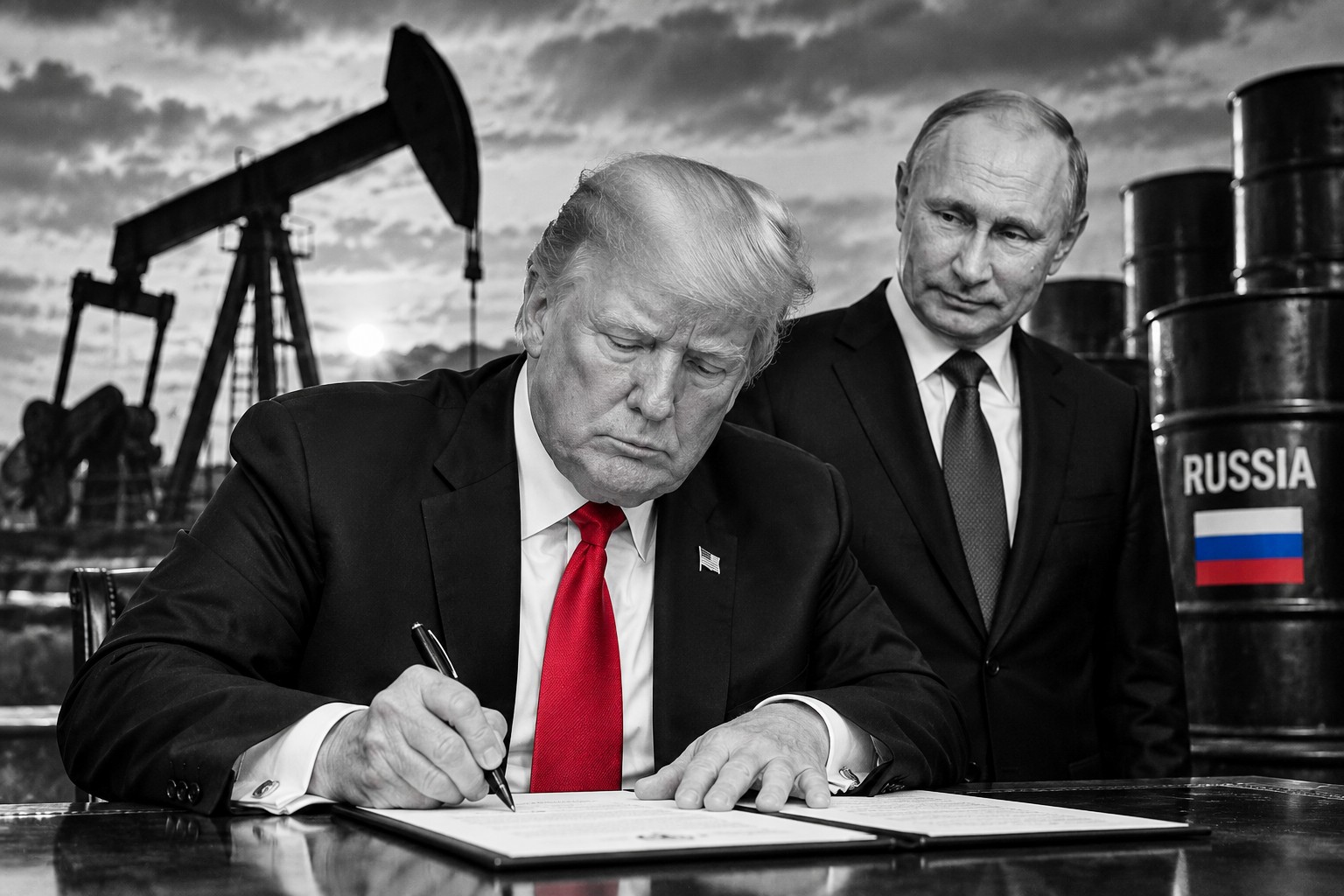
US President Donald Trump has signed an executive order suspending major new sanctions against Russia, just one week after reaching an agreement with Russian President Vladimir Putin to release millions of tonnes of Russian diesel onto international markets. The decision, signed on 16 October 2026, represents a significant change in Washington’s economic pressure on Moscow and has triggered criticism from both Republicans and Democrats.
Presidential order reverses sanctions pressure
The executive order suspends key provisions of the Lindsey O. Graham Sanctioning Russia and Iran Act of 2026, legislation Trump signed on 18 September.
The law was designed to increase financial pressure on Russia over its invasion of Ukraine, including sanctions against Russian energy interests and steep tariffs targeting countries purchasing Russian oil and gas.


Trump invoked a national-interest waiver, effectively preventing numerous new restrictions from taking effect.
However, the order does not eliminate every existing American sanction against Russia. Restrictions imposed under earlier executive orders remain in force.
The agreement with Vladimir Putin
The decision follows Trump’s 9 October announcement of an agreement with Putin under which Russia would release substantial quantities of diesel fuel to American and international markets.
The administration had already temporarily eased restrictions on Russian diesel exports in an effort to reduce energy prices.
Trump has defended the arrangement as necessary to protect American consumers from rising fuel costs, particularly as international energy markets remain under pressure from conflicts involving Iran and Ukraine.
The latest presidential order removes additional potential obstacles to Russian energy trade, although the White House has not explicitly described the broader sanctions waiver as a requirement of the diesel agreement.
Congress raises legal and political objections
The agreement has generated opposition from lawmakers in both major American political parties.
Critics argue that allowing Russian fuel revenues to increase risks strengthening Moscow’s ability to finance its continuing military operations in Ukraine.
They also question whether the administration’s actions undermine legislation intended to restrict Russian energy imports.
Supporters of the administration’s approach argue that easing restrictions on fuel supplies could help contain inflation and reduce costs for American households and businesses.
Economic consequences for Russia and global energy
Russian oil and petroleum exports remain an important source of government revenue.
Reducing sanctions pressure could improve Moscow’s access to international buyers, although the actual financial benefit will depend on trading volumes, prices and remaining restrictions.
For global energy markets, additional Russian diesel supplies could provide some relief, particularly where refinery capacity and shipping disruptions have tightened availability.
Nevertheless, increased Russian exports would not necessarily produce immediate or substantial reductions in consumer fuel prices.
A new test for Washington’s Ukraine policy
The decision also raises questions about the relationship between American energy policy and Washington’s efforts to influence the war in Ukraine.
Ukrainian officials and several Western politicians have warned that weakening economic pressure on Moscow could undermine attempts to negotiate an end to the conflict.
Trump’s latest order leaves the administration with authority to reintroduce the suspended sanctions.
For now, the United States has chosen greater flexibility in Russian energy trade, placing immediate economic considerations alongside its longstanding sanctions strategy.
NewsHub Finance | Geopolitics & Global Energy | 17 October 2026
US President Donald Trump has signed an executive order suspending major new sanctions against Russia, just one week after reaching an agreement with Russian President Vladimir Putin to release millions of tonnes of Russian diesel onto international markets. The decision, signed on 16 October 2026, represents a significant change in Washington's economic pressure on Moscow and has triggered criticism from both Republicans and Democrats.
Recent Comments