
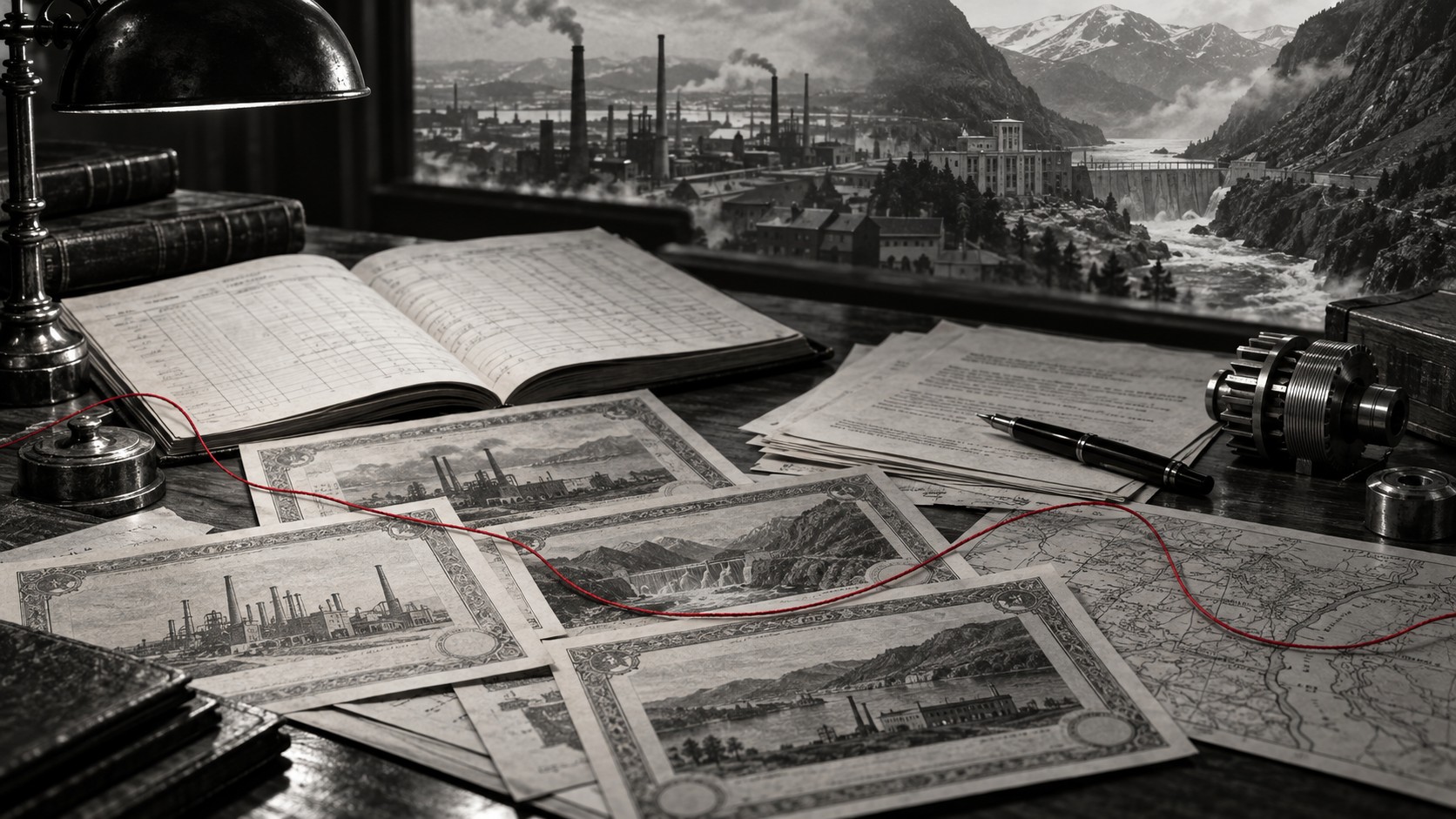
Before the Second World War, the Wallenbergs’ German connections ran through bank correspondence, industrial licences and shareholdings. Norsk Hydro, IG Farben, the Warburg bank and Bosch reveal how those relationships developed — and how the approaching conflict changed their stakes.
Hydro brings German industry into the picture
Marcus Wallenberg senior helped finance Norsk Hydro’s foundation in 1905 and chaired the company for 37 years. Its fertiliser business subsequently created a significant connection with German chemicals.
In 1927, under managing director Axel Aubert, Hydro adopted German ammonia technology. IG Farben acquired 25 per cent of Hydro’s shares and assumed responsibility for marketing its products outside Norway.


This was a relationship involving ownership, production technology and access to customers. Further agreements supported sales, while cooperation with IG Farben and Britain’s ICI sought to restrict competition during the depression.
The direction of ownership matters: IG Farben held a quarter of Hydro. That does not establish Wallenberg ownership or control of IG Farben.
The Warburg negotiations
Another connection appears in Sweden’s official investigation into Jewish assets, published in 1999.
In January 1937, Max Warburg and Jacob Wallenberg discussed Swedish participation in Hamburg’s Jewish-owned M.M. Warburg bank. As Nazi pressure forced the Warburg family towards relinquishing its business, negotiations resumed in 1938.
Jacob’s conditions included German official approval, participation through a separate company and financing with restricted German currency. Correspondence also proposed selling IG Farben shares available in Berlin to finance the investment.
The proposed participation never materialised. After the bank passed to Rudolf Brinckmann and Paul Wirtz, Stockholms Enskilda Bank declined to proceed under the changed circumstances. The record documents negotiations and available securities; it does not establish a controlling Wallenberg stake in the chemicals group.
Bosch at the threshold of war
Bosch belongs at the chronological boundary. In April 1937, its foreign companies had been placed under a Dutch holding structure associated with Mendelssohn & Co, Amsterdam. Contracts preserved Bosch’s influence over patents, markets and appointments.
Mendelssohn’s collapse in August 1939 threatened that arrangement. In early September, Bosch adviser Carl Goerdeler approached Jacob Wallenberg. Banker Waldemar von Oppenheim, already acquainted with Jacob, subsequently advanced the discussions.
In December, the Enskilda group acquired eight Bosch companies through Planeten. These were wartime transactions built on earlier commercial relationships.
By then, licences, shares and personal banking contacts had acquired new significance: who formally owned an enterprise, who influenced its operations and whose interests its contracts protected could become separate questions.
Newshub Editorial in Europe – 8 October 2026
Before the Second World War, the Wallenbergs’ German connections ran through bank correspondence, industrial licences and shareholdings. Norsk Hydro, IG Farben, the Warburg bank and Bosch reveal how those relationships developed — and how the approaching conflict changed their stakes.
Recent Comments