
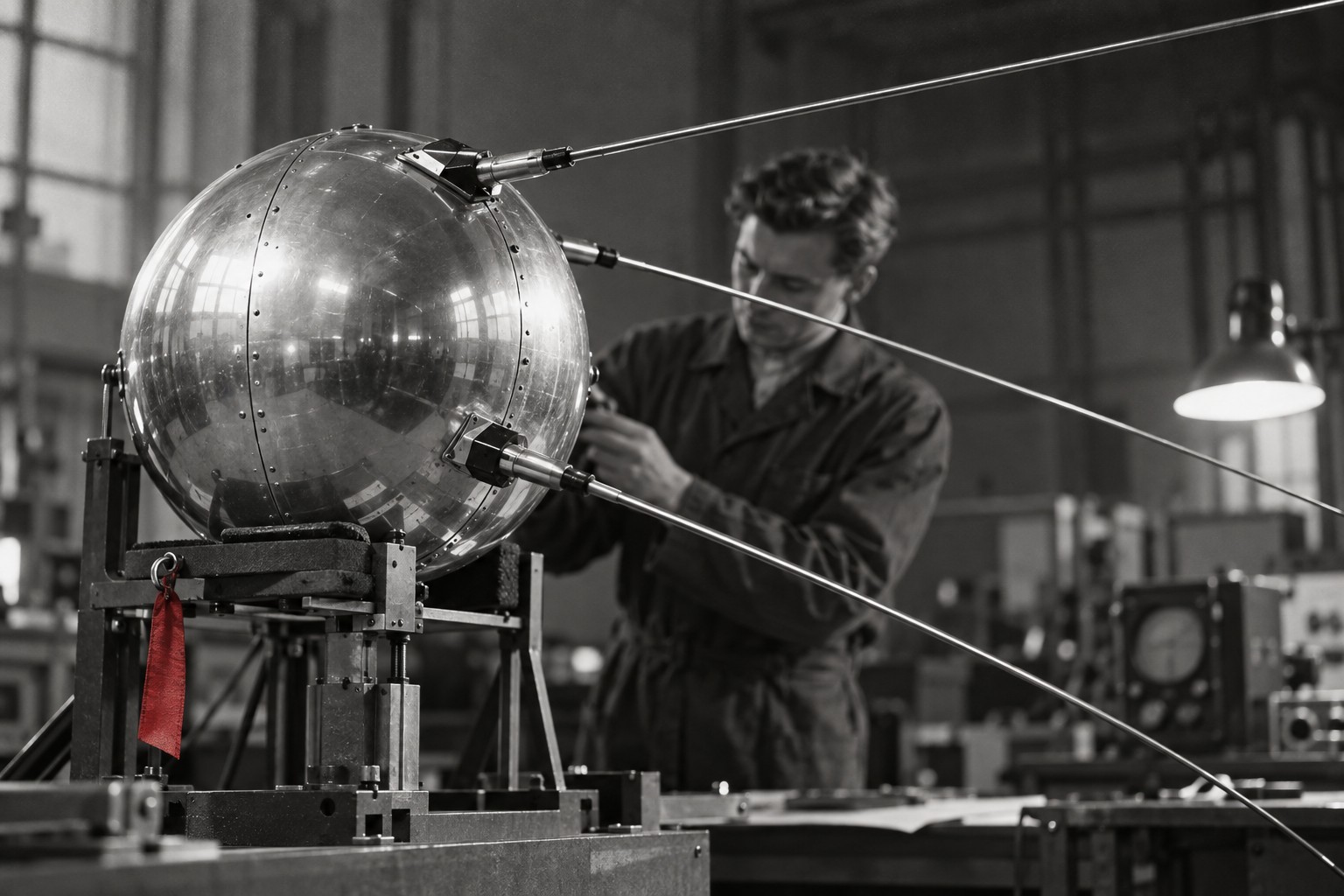
On 4 October 1957, the Soviet Union launched Sputnik 1, the world’s first artificial satellite, opening the space age and transforming the Cold War. Sixty-nine years later, the achievement remains a defining moment in the history of science, international competition and humanity’s ambitions beyond Earth.
The launch took place from the site now known as the Baikonur Cosmodrome in Kazakhstan. Measuring just 58 centimetres across and weighing 83.6 kilogrammes, Sputnik was a polished metal sphere with four antennas. Its appearance was modest, but reaching orbit demonstrated a capability no country had previously achieved.
A small satellite with a global audience
Sputnik transmitted regular radio pulses that amateur radio operators could detect as it travelled overhead. Those signals gave people around the world direct evidence that an artificial object was circling the planet.

Under Soviet rocket designer Sergei Korolev, engineers had initially planned a more sophisticated scientific satellite. When that project fell behind schedule, they developed a simpler spacecraft that could be launched sooner. The decision secured the Soviet Union’s historic first.
A shock beyond science
In the United States, the launch challenged assumptions about American technological leadership. Space exploration became an urgent political and strategic issue, with Soviet rocket capabilities raising concerns far beyond the satellite itself.
The reaction helped drive greater investment in aerospace research and scientific education. It also intensified scrutiny of how the United States organised its space programme, turning a distant object into a powerful force in domestic politics.
The race gathers speed
America launched its first successful satellite, Explorer 1, on 31 January 1958. Its instruments provided evidence of the radiation belts surrounding Earth, demonstrating how the competition could produce major scientific discoveries.
NASA began operations on 1 October 1958, less than a year after Sputnik’s launch. The rivalry accelerated advances in rockets and spacecraft, eventually helping propel astronauts towards the Moon.
A brief mission with lasting consequences
Sputnik’s batteries ran out in October 1957, and the satellite re-entered Earth’s atmosphere on 4 January 1958. Its mission lasted only three months, but its impact endured.
The launch established space as a new arena for national competition and scientific exploration. A small sphere transmitting simple radio signals had changed what governments considered possible—and what they were prepared to invest in achieving.
Newshub Editorial in Asia – 4 October 2026
On 4 October 1957, the Soviet Union launched Sputnik 1, the world’s first artificial satellite, opening the space age and transforming the Cold War. Sixty-nine years later, the achievement remains a defining moment in the history of science, international competition and humanity’s ambitions beyond Earth.
Recent Comments