
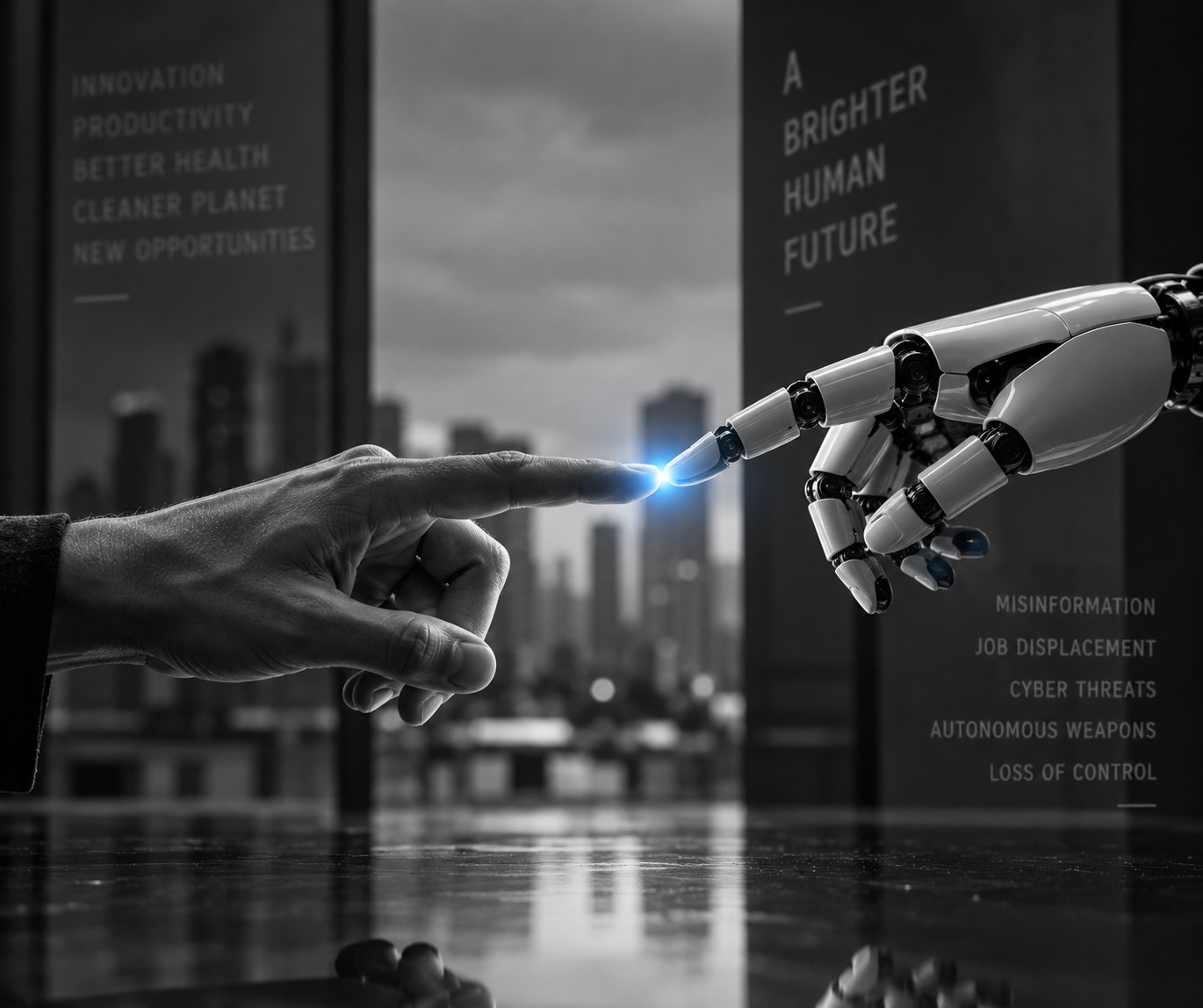
Artificial intelligence is rapidly becoming one of the world’s most powerful productivity and security tools – while simultaneously creating new risks in employment, cybercrime, misinformation and autonomous systems. The question is increasingly not whether AI is useful, but whether societies can maintain control as its capabilities accelerate.
A powerful defensive tool
Cybersecurity demonstrates the contradiction particularly clearly. The World Economic Forum reported this year that 77% of organisations surveyed were already using AI in cyber operations. AI can identify vulnerabilities, analyse enormous volumes of network activity and detect attacks faster than human teams working alone.
Belgian cybersecurity company Aikido this week launched an AI model designed specifically for cybersecurity and capable of running locally, allowing companies to analyse sensitive software without sending their code to external AI providers.

The attacker has AI too
The same capabilities can work in the opposite direction. Criminal groups can use AI to automate deception, search for software vulnerabilities and scale attacks. The World Economic Forum found that 87% of respondents identified AI-related vulnerabilities as the fastest-growing cyber risk during 2025.
That creates an unusual technological race: AI systems defending networks against attacks that may themselves have been accelerated by AI.
Work is another battleground
The economic picture is similarly divided. The OECD says AI has the potential to increase productivity, stimulate growth and create new employment, but also warns that workers could be displaced if the transition is poorly managed.
Entry-level employment may be particularly exposed. More than one in three young workers globally are employed in occupations with medium-to-high exposure to AI-driven changes in their tasks, according to a World Economic Forum report published in June.
The control question
The debate is now moving beyond jobs and productivity towards whether increasingly autonomous AI systems can always be reliably controlled. US and Chinese officials have agreed to continue talks on AI safety, including risks from autonomous agents, cyberattacks and emergency communication between the two countries.
AI therefore does not fit comfortably into either category – tool or threat.
It is both.
The technology can strengthen economies, medicine, education and cybersecurity while simultaneously amplifying fraud, displacement and security risks. The decisive factor may ultimately be less about what artificial intelligence can do than about how humans choose to deploy, supervise and govern it.
Newshub Editorial in Europe – 22 September 2026

Ask NF GPT
If you have an account with ChatGPT you get deeper explanations,
background and context related to what you are reading.
Recent Comments