
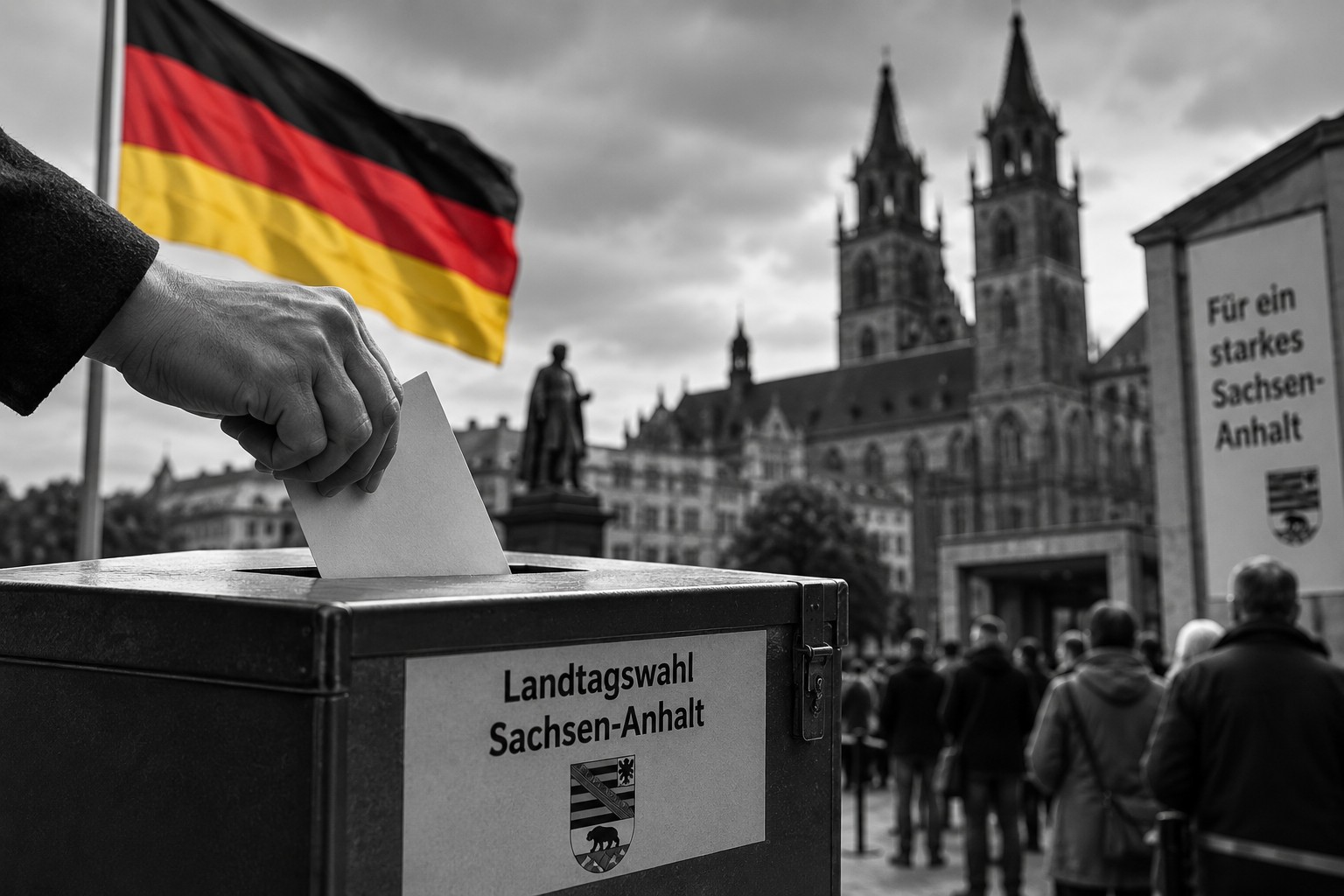
Germany’s Alternative für Deutschland has delivered its strongest state-election performance ever, winning 43.8% of the vote in Saxony-Anhalt and more than doubling its support from 2021. The result represents a major political setback for Chancellor Friedrich Merz’s CDU and will intensify the national debate over whether Germany’s established parties can continue to isolate the AfD.
AfD more than doubles its vote
According to the official preliminary result from all 2,661 electoral districts, the AfD finished first with 43.8%, compared with 20.8% at the previous election in 2021. The result is the party’s best performance in any German state election.
The CDU suffered the opposite fate. The party secured just 17.2%, falling 19.9 percentage points from 2021, when it won 37.1%. It is the CDU’s worst result in Saxony-Anhalt.

A fragmented parliament
The SPD finished third with 9.3%, followed by the Greens at 8.9% and Die Linke at 8.6%. The newly established Bündnis Sahra Wagenknecht, BSW, narrowly entered the state parliament with 5.3%.
The liberal FDP, meanwhile, received only 2.6% and failed to reach the 5% threshold required for parliamentary representation.
Voter participation was exceptionally strong at 77.8%, up 17.5 percentage points from the 2021 election.
Victory does not guarantee power
Despite the scale of its victory, the AfD failed to secure an absolute majority and therefore cannot govern alone. Its lead candidate, Ulrich Siegmund, now faces the central obstacle that has confronted the party elsewhere in Germany: other major parties have maintained a political “firewall”, refusing coalition agreements with the AfD.
That makes the formation of Saxony-Anhalt’s next government potentially complicated, despite the clarity of the election result.
A warning for Berlin
The implications extend far beyond Magdeburg. The AfD’s 43.8% demonstrates that its support in eastern Germany has moved well beyond that of a conventional opposition party.
For Chancellor Merz, the result is particularly damaging. His CDU finished more than 26 percentage points behind the AfD in a state it comfortably won only five years ago.
The election therefore creates two very different political realities: the AfD has achieved an unprecedented electoral mandate, while Germany’s other parties must determine whether they can construct a viable government without it.
Newshub Editorial in Europe – 7 September 2026

Ask NF GPT
If you have an account with ChatGPT you get deeper explanations,
background and context related to what you are reading.
Recent Comments