
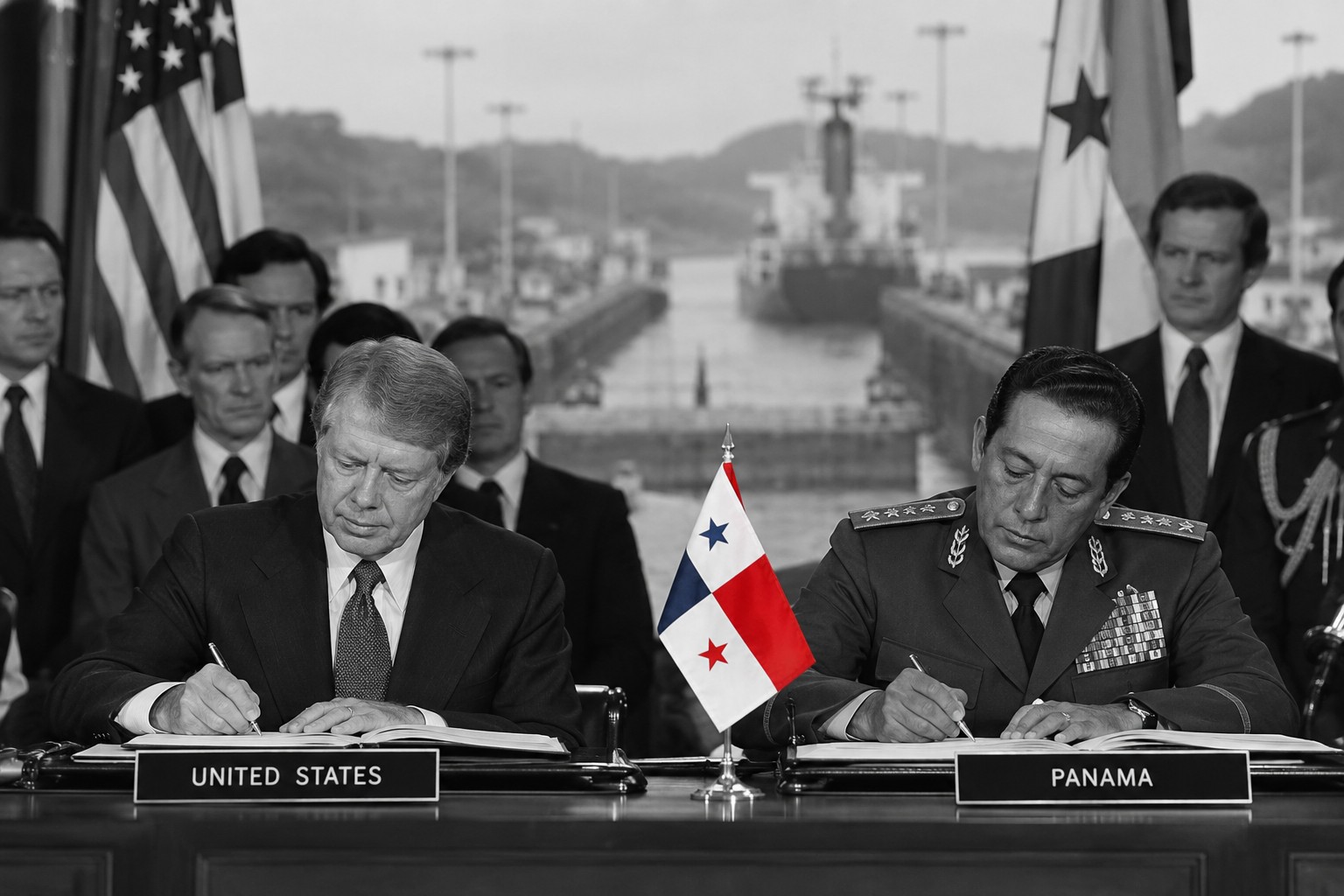
On 7 September 1977, US President Jimmy Carter and Panamanian leader General Omar Torrijos signed two historic treaties that set in motion the transfer of the Panama Canal from American to Panamanian control, ending one of the most contentious chapters in relations between the United States and Latin America.
A strategic waterway under US control
The United States had exercised extensive control over the Panama Canal Zone since the early 20th century, following an agreement with newly independent Panama in 1903. The canal opened in 1914 and rapidly became one of the world’s most strategically important shipping routes, connecting the Atlantic and Pacific oceans.
For Panama, however, American control of the Canal Zone increasingly became a question of national sovereignty. Tensions intensified during the 1960s, including violent clashes in 1964 that contributed to growing pressure for a new agreement.

Carter and Torrijos reach agreement
After years of negotiations spanning several US administrations, Carter made reaching a settlement with Panama a foreign-policy priority after taking office in January 1977.
On 7 September, Carter and Torrijos signed the Panama Canal Treaty and the Treaty Concerning the Permanent Neutrality and Operation of the Panama Canal in Washington. The agreements provided for the gradual dismantling of American control while protecting the canal’s continued operation and neutrality.
The deal was politically controversial in the United States. Opponents argued that Washington was surrendering a strategically vital asset, while Carter maintained that a negotiated transfer would strengthen American relations with Panama and the wider Latin American region.
A narrow political victory
Winning approval in the US Senate proved difficult. The Neutrality Treaty was ratified on 16 March 1978 by 68 votes to 32, while the Panama Canal Treaty passed on 18 April by the same margin – only one vote above the required two-thirds majority.
The treaties entered into force on 1 October 1979, beginning a 20-year transition period.
Panama takes full control
At noon on 31 December 1999, Panama formally assumed complete responsibility for the canal, fulfilling the central commitment Carter and Torrijos had made more than two decades earlier.
The 1977 agreement became one of Carter’s most consequential foreign-policy achievements and fundamentally changed the relationship between Washington and Panama.
Newshub Editorial in North America – 7 September 2026

Ask NF GPT
If you have an account with ChatGPT you get deeper explanations,
background and context related to what you are reading.
Recent Comments